
Ch. 2 Chemistry Comes Alive
Hoehn - Marieb Human Anatomy & Physiology, 12th edition
Hoehn, Haynes, Abbott12th EditionMarieb Human Anatomy & PhysiologyISBN: 9780138242732Non è quello che usi tu?Cambia libro di testo
Capitolo 2, Problema 20

What are hydrogen bonds and how are they important in the body?

Guida verificata passo dopo passo
1
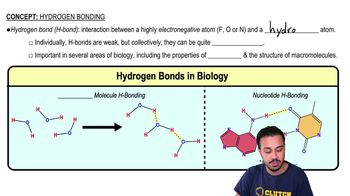
Understand that hydrogen bonds are a type of weak chemical bond that occurs when a hydrogen atom covalently bonded to an electronegative atom (like oxygen or nitrogen) experiences an attraction to another electronegative atom nearby.
Recognize that in the body, hydrogen bonds are crucial for stabilizing the three-dimensional structures of biomolecules such as proteins and nucleic acids (DNA and RNA).
Note that in proteins, hydrogen bonds help maintain secondary structures like alpha-helices and beta-pleated sheets by linking different parts of the polypeptide chain.
Understand that in DNA, hydrogen bonds between complementary nitrogenous bases (adenine-thymine and cytosine-guanine) hold the two strands of the double helix together, allowing for accurate replication and transcription.
Appreciate that hydrogen bonds also contribute to the properties of water, such as its high specific heat and solvent capabilities, which are essential for maintaining homeostasis and facilitating biochemical reactions in the body.

Risposta video verificata per un problema simile:

Questa soluzione video è stata consigliata dai nostri tutor come utile per risolvere questo problema.
Durata del video:
1m

Concetti chiave

Ecco i concetti essenziali che devi comprendere per rispondere correttamente alla domanda.

Hydrogen Bonds

Hydrogen bonds are weak interactions that occur when a hydrogen atom covalently bonded to an electronegative atom, like oxygen or nitrogen, is attracted to another electronegative atom. These bonds are weaker than covalent bonds but crucial for molecular structure and function.
Video consigliato:
Percorso guidato
05:03
Hydrogen Bonding

Role of Hydrogen Bonds in Water

In the body, hydrogen bonds between water molecules create cohesion and high surface tension, which are essential for maintaining cell structure, regulating temperature, and enabling biochemical reactions in an aqueous environment.
Video consigliato:
Percorso guidato
05:03
Hydrogen Bonding

Hydrogen Bonds in Biomolecules

Hydrogen bonds stabilize the three-dimensional structures of proteins and nucleic acids, such as DNA and RNA, enabling proper folding, function, and replication. They are vital for enzyme activity and genetic information storage.
Video consigliato:
Percorso guidato
05:03
Hydrogen Bonding