Ch. 12 The Central Nervous System
Marieb - Human Anatomy & Physiology 11th Edition
Marieb, Hoehn11th EditionHuman Anatomy & PhysiologyISBN: 9780136874034Non è quello che usi tu?Cambia libro di testo
Capitolo 12, Problema 12

A patient has suffered a cerebral hemorrhage that has caused dysfunction of the precentral gyrus of his right cerebral cortex. As a result:
a. He cannot voluntarily move his left arm or leg.
b. He feels no sensation on the left side of his body.
c. He feels no sensation on his right side.

Guida verificata passo dopo passo
1
Step 1: Identify the function of the precentral gyrus. The precentral gyrus is the primary motor cortex responsible for voluntary motor control of the contralateral side of the body.
Step 2: Understand the lateralization of brain function. The right cerebral cortex controls voluntary movements on the left side of the body, and the left cerebral cortex controls the right side.
Step 3: Analyze the symptoms related to motor function. Since the patient cannot voluntarily move his left arm or leg, this aligns with damage to the right precentral gyrus affecting motor control on the left side.
Step 4: Consider the sensory symptoms. The precentral gyrus is primarily motor, so loss of sensation (which is processed in the postcentral gyrus) on the left side is unlikely to be caused by damage to the precentral gyrus.
Step 5: Conclude which symptoms are consistent with the lesion. The inability to move the left side voluntarily (a) is expected, but loss of sensation on either side (b or c) is not directly caused by precentral gyrus dysfunction.

Risposta video verificata per un problema simile:

Questa soluzione video è stata consigliata dai nostri tutor come utile per risolvere questo problema.
Durata del video:
2m

Concetti chiave

Ecco i concetti essenziali che devi comprendere per rispondere correttamente alla domanda.

Precentral Gyrus and Motor Function

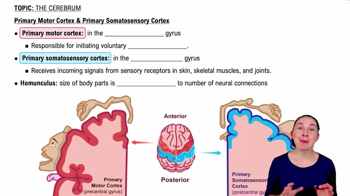
The precentral gyrus, located in the frontal lobe, is the primary motor cortex responsible for voluntary movement control. Damage to this area disrupts motor commands, leading to paralysis or weakness on the opposite side of the body due to the crossing of motor pathways.
Video consigliato:
4:31
Primary Motor Cortex & Primary Somatosensory Cortex

Contralateral Control of the Body

Each cerebral hemisphere controls the opposite side of the body. Therefore, injury to the right precentral gyrus affects motor function on the left side, explaining why voluntary movement of the left arm and leg would be impaired.
Video consigliato:
3:33
Levels of Control in the ANS

Distinction Between Motor and Sensory Functions

The precentral gyrus is involved in motor control, not sensory perception. Sensory information is processed in the postcentral gyrus; thus, damage to the precentral gyrus does not cause loss of sensation, only motor deficits.
Video consigliato:
Percorso guidato
06:04
Functional Groups
Pratica correlata
Domanda del libro di testo

a. What is the function of the basal nuclei?

b. Which basal nuclei form the striatum?

c. Which arches over the diencephalon?

37
views
Domanda del libro di testo

All of the following descriptions refer to dorsal column–medial lemniscal ascending pathways except one:

a. They include the fasciculus gracilis and fasciculus cuneatus.

b. They include a chain of three neurons.

c. Their connections are diffuse and poorly localized.

d. They are concerned with precise transmission of one or a few related types of sensory input.

749
views
Domanda del libro di testo

What constitutes the blood brain barrier?

1183
views
Domanda del libro di testo

List four ways in which the CNS is protected.

1056
views
Domanda del libro di testo

A number of brain structures are listed below. If an area is primarily gray matter, write a in the answer blank; if mostly white matter, respond with b. 

________  (1) cerebral cortex 

________   (2) corpus callosum and corona radiata 

________   (3) red nucleus 

________   (4) medial and lateral nuclear groups 

________   (5) medial lemniscus 

________   (6) cranial nerve nuclei 

________   (7) spinothalamic tract 

________   (8) fornix 

________  (9) cingulate and precentral gyri

938
views
Domanda del libro di testo

a. What is the advantage of having a cerebrum that is highly convoluted?

b. What term is used to indicate its grooves? Its outward folds?

c. Which groove divides the cerebrum into two hemispheres?

d. What divides the parietal from the frontal lobe? The parietal from the temporal lobe?

940
views