Ch. 12 The Central Nervous System
Marieb - Human Anatomy & Physiology 11th Edition
Marieb, Hoehn11th EditionHuman Anatomy & PhysiologyISBN: 9780136874034Non è quello che usi tu?Cambia libro di testo
Capitolo 12, Problema 11

What constitutes the blood brain barrier?

Guida verificata passo dopo passo
1
Understand that the blood-brain barrier (BBB) is a selective permeability barrier that protects the brain from harmful substances in the blood while allowing essential nutrients to pass through.
Identify the main cellular components of the BBB, which include endothelial cells lining the brain capillaries, connected by tight junctions that restrict paracellular transport.
Recognize the role of astrocyte end-feet that surround the capillaries and contribute to the maintenance and regulation of the BBB.
Note the involvement of pericytes embedded in the capillary basement membrane, which help regulate blood flow and BBB stability.
Summarize that the BBB is constituted primarily by tight junctions between endothelial cells, astrocyte end-feet, pericytes, and the basement membrane, all working together to control the passage of substances from blood to brain tissue.

Risposta video verificata per un problema simile:

Questa soluzione video è stata consigliata dai nostri tutor come utile per risolvere questo problema.
Durata del video:
2m

Concetti chiave

Ecco i concetti essenziali che devi comprendere per rispondere correttamente alla domanda.

Structure of the Blood-Brain Barrier

The blood-brain barrier (BBB) is a selective barrier formed primarily by endothelial cells lining brain capillaries. These cells are tightly joined by tight junctions, preventing most substances in the blood from entering the brain tissue, thus maintaining a stable environment for neural function.
Video consigliato:
Percorso guidato
14:36
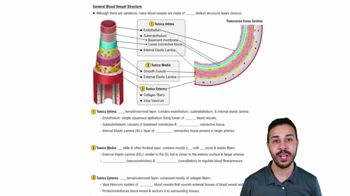
General Blood Vessel Structure

Function of the Blood-Brain Barrier

The BBB regulates the passage of molecules between the bloodstream and the brain, protecting neural tissue from toxins, pathogens, and fluctuations in blood composition. It allows essential nutrients to pass while blocking harmful substances, ensuring proper brain homeostasis.
Video consigliato:
Percorso guidato
6:11
Functions of Blood

Supporting Cells in the Blood-Brain Barrier

Astrocytes and pericytes support the BBB by maintaining endothelial cell function and integrity. Astrocyte end-feet surround capillaries, releasing factors that strengthen tight junctions, while pericytes regulate blood flow and barrier permeability, contributing to the BBB’s selective nature.
Video consigliato:
Pratica correlata
Domanda del libro di testo

A professor unexpectedly blew a loud horn in his anatomy and physiology class. The students looked up, startled. The reflexive movements of their eyes were mediated by the:

a. Cerebral cortex

b. Inferior olives

c. Raphe nuclei

d. Superior colliculi

e. Nucleus gracilis

959
views
1
rank
Domanda del libro di testo

a. What is the function of the basal nuclei?

b. Which basal nuclei form the striatum?

c. Which arches over the diencephalon?

37
views
Domanda del libro di testo

All of the following descriptions refer to dorsal column–medial lemniscal ascending pathways except one:

a. They include the fasciculus gracilis and fasciculus cuneatus.

b. They include a chain of three neurons.

c. Their connections are diffuse and poorly localized.

d. They are concerned with precise transmission of one or a few related types of sensory input.

749
views
Domanda del libro di testo

List four ways in which the CNS is protected.

1056
views
Domanda del libro di testo

A number of brain structures are listed below. If an area is primarily gray matter, write a in the answer blank; if mostly white matter, respond with b. 

________  (1) cerebral cortex 

________   (2) corpus callosum and corona radiata 

________   (3) red nucleus 

________   (4) medial and lateral nuclear groups 

________   (5) medial lemniscus 

________   (6) cranial nerve nuclei 

________   (7) spinothalamic tract 

________   (8) fornix 

________  (9) cingulate and precentral gyri

938
views
Domanda del libro di testo

A patient has suffered a cerebral hemorrhage that has caused dysfunction of the precentral gyrus of his right cerebral cortex. As a result:

a. He cannot voluntarily move his left arm or leg.

b. He feels no sensation on the left side of his body.

c. He feels no sensation on his right side.

851
views