Ch. 19 The Cardiovascular System: Blood Vessels
Marieb - Human Anatomy & Physiology 11th Edition
Marieb, Hoehn11th EditionHuman Anatomy & PhysiologyISBN: 9780136874034Non è quello che usi tu?Cambia libro di testo
Capitolo 19, Problema 20

Write an equation showing the relationship between total peripheral resistance, blood flow, and blood pressure.

Guida verificata passo dopo passo
1
Understand the key variables involved: total peripheral resistance (TPR), blood flow (Q), and blood pressure (P). These are fundamental concepts in cardiovascular physiology.
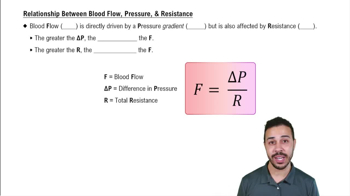
Recall that blood flow (Q) through the circulatory system is driven by the pressure difference (ΔP) across the system and opposed by the resistance (R) to flow, which in this context is the total peripheral resistance (TPR).
Express this relationship using a form of Ohm's law adapted for fluid flow: \(Q = \frac{\Delta P}{R}\). Here, \(Q\) is blood flow, \(\Delta P\) is the pressure difference, and \(R\) is resistance.
In the systemic circulation, the pressure difference driving blood flow is the mean arterial pressure (MAP) minus the right atrial pressure (RAP), but often RAP is close to zero, so \(\Delta P \approx \text{MAP}\). Therefore, the equation becomes \(Q = \frac{\text{MAP}}{\text{TPR}}\).
Rearrange the equation to show the relationship explicitly between total peripheral resistance, blood flow, and blood pressure: \(\text{TPR} = \frac{\text{MAP}}{Q}\). This equation shows that total peripheral resistance equals the mean arterial pressure divided by blood flow.

Risposta video verificata per un problema simile:

Questa soluzione video è stata consigliata dai nostri tutor come utile per risolvere questo problema.
Durata del video:
2m

Concetti chiave

Ecco i concetti essenziali che devi comprendere per rispondere correttamente alla domanda.

Total Peripheral Resistance (TPR)

Total Peripheral Resistance refers to the resistance to blood flow offered by the systemic blood vessels, primarily the arterioles. It affects how hard the heart must work to pump blood through the circulatory system and is influenced by vessel diameter, length, and blood viscosity.
Video consigliato:
3:33
Peripheral Nervous System

Blood Flow

Blood flow is the volume of blood moving through a vessel, organ, or the entire circulation per unit time. It depends on the pressure gradient and the resistance within the vessels, determining how effectively oxygen and nutrients are delivered to tissues.
Video consigliato:
Percorso guidato
6:40
Relationship Between Blood Flow, Pressure, & Resistance

Blood Pressure

Blood pressure is the force exerted by circulating blood on the walls of blood vessels. It is generated by the heart's pumping action and is a key factor driving blood flow through the circulatory system, influenced by cardiac output and peripheral resistance.
Video consigliato:
6:12
Partial Pressure