Ch. 24 Nutrition, Metabolism, and Energy Balance
Marieb - Human Anatomy & Physiology 11th Edition
Marieb, Hoehn11th EditionHuman Anatomy & PhysiologyISBN: 9780136874034Non è quello che usi tu?Cambia libro di testo
Capitolo 24, Problema 5

What is formed during aerobic respiration when electrons are passed down the electron transport chain?
a. Oxygen
b. Water
c. Glucose
d. NADH + H⁺

Guida verificata passo dopo passo
1
Understand the process of aerobic respiration: Aerobic respiration is a metabolic pathway where glucose is broken down in the presence of oxygen to produce ATP, carbon dioxide, and water. The electron transport chain (ETC) is the final stage of this process.
Learn the role of the electron transport chain: The ETC is located in the inner mitochondrial membrane. Electrons are passed down a series of protein complexes and carriers, releasing energy that is used to pump protons (H⁺) across the membrane, creating a proton gradient.
Identify the final electron acceptor: At the end of the electron transport chain, oxygen acts as the final electron acceptor. Oxygen combines with electrons and protons (H⁺) to form water (H₂O).
Understand the chemical reaction: The reaction at the end of the ETC can be represented as: O2+4e+4H+→2H2O. This reaction produces water as a byproduct of aerobic respiration.
Eliminate incorrect options: Oxygen is the final electron acceptor, not the product. Glucose is the initial substrate, not formed during this stage. NADH + H⁺ donates electrons to the ETC but is not formed here. Therefore, water is the correct answer.

Risposta video verificata per un problema simile:

Questa soluzione video è stata consigliata dai nostri tutor come utile per risolvere questo problema.
Durata del video:
2m

Concetti chiave

Ecco i concetti essenziali che devi comprendere per rispondere correttamente alla domanda.

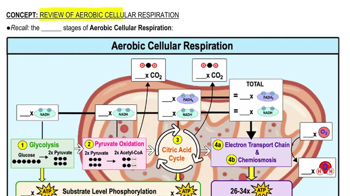
Aerobic Respiration

Aerobic respiration is a metabolic process that uses oxygen to convert glucose into energy, primarily in the form of ATP. This process occurs in the mitochondria of cells and involves several stages, including glycolysis, the Krebs cycle, and the electron transport chain. It is essential for producing energy in organisms that require oxygen.
Video consigliato:
Percorso guidato
07:51
Review of Aerobic Cellular Respiration

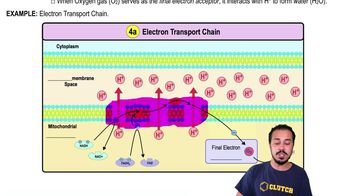
Electron Transport Chain (ETC)

The electron transport chain is a series of protein complexes located in the inner mitochondrial membrane that facilitate the transfer of electrons derived from NADH and FADH2. As electrons move through the chain, they release energy, which is used to pump protons across the membrane, creating a proton gradient that drives ATP synthesis. This process is crucial for the efficient production of ATP during aerobic respiration.
Video consigliato:
Percorso guidato
07:41
Electron Transport Chain

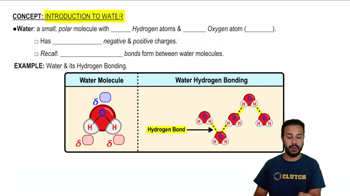
Water Formation

During aerobic respiration, particularly in the electron transport chain, oxygen acts as the final electron acceptor. When electrons combine with oxygen and protons (H⁺), water (H₂O) is formed as a byproduct. This reaction is vital for maintaining the flow of electrons through the chain and is essential for the overall efficiency of aerobic respiration.
Video consigliato:
Percorso guidato
01:54
Introduction to Water