Ch. 25 The Urinary System
Marieb - Human Anatomy & Physiology 11th Edition
Marieb, Hoehn11th EditionHuman Anatomy & PhysiologyISBN: 9780136874034Non è quello che usi tu?Cambia libro di testo
Capitolo 25, Problema 13

Describe the mechanisms of extrinsic regulation of GFR, and their physiological role.

Guida verificata passo dopo passo
1
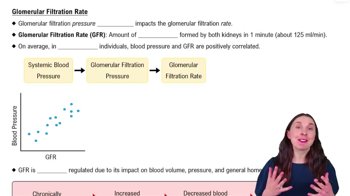
Begin by defining Glomerular Filtration Rate (GFR) as the rate at which blood is filtered through the glomeruli of the kidneys, which is crucial for maintaining fluid and electrolyte balance.
Explain that extrinsic regulation of GFR involves systemic mechanisms outside the kidney that adjust filtration rate primarily through neural and hormonal pathways to maintain blood pressure and volume.
Describe the role of the sympathetic nervous system: during stress or low blood pressure, sympathetic activation causes vasoconstriction of the afferent arterioles, reducing blood flow into the glomerulus and thus decreasing GFR to conserve fluid.
Discuss the renin-angiotensin-aldosterone system (RAAS): low blood pressure or low sodium triggers renin release, leading to angiotensin II production, which constricts efferent arterioles to maintain GFR despite reduced renal perfusion, and stimulates aldosterone to increase sodium and water reabsorption.
Summarize the physiological role of extrinsic regulation as a protective mechanism to maintain systemic blood pressure and volume, ensuring adequate perfusion of vital organs while adjusting kidney filtration to prevent excessive fluid loss.

Risposta video verificata per un problema simile:

Questa soluzione video è stata consigliata dai nostri tutor come utile per risolvere questo problema.
Durata del video:
3m

Concetti chiave

Ecco i concetti essenziali che devi comprendere per rispondere correttamente alla domanda.

Extrinsic Regulation of Glomerular Filtration Rate (GFR)

Extrinsic regulation refers to systemic mechanisms that adjust GFR primarily through neural and hormonal signals, overriding intrinsic kidney controls. These mechanisms respond to overall body needs, such as blood pressure and volume changes, to maintain homeostasis.
Video consigliato:
3:15
Glomerular Filtration Rate

Sympathetic Nervous System and GFR Control

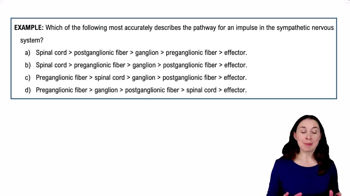
The sympathetic nervous system reduces GFR by constricting afferent arterioles during stress or low blood pressure, decreasing renal blood flow and filtration. This helps conserve fluid and maintain blood pressure during emergencies.
Video consigliato:
1:21
Sympathetic Nervous System Example 3

Renin-Angiotensin-Aldosterone System (RAAS)

RAAS is a hormonal pathway activated by low blood pressure or sodium levels, leading to angiotensin II production, which constricts efferent arterioles and stimulates aldosterone release. This increases GFR efficiency and promotes sodium and water retention to restore blood volume.
Video consigliato:
Percorso guidato
11:30
Renin-Angiotensin-Aldosterone-System