Ch. 25 The Urinary System
Marieb - Human Anatomy & Physiology 11th Edition
Marieb, Hoehn11th EditionHuman Anatomy & PhysiologyISBN: 9780136874034Non è quello che usi tu?Cambia libro di testo
Capitolo 25, Problema 12

Describe the mechanisms that contribute to renal autoregulation.

Guida verificata passo dopo passo
1
Begin by defining renal autoregulation as the kidney's intrinsic ability to maintain a relatively constant glomerular filtration rate (GFR) despite fluctuations in systemic blood pressure.
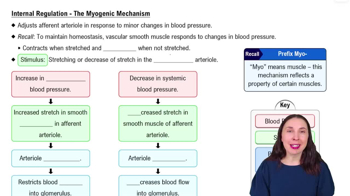
Explain the myogenic mechanism: when blood pressure increases, the afferent arteriole's smooth muscle stretches and responds by contracting, which reduces blood flow into the glomerulus, helping to stabilize GFR.
Describe the tubuloglomerular feedback mechanism: specialized cells in the juxtaglomerular apparatus (macula densa) sense changes in sodium chloride concentration in the distal tubule and signal the afferent arteriole to constrict or dilate accordingly, adjusting GFR.
Mention the role of the juxtaglomerular cells in releasing renin when blood pressure drops, which initiates the renin-angiotensin-aldosterone system (RAAS) to help regulate blood volume and pressure, indirectly influencing renal autoregulation.
Summarize how these mechanisms work together to protect the kidneys from damage due to high blood pressure and ensure stable filtration for proper kidney function.

Risposta video verificata per un problema simile:

Questa soluzione video è stata consigliata dai nostri tutor come utile per risolvere questo problema.
Durata del video:
1m

Concetti chiave

Ecco i concetti essenziali che devi comprendere per rispondere correttamente alla domanda.

Renal Autoregulation

Renal autoregulation is the kidney's intrinsic ability to maintain a stable glomerular filtration rate (GFR) and renal blood flow despite fluctuations in systemic blood pressure. This ensures consistent kidney function and protects delicate renal structures from damage caused by blood pressure changes.
Video consigliato:
1:11
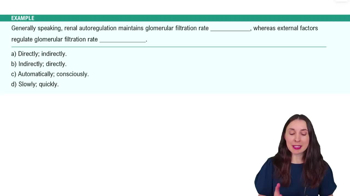
Renal Physiology: Regulation of Glomerular Filtration Example 1

Myogenic Mechanism

The myogenic mechanism involves the contraction or relaxation of afferent arteriolar smooth muscle in response to changes in blood pressure. When blood pressure rises, the arteriole constricts to reduce blood flow; when pressure falls, it dilates, helping to stabilize GFR.
Video consigliato:
3:02
Internal Regulation - The Myogenic Mechanism

Tubuloglomerular Feedback

Tubuloglomerular feedback is a process where the macula densa cells in the distal tubule sense sodium chloride concentration and signal the afferent arteriole to constrict or dilate. This feedback adjusts GFR by modifying blood flow based on the tubular fluid composition.
Video consigliato:
02:43
Feedback Loops: Positive Feedback Example 1