The type of fracture that occurs in osteoporosis:
Ch. 3 Cells: The Living Units

Marieb, Hoehn11th EditionHuman Anatomy & PhysiologyISBN: 9780136874034Non è quello che usi tu?Cambia libro di testo
Capitolo 3, Problema 12
A physiologist observes that the concentration of sodium inside a cell is decidedly lower than that outside the cell. She also observes that there is a small leakage of sodium into the cell. What cellular process prevents the sodium concentration gradient from disappearing?
a. Osmosis
b. Diffusion
c. Primary active transport
d. Secondary active transport
Guida verificata passo dopo passo1
Step 1: Understand the scenario described. Sodium concentration is lower inside the cell compared to outside, and sodium ions tend to leak into the cell due to this concentration gradient.
Step 2: Recognize that diffusion (option b) is the passive movement of ions from an area of higher concentration to lower concentration, which explains the leakage of sodium into the cell but does not prevent the gradient from disappearing.
Step 3: Consider osmosis (option a), which involves the movement of water across a membrane, not ions like sodium, so it is not the process maintaining the sodium gradient.
Step 4: Identify that to maintain a concentration gradient against the natural diffusion, the cell must use energy-dependent transport mechanisms, which are active transport processes.
Step 5: Differentiate between primary active transport (option c), which uses ATP directly to pump sodium out of the cell, and secondary active transport (option d), which uses the energy from another ion's gradient. The process that directly prevents the sodium gradient from disappearing is primary active transport.

Risposta video verificata per un problema simile:
Questa soluzione video è stata consigliata dai nostri tutor come utile per risolvere questo problema.
Durata del video:
3mConcetti chiave
Ecco i concetti essenziali che devi comprendere per rispondere correttamente alla domanda.
Sodium Concentration Gradient
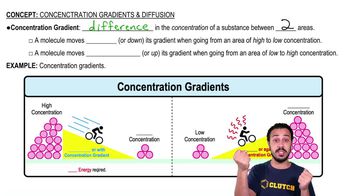
The sodium concentration gradient refers to the difference in sodium ion concentration inside and outside the cell. Typically, sodium is much higher outside the cell than inside, creating a gradient that drives sodium to move into the cell by diffusion. Maintaining this gradient is essential for many cellular functions, including nerve impulse transmission and muscle contraction.
Video consigliato:
Percorso guidato
Concentration Gradients and Diffusion
Diffusion and Leakage of Sodium
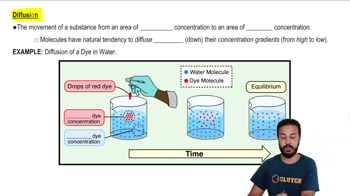
Diffusion is the passive movement of molecules from an area of higher concentration to lower concentration. Sodium ions tend to leak into the cell down their concentration gradient through channels or leaks, which would eventually equalize concentrations if unopposed. This leakage is a passive process and does not require energy.
Video consigliato:
Percorso guidato
Diffusion
Primary Active Transport
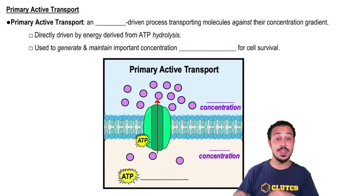
Primary active transport uses energy, usually from ATP hydrolysis, to move ions against their concentration gradient. The sodium-potassium pump is a classic example, pumping sodium out of the cell and potassium in, maintaining the sodium gradient despite leakage. This process is vital to preserve cellular homeostasis and membrane potential.
Video consigliato:
Percorso guidato
Primary Active Transport
Pratica correlata
Domanda del libro di testo
85
views
Domanda del libro di testo
A nerve cell and a lymphocyte are presumed to differ in their:
a. Specialized structure
b. Suppressed genes and embryonic history
c. Genetic information
d. a and b, e. a and c
128
views
Domanda del libro di testo
Cells lining the trachea have whiplike motile extensions on their free surfaces. What are these extensions, what is their source, and what is their function?
87
views
Domanda del libro di testo
The RNA species that travels from the nucleus to the cytoplasm carrying the coded message specifying the sequence of amino acids in the protein to be made is
a. mRNA
b. tRNA
c. rRNA
d. all of these
116
views
Domanda del libro di testo
The RNA synthesized on one of the DNA strands is:
a. mRNA
b. tRNA
c. rRNA
d. all of these.
86
views
Domanda del libro di testo
If DNA has a sequence of AAA, then a segment of mRNA synthesized on it will have a sequence of:
a. TTT
b. UUU
c. GGG
d. CCC
1155
views