Ch. 9 Muscles and Muscle Tissue
Marieb - Human Anatomy & Physiology 11th Edition
Marieb, Hoehn11th EditionHuman Anatomy & PhysiologyISBN: 9780136874034Non è quello che usi tu?Cambia libro di testo
Capitolo 9, Problema 16

Distinguish between
a. Direct and indirect muscle attachments and
b. A tendon and an aponeurosis

Guida verificata passo dopo passo
1
Step 1: Understand that muscle attachments refer to how muscles connect to bones or other structures, enabling movement. Direct and indirect attachments describe different ways this connection occurs.
Step 2: Define direct muscle attachment as when the muscle's connective tissue fibers are short and the muscle appears to attach directly to the bone's periosteum (the outer layer of the bone) without an intervening tendon.
Step 3: Define indirect muscle attachment as when the muscle's connective tissue extends beyond the muscle fibers as a tendon or aponeurosis, which then attaches to the bone. This is a more common and stronger form of attachment.
Step 4: Differentiate between a tendon and an aponeurosis by explaining that a tendon is a cord-like, dense connective tissue structure that connects muscle to bone, whereas an aponeurosis is a broad, flat sheet of connective tissue that also connects muscle to bone or to other muscles.
Step 5: Summarize that tendons are typically rope-like and focused on transmitting force from muscle to a specific point on bone, while aponeuroses cover a wider area and can distribute force over a broader region.

Risposta video verificata per un problema simile:

Questa soluzione video è stata consigliata dai nostri tutor come utile per risolvere questo problema.
Durata del video:
2m

Concetti chiave

Ecco i concetti essenziali che devi comprendere per rispondere correttamente alla domanda.

Direct and Indirect Muscle Attachments

Direct muscle attachments occur when the muscle's connective tissue fuses directly with the periosteum of the bone, creating a close and broad connection. Indirect attachments involve the muscle connecting to bone via a tendon or aponeurosis, which are strong connective tissues that transmit force from muscle to bone over a distance.
Video consigliato:
02:06
Directional Terms: Limbs Example 1

Tendon

A tendon is a dense, cord-like connective tissue that connects muscle to bone. It is composed mainly of collagen fibers, providing strength and flexibility to transmit the force generated by muscle contraction to move the skeleton.
Video consigliato:
3:01
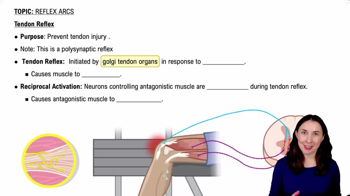
Tendon Reflex

Aponeurosis

An aponeurosis is a broad, flat sheet of connective tissue that serves as a tendon-like structure. It connects muscles to bones or other muscles, distributing force over a wider area compared to a cord-like tendon.
Video consigliato:
7:12
Organization of Muscle Tissue