Ch. 9 Muscles and Muscle Tissue
Marieb - Human Anatomy & Physiology 11th Edition
Marieb, Hoehn11th EditionHuman Anatomy & PhysiologyISBN: 9780136874034Non è quello che usi tu?Cambia libro di testo
Capitolo 9, Problema 18

Explain what is meant by the term excitation-contraction coupling.

Guida verificata passo dopo passo
1
Begin by defining excitation-contraction coupling as the physiological process that links the electrical signal (excitation) in a muscle fiber to the mechanical response (contraction) of the muscle.
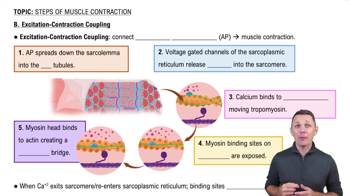
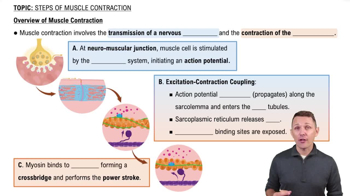
Explain that excitation starts with an action potential traveling along the sarcolemma (muscle cell membrane) and down the T-tubules, which are invaginations of the sarcolemma that penetrate into the muscle fiber.
Describe how the action potential triggers the release of calcium ions (Ca^{2+}) from the sarcoplasmic reticulum, a specialized organelle that stores calcium within the muscle cell.
Clarify that the increase in intracellular calcium concentration allows calcium to bind to troponin, causing a conformational change that moves tropomyosin away from the myosin-binding sites on actin filaments.
Conclude by stating that this exposure of binding sites enables cross-bridge cycling between actin and myosin, leading to muscle contraction.

Risposta video verificata per un problema simile:

Questa soluzione video è stata consigliata dai nostri tutor come utile per risolvere questo problema.
Durata del video:
1m

Concetti chiave

Ecco i concetti essenziali che devi comprendere per rispondere correttamente alla domanda.

Excitation

Excitation refers to the process by which a muscle fiber receives a signal, typically an action potential, from a motor neuron. This electrical signal triggers events at the neuromuscular junction, leading to the depolarization of the muscle cell membrane.
Video consigliato:
5:47
B. Excitation-Contraction Coupling

Contraction

Contraction is the process where muscle fibers generate tension and shorten in response to stimulation. This occurs through the sliding filament mechanism, where actin and myosin filaments interact to produce force.
Video consigliato:
4:53
Overview of Muscle Contraction

Coupling Mechanism

The coupling mechanism links excitation to contraction by translating the electrical signal into a mechanical response. It involves calcium release from the sarcoplasmic reticulum, which initiates the interaction of contractile proteins, enabling muscle contraction.
Video consigliato:
Percorso guidato
04:57
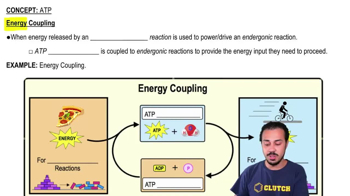
Energy Coupling