Ch. 9 Muscles and Muscle Tissue
Marieb - Human Anatomy & Physiology 11th Edition
Marieb, Hoehn11th EditionHuman Anatomy & PhysiologyISBN: 9780136874034Non è quello che usi tu?Cambia libro di testo
Capitolo 9, Problema 20

True or false: Most muscles contain a predominance of one skeletal muscle fiber type. Explain the reasoning behind your choice.

Guida verificata passo dopo passo
1
Understand that skeletal muscles are composed of different fiber types, primarily Type I (slow-twitch) and Type II (fast-twitch) fibers, each with distinct characteristics and functions.
Recognize that most muscles contain a mixture of these fiber types rather than being composed predominantly of just one type, allowing them to perform a range of activities requiring endurance and strength.
Consider that the proportion of fiber types varies depending on the muscle's function and the individual's genetics and training, but a complete dominance of one fiber type in most muscles is uncommon.
Explain that this mixed fiber composition provides versatility, enabling muscles to adapt to different demands such as sustained activity or quick, powerful movements.
Conclude that the statement is false because most muscles do not have a predominance of a single fiber type; instead, they have a combination that supports various functional needs.

Risposta video verificata per un problema simile:

Questa soluzione video è stata consigliata dai nostri tutor come utile per risolvere questo problema.
Durata del video:
1m

Concetti chiave

Ecco i concetti essenziali che devi comprendere per rispondere correttamente alla domanda.

Skeletal Muscle Fiber Types

Skeletal muscles are composed of different fiber types, mainly Type I (slow-twitch) and Type II (fast-twitch) fibers. Each type has distinct properties related to contraction speed, fatigue resistance, and energy metabolism, influencing muscle function.
Video consigliato:
7:47
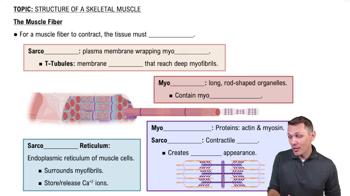
The Muscle Fiber

Muscle Fiber Distribution Within Muscles

Most muscles contain a mix of fiber types rather than a predominance of one type. The proportion varies depending on the muscle's function, with postural muscles having more Type I fibers and muscles used for quick, powerful movements having more Type II fibers.
Video consigliato:
7:47
The Muscle Fiber

Functional Adaptation of Muscle Fibers

Muscle fiber composition adapts to the demands placed on the muscle through training or activity. This plasticity means that fiber type predominance can shift, but generally, muscles maintain a characteristic fiber type distribution suited to their primary role.
Video consigliato:
7:47
The Muscle Fiber