Ch. 11 Cardiovascular System
Marieb - Essentials of Human Anatomy & Physiology 13th Edition
Marieb13th EditionEssentials of Human Anatomy & PhysiologyISBN: 9780135624340Non è quello che usi tu?Cambia libro di testo
Capitolo 11, Problema 2

More than one choice may apply.
Given a volume of 150 ml at the end of diastole, a volume of 50 ml at the end of systole, and a heart rate of 60 bpm, the cardiac output is
a. 600 ml/min
b. 6 liters/min
c. 1200 ml/min
d. 3 liters/min

Guida verificata passo dopo passo
1
Step 1: Understand the formula for cardiac output (CO). Cardiac output is calculated using the formula: CO = Stroke Volume (SV) × Heart Rate (HR).
Step 2: Calculate the Stroke Volume (SV). Stroke Volume is the difference between the end-diastolic volume (EDV) and the end-systolic volume (ESV). Use the formula: SV = EDV - ESV. Substitute the given values: EDV = 150 ml and ESV = 50 ml.
Step 3: Multiply the Stroke Volume (SV) by the Heart Rate (HR) to find the Cardiac Output (CO). Use the formula: CO = SV × HR. Substitute the calculated SV and the given HR = 60 bpm.
Step 4: Convert the cardiac output to the appropriate units if necessary. Cardiac output is often expressed in liters per minute (L/min). To convert ml/min to L/min, divide the result by 1000.
Step 5: Compare the calculated cardiac output to the multiple-choice options provided (a, b, c, d) to determine the correct answer(s).

Risposta video verificata per un problema simile:

Questa soluzione video è stata consigliata dai nostri tutor come utile per risolvere questo problema.
Durata del video:
2m

Concetti chiave

Ecco i concetti essenziali che devi comprendere per rispondere correttamente alla domanda.

Cardiac Output

Cardiac output (CO) is the volume of blood the heart pumps per minute, calculated as the product of stroke volume (SV) and heart rate (HR). It is a crucial measure of heart function and overall cardiovascular health. In this context, CO can be determined using the formula CO = SV × HR, where SV is the difference between end-diastolic volume and end-systolic volume.
Video consigliato:
9:44
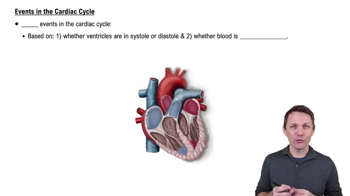
Events in the Cardiac Cycle

Stroke Volume

Stroke volume (SV) is the amount of blood ejected by the heart with each beat. It is calculated by subtracting the end-systolic volume (ESV) from the end-diastolic volume (EDV). In this question, the stroke volume can be calculated as SV = EDV - ESV, which helps in determining the cardiac output when combined with the heart rate.
Video consigliato:
6:28
Lung Volumes

Heart Rate

Heart rate (HR) is the number of times the heart beats in one minute, typically measured in beats per minute (bpm). It is a vital sign that reflects the heart's activity and is a key component in calculating cardiac output. In this scenario, the heart rate is given as 60 bpm, which is essential for determining the overall cardiac output when multiplied by the stroke volume.
Video consigliato:
6:13
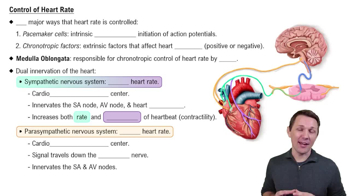
Control of Heart Rate