Indietro
Problema 1
More than one choice may apply.
Lymph capillaries
a. Are open-ended, like drinking straws
b. Have continuous tight junctions, like the capillaries of the brain
c. Contain endothelial cells separated by flaplike valves that can open wide
d. Have special barriers that stop cancer cells from entering
Problema 2
More than one choice may apply.
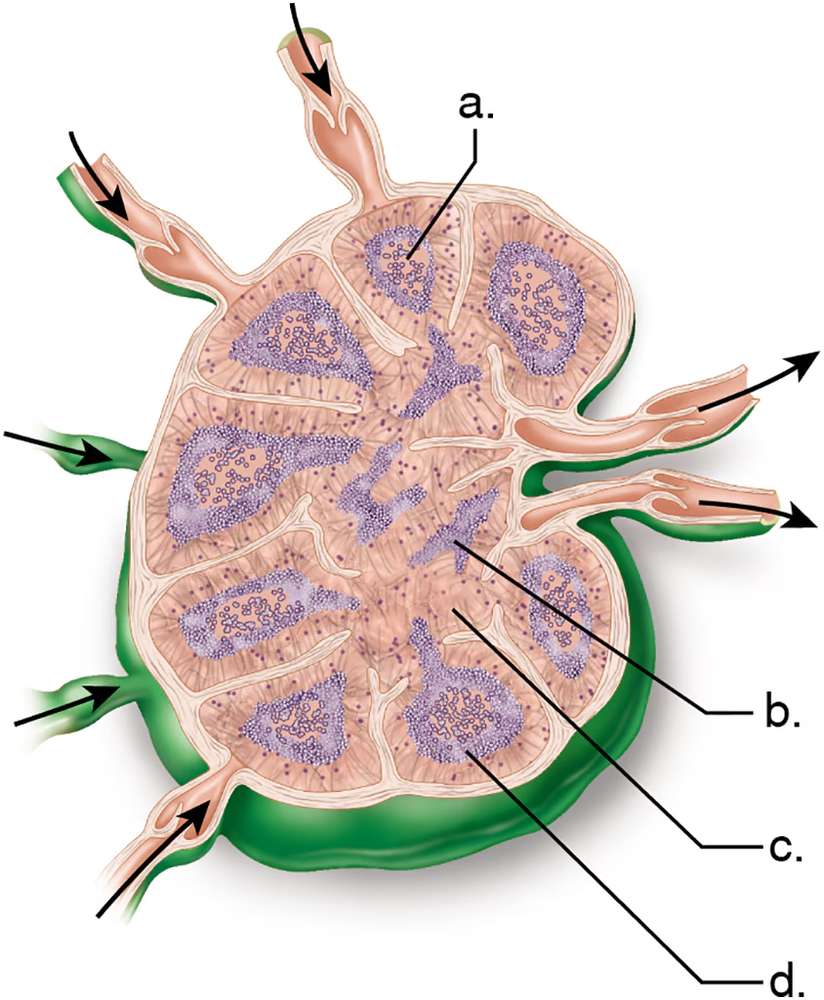
Which parts of the lymph node show increased activity when antibody production is high?
Problema 3
More than one choice may apply.
Which of the following connect to the lymph node at the hilum?
a. Afferent lymphatic vessels
b. Efferent lymphatic vessels
c. Trabeculae
d. Anchoring filaments
Problema 4
More than one choice may apply.
Which of the following are part of MALT?
a. Tonsils
b. Thymus
c. Peyer’s patches
d. Any lymphoid tissue along the digestive tract
Problema 5
More than one choice may apply.
Developmentally, embryonic lymphatic vessels are most closely associated with the
a. Veins
b. Arteries
c. Nerves
d. Thymus gland
Problema 6
More than one choice may apply.
Which of the following are among the most common indicators of inflammation?
a. Phagocytosis
b. Edema
c. Leukocytosis
d. Pain
Problema 7
More than one choice may apply.
Chemical mediators of inflammation include
a. Interferon
b. Complement
c. Histamine
d. Antibodies
Problema 8
More than one choice may apply.
Against which of the following will interferon do some good?
a. Infection of body cells by a virus
b. Circulating free viruses
c. Some types of cancer
d. Bacterial infection
Problema 9
More than one choice may apply.
Which of these antibody classes is usually arranged as a pentamer?
a. IgG
b. IgM
c IgA
d. IgD
Problema 10
More than one choice may apply.
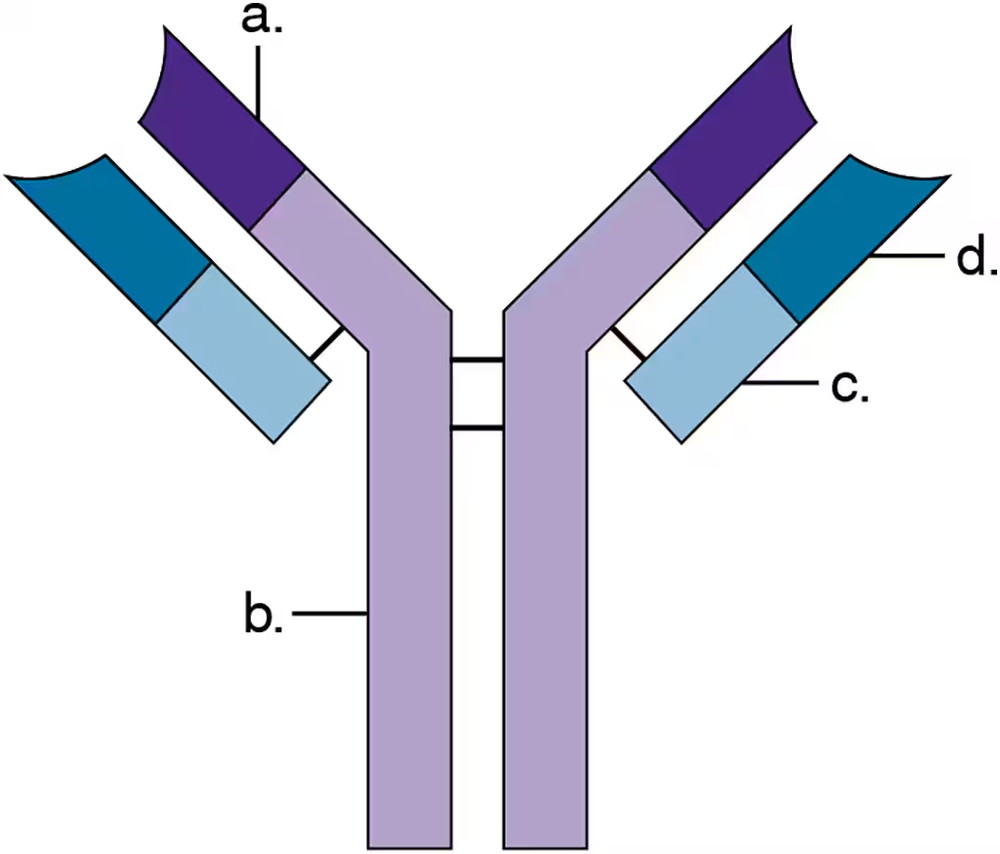
Where exactly does an antigen bind to an antibody molecule?
Problema 11
More than one choice may apply.
Which of the following antibody capabilities causes a transfusion reaction with A or B erythrocyte antigens?
a. Neutralization
b. Precipitation
c. Complement fixation
d. Agglutination
Problema 12
Which of the following is/are examples of autoimmune disease?
a. Type 1 diabetes
b. Multiple sclerosis
c. Graves’ disease
d. Rheumatoid arthritis
Problema 13
The main cellular target of the HIV virus that causes AIDS is
a. Helper T cells
b. Cytotoxic T cells
c. Macrophages
d. B cells
Problema 14
Compare and contrast blood, interstitial fluid, and lymph.
Problema 15
What is complement? Besides bacterial lysis, what are some of the roles of complement?
Problema 16
Interferons are referred to as antiviral proteins. What stimulates their production, and how do they protect uninfected cells?
Problema 18
Binding of antigens to receptors of immunocompetent lymphocytes leads to clonal selection. Describe the process of clonal selection. What nonlymphocyte cell is a central actor in this process, and what is its function?
Problema 19
Describe the specific roles of helper, cytotoxic, and regulatory T cells in cell-mediated immunity. Which is thought to be disabled in AIDS?
Problema 20
Name the five classes of immunoglobulins. Which is most likely to be found attached to a B cell membrane? Which is most abundant in plasma? Which is important in allergic responses? Which is the first Ig to be released during the primary response? Which can cross the placental barrier?
Problema 22
Mr. James, an 80-year-old man, is grumbling about having to receive a flu shot every year. Flu viruses have a high mutation rate (undergo rapid genetic changes), which results in the appearance of new proteins on the flu virus's 'coat.' How does this help explain the need to get a flu shot each year?
Problema 23
Mrs. Morrow, a 59-year-old woman, has undergone a left radical mastectomy (removal of the left breast and left axillary lymph nodes and vessels). Her left arm is severely swollen and painful, and she is unable to raise it more than shoulder height.
(a) Explain her signs and symptoms.
(b) Can she expect relief from these symptoms in time? How so?