Ch. 16 The Reproductive System
Marieb - Essentials of Human Anatomy & Physiology 13th Edition
Marieb13th EditionEssentials of Human Anatomy & PhysiologyISBN: 9780135624340Non è quello che usi tu?Cambia libro di testo
Capitolo 16, Problema 11

More than one choice may apply.
The outer layer of the blastocyst, which attaches to the uterine wall, is the
a. Yolk sac
b. Inner cell mass
c. Amnion
d. Trophoblast

Guida verificata passo dopo passo
1
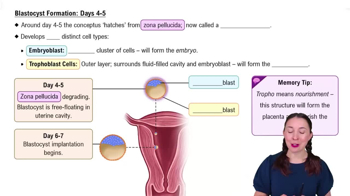
Understand the structure of the blastocyst: The blastocyst is an early stage of embryonic development that consists of two main parts: the inner cell mass (which will develop into the embryo) and the trophoblast (the outer layer that facilitates implantation and forms part of the placenta).
Review the function of the trophoblast: The trophoblast is responsible for attaching the blastocyst to the uterine wall and initiating the formation of the placenta. It plays a critical role in implantation and nutrient exchange.
Clarify the role of the yolk sac: The yolk sac is an extraembryonic structure that provides nutrients during early development but is not involved in attachment to the uterine wall.
Clarify the role of the inner cell mass: The inner cell mass is the group of cells inside the blastocyst that will develop into the embryo. It does not attach to the uterine wall.
Clarify the role of the amnion: The amnion is a membrane that forms later in development and surrounds the embryo, providing a protective environment. It is not involved in the attachment of the blastocyst to the uterine wall.

Risposta video verificata per un problema simile:

Questa soluzione video è stata consigliata dai nostri tutor come utile per risolvere questo problema.
Durata del video:
2m

Concetti chiave

Ecco i concetti essenziali che devi comprendere per rispondere correttamente alla domanda.

Blastocyst Structure

The blastocyst is an early stage of embryonic development that forms about five days after fertilization. It consists of two main parts: the inner cell mass, which will develop into the embryo, and the outer layer called the trophoblast, which plays a crucial role in implantation into the uterine wall.
Video consigliato:
2:18
Blastocyst Formation: Days 4-5

Trophoblast Function

The trophoblast is the outer layer of the blastocyst that facilitates implantation into the uterine lining. It is responsible for forming the placenta and secreting enzymes that help the blastocyst embed itself into the endometrium, ensuring proper nutrient exchange between the mother and developing embryo.
Video consigliato:
Percorso guidato
06:04
Functional Groups

Uterine Wall Interaction

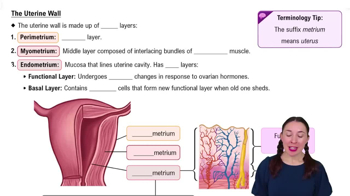
The interaction between the trophoblast and the uterine wall is essential for successful implantation. This process involves the trophoblast adhering to the endometrial cells, which triggers a series of biological responses that prepare the uterus for pregnancy, including changes in blood flow and nutrient availability.
Video consigliato:
3:30
The Uterine Wall