Roger, a 40-year-old man who loves spending time on the beach, is complaining to you that his suntan made him popular when he was young—but now his face is all wrinkled, and he has several darkly pigmented moles that are growing rapidly and are as big as large coins. He shows you the moles, and immediately you think “ABCDE.” What does that mean, and why should he be concerned?
Ch. 4 Skin and Body Membranes

Marieb13th EditionEssentials of Human Anatomy & PhysiologyISBN: 9780135624340Non è quello che usi tu?Cambia libro di testo
Capitolo 4, Problema 21
Mr. Grayson is receiving a drug treatment transdermally (through the skin). Explain why drugs delivered by this route are fat-soluble rather than water-soluble.
Guida verificata passo dopo passo1
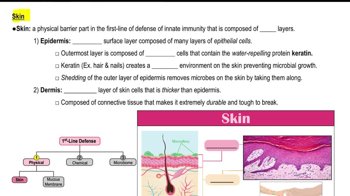
Understand the structure of the skin: The skin consists of multiple layers, with the outermost layer being the stratum corneum. This layer is composed primarily of dead keratinized cells surrounded by lipids, making it a hydrophobic (water-repelling) barrier.
Recognize the properties of fat-soluble substances: Fat-soluble (lipophilic) substances can easily dissolve in and pass through the lipid-rich environment of the stratum corneum, allowing them to penetrate the skin and enter the bloodstream.
Contrast fat-soluble and water-soluble substances: Water-soluble (hydrophilic) substances are less likely to penetrate the lipid-rich stratum corneum because they are repelled by the hydrophobic nature of the lipids, making them ineffective for transdermal delivery.
Explain the mechanism of transdermal drug delivery: Fat-soluble drugs diffuse through the lipid layers of the stratum corneum, then pass into the deeper layers of the skin and eventually reach the capillaries to enter systemic circulation.
Summarize the importance of drug solubility: For transdermal drug delivery to be effective, the drug must be fat-soluble to overcome the skin's lipid barrier and ensure proper absorption into the bloodstream.

Risposta video verificata per un problema simile:
Questa soluzione video è stata consigliata dai nostri tutor come utile per risolvere questo problema.
Durata del video:
2mConcetti chiave
Ecco i concetti essenziali che devi comprendere per rispondere correttamente alla domanda.
Transdermal Drug Delivery
Transdermal drug delivery involves administering medication through the skin to achieve systemic effects. This method allows for a controlled release of the drug into the bloodstream, bypassing the digestive system and first-pass metabolism. It is particularly useful for drugs that require steady plasma levels over time.
Video consigliato:
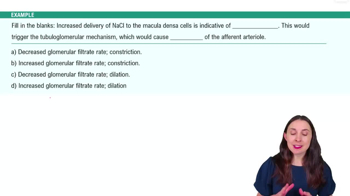
Renal Physiology: Regulation of Glomerular Filtration Example 3
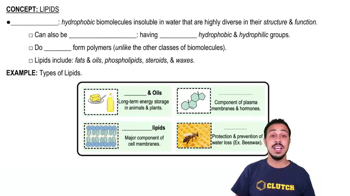
Lipid Solubility
Lipid solubility refers to a drug's ability to dissolve in fats or lipids rather than in water. Since the skin's outer layer, the stratum corneum, is primarily composed of lipids, fat-soluble drugs can more easily penetrate this barrier. This property is crucial for effective transdermal absorption.
Video consigliato:
Percorso guidato
Lipids
Skin Barrier Function
The skin acts as a barrier to protect the body from external substances, which includes limiting the absorption of water-soluble compounds. The structure of the skin, particularly the lipid-rich layers, favors the passage of lipophilic (fat-soluble) substances, making them more suitable for transdermal delivery compared to hydrophilic (water-soluble) drugs.
Video consigliato:
Pratica correlata
Domanda del libro di testo
35
views
Domanda del libro di testo
Rebecca, the mother of a 13-month-old infant, brings her child to the clinic because his skin has turned orange. Why does the pediatrician inquire about the child’s diet?
30
views
Domanda del libro di testo
A burn victim exhibits a red and swollen arm with blistering; a hand that has been charred black, exposing bone; and a cheek that appears blanched. How serious is each burn, and is this patient critical? Explain.
40
views
Domanda del libro di testo
More than one choice may apply.
Which layer of the heart wall is an endothelium?
a. Endocardium
b. Myocardium
c. Epicardium
d. Pericardium
568
views
