Ch. 7 The Nervous System
Marieb - Essentials of Human Anatomy & Physiology 13th Edition
Marieb13th EditionEssentials of Human Anatomy & PhysiologyISBN: 9780135624340Non è quello che usi tu?Cambia libro di testo
Capitolo 7, Problema 18

How many pairs of cranial nerves are there? Which are purely sensory? Which activates the chewing muscles? Which helps regulate heart rate and activity of the digestive tract?

Guida verificata passo dopo passo
1
Step 1: Understand that there are 12 pairs of cranial nerves in the human body, each with specific functions. These nerves are numbered I through XII and are named based on their function or structure.
Step 2: Identify the cranial nerves that are purely sensory. These include the Olfactory nerve (I), responsible for the sense of smell, and the Optic nerve (II), responsible for vision. Additionally, the Vestibulocochlear nerve (VIII) is involved in hearing and balance.
Step 3: Determine which cranial nerve activates the chewing muscles. The Trigeminal nerve (V) is responsible for motor functions, including activating the muscles involved in chewing.
Step 4: Identify the cranial nerve that helps regulate heart rate and activity of the digestive tract. The Vagus nerve (X) plays a key role in parasympathetic control of the heart, lungs, and digestive system.
Step 5: Review the functions of each cranial nerve to ensure understanding of their roles, focusing on sensory, motor, and mixed functions as relevant to the problem.

Risposta video verificata per un problema simile:

Questa soluzione video è stata consigliata dai nostri tutor come utile per risolvere questo problema.
Durata del video:
2m

Concetti chiave

Ecco i concetti essenziali che devi comprendere per rispondere correttamente alla domanda.

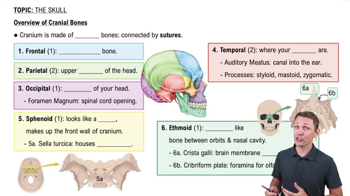
Cranial Nerves

Cranial nerves are a set of twelve pairs of nerves that emerge directly from the brain, primarily responsible for sensory and motor functions of the head and neck. Each cranial nerve has a specific function, which can be sensory, motor, or both. Understanding the roles of these nerves is essential for answering questions about their functions and classifications.
Video consigliato:
8:20
Overview of Cranial Bones

Sensory Nerves

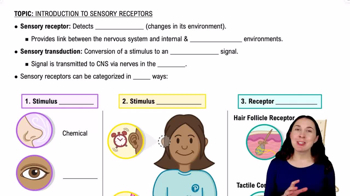
Sensory nerves are responsible for transmitting sensory information from the body to the brain. In the context of cranial nerves, some are purely sensory, meaning they only carry sensory information without any motor function. Identifying which cranial nerves are purely sensory is crucial for understanding their specific roles in sensory perception.
Video consigliato:
2:47
Sensory Receptors

Autonomic Nervous System

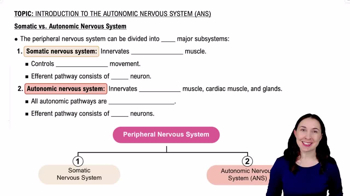
The autonomic nervous system (ANS) regulates involuntary bodily functions, including heart rate and digestion. Certain cranial nerves, such as the vagus nerve, play a significant role in the ANS by influencing heart rate and digestive tract activity. Recognizing the connection between cranial nerves and the ANS is vital for understanding how these nerves affect physiological processes.
Video consigliato:
1:50
Somatic vs. Autonomic Nervous System