Ch. 8 Special Senses
Marieb - Essentials of Human Anatomy & Physiology 13th Edition
Marieb13th EditionEssentials of Human Anatomy & PhysiologyISBN: 9780135624340Non è quello che usi tu?Cambia libro di testo
Capitolo 8, Problema 16

Name the structures of the outer, middle, and inner ears, and give the general function of each structure and each group of structures.

Guida verificata passo dopo passo
1
Identify the structures of the outer ear: The outer ear consists of the pinna (auricle) and the external auditory canal. The pinna collects sound waves and directs them into the external auditory canal, which channels the sound waves toward the tympanic membrane (eardrum).
Describe the structures of the middle ear: The middle ear includes the tympanic membrane, ossicles (malleus, incus, and stapes), and the Eustachian tube. The tympanic membrane vibrates in response to sound waves, transferring the vibrations to the ossicles. The ossicles amplify the vibrations and transmit them to the oval window of the inner ear. The Eustachian tube helps equalize pressure between the middle ear and the external environment.
Explain the structures of the inner ear: The inner ear contains the cochlea, vestibule, and semicircular canals. The cochlea is responsible for converting sound vibrations into electrical signals that are sent to the brain via the auditory nerve. The vestibule and semicircular canals are involved in balance and spatial orientation.
Group the structures by function: The outer ear is responsible for sound collection and direction. The middle ear amplifies and transmits sound vibrations. The inner ear processes sound signals and maintains balance.
Summarize the general functions: The ear as a whole is responsible for hearing and balance. The outer ear collects sound, the middle ear amplifies and transmits it, and the inner ear converts sound into neural signals while also aiding in equilibrium.

Risposta video verificata per un problema simile:

Questa soluzione video è stata consigliata dai nostri tutor come utile per risolvere questo problema.
Durata del video:
3m

Concetti chiave

Ecco i concetti essenziali che devi comprendere per rispondere correttamente alla domanda.

Outer Ear Structures

The outer ear consists of the pinna (the visible part of the ear) and the ear canal. The pinna collects sound waves and directs them into the ear canal, which amplifies the sound and channels it toward the eardrum. This structure plays a crucial role in sound localization and protection of the inner ear.
Video consigliato:
4:16
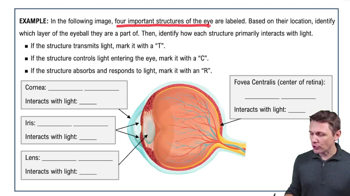
Structure of the Eyeball Example 1

Middle Ear Structures

The middle ear contains the tympanic membrane (eardrum) and three tiny bones known as the ossicles (malleus, incus, and stapes). The eardrum vibrates in response to sound waves, and the ossicles amplify these vibrations and transmit them to the inner ear. This amplification is essential for converting sound waves into mechanical energy.
Video consigliato:
4:16
Structure of the Eyeball Example 1

Inner Ear Structures

The inner ear includes the cochlea, vestibule, and semicircular canals. The cochlea is responsible for converting mechanical vibrations into electrical signals that the brain interprets as sound. The vestibule and semicircular canals are involved in balance and spatial orientation, making the inner ear crucial for both hearing and equilibrium.
Video consigliato:
7:59
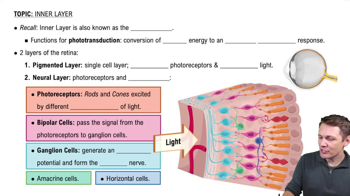
Inner Layer