Ch. 9 The Endocrine System
Marieb - Essentials of Human Anatomy & Physiology 13th Edition
Marieb13th EditionEssentials of Human Anatomy & PhysiologyISBN: 9780135624340Non è quello che usi tu?Cambia libro di testo
Capitolo 9, Problema 5

More than one choice may apply.
Hormones that act directly or indirectly to elevate the blood glucose level include which of the following?
a. GH
b. Cortisol
c. Insulin
d. ACTH

Guida verificata passo dopo passo
1
Step 1: Understand the role of blood glucose regulation in the body. Blood glucose levels are regulated by hormones that either increase or decrease glucose levels. Hormones that elevate blood glucose levels typically promote glycogen breakdown, gluconeogenesis, or inhibit glucose uptake by cells.
Step 2: Analyze the function of each hormone listed in the question: GH (Growth Hormone), Cortisol, Insulin, and ACTH (Adrenocorticotropic Hormone). Determine whether each hormone has a direct or indirect effect on blood glucose levels.
Step 3: Recall that GH (Growth Hormone) stimulates gluconeogenesis and lipolysis, indirectly increasing blood glucose levels. It also reduces glucose uptake by cells, contributing to elevated blood glucose.
Step 4: Cortisol, a glucocorticoid, promotes gluconeogenesis in the liver and inhibits glucose uptake by cells, leading to an increase in blood glucose levels during stress or fasting.
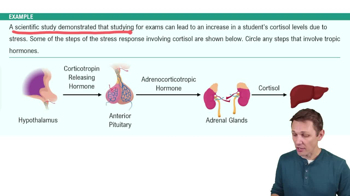
Step 5: Insulin is the only hormone listed that lowers blood glucose levels by promoting glucose uptake by cells and glycogen synthesis. ACTH stimulates the adrenal cortex to release cortisol, which indirectly elevates blood glucose levels. Therefore, identify the hormones that act directly or indirectly to elevate blood glucose levels.

Risposta video verificata per un problema simile:

Questa soluzione video è stata consigliata dai nostri tutor come utile per risolvere questo problema.
Durata del video:
1m

Concetti chiave

Ecco i concetti essenziali che devi comprendere per rispondere correttamente alla domanda.

Hormonal Regulation of Blood Glucose

Hormones play a crucial role in maintaining blood glucose levels. Insulin lowers blood glucose by facilitating cellular uptake, while hormones like glucagon, cortisol, and growth hormone (GH) increase blood glucose levels by promoting gluconeogenesis and glycogenolysis in the liver.
Video consigliato:
13:06
Review of Major Hormones

Cortisol

Cortisol is a glucocorticoid hormone produced by the adrenal cortex. It increases blood glucose levels by stimulating gluconeogenesis and inhibiting glucose uptake in non-essential tissues, thus ensuring that glucose is available for vital functions, especially during stress.
Video consigliato:
2:38
The Hypothalamus and Pituitary Gland Example 1

Growth Hormone (GH)

Growth hormone, secreted by the pituitary gland, has several metabolic effects, including increasing blood glucose levels. It does this by promoting lipolysis and reducing glucose uptake in muscle and adipose tissue, thereby ensuring that more glucose remains available in the bloodstream.
Video consigliato:
4:31
Hormone Review Table Example 1