Which of the effects listed in response to question 9 would be reversed by parasympathetic activity?
Ch. 14 The Autonomic Nervous System

Marieb, Hoehn7th EditionHuman Anatomy & PhysiologyISBN: 9780805359091Non è quello che usi tu?Cambia libro di testo
Capitolo 14, Problema 7
Briefly explain why the following terms are sometimes used to refer to the autonomic nervous system: involuntary nervous system and emotional-visceral system.
Guida verificata passo dopo passo1
Step 1: Understand that the autonomic nervous system (ANS) controls bodily functions that are not consciously directed, such as heart rate, digestion, and respiratory rate.
Step 2: Recognize that the term 'involuntary nervous system' is used because the ANS operates automatically without conscious control, managing essential physiological processes.
Step 3: Note that the term 'emotional-visceral system' highlights the ANS's role in linking emotional states to visceral (internal organ) responses, such as changes in heart rate or digestion during stress or relaxation.
Step 4: Connect these terms by explaining that the ANS integrates emotional experiences with physical reactions, which is why it is sometimes described as the emotional-visceral system.
Step 5: Summarize that both terms emphasize different aspects of the ANS: 'involuntary' focuses on its automatic control, while 'emotional-visceral' emphasizes its role in emotional and internal organ regulation.

Risposta video verificata per un problema simile:
Questa soluzione video è stata consigliata dai nostri tutor come utile per risolvere questo problema.
Durata del video:
2mConcetti chiave
Ecco i concetti essenziali che devi comprendere per rispondere correttamente alla domanda.
Autonomic Nervous System (ANS)
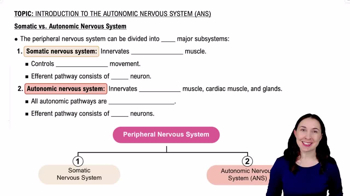
The ANS is a part of the peripheral nervous system that controls involuntary bodily functions such as heart rate, digestion, and respiratory rate. It operates without conscious control, regulating internal organs to maintain homeostasis.
Video consigliato:
Somatic vs. Autonomic Nervous System
Involuntary Nervous System
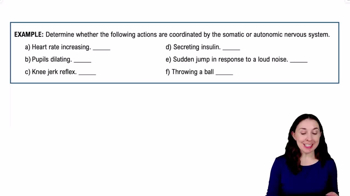
This term highlights the ANS's role in managing bodily functions that occur automatically, without conscious effort. Unlike the somatic nervous system, it controls muscles and glands that respond reflexively to internal stimuli.
Video consigliato:
Introduction to the Autonomic Nervous System Example 1
Emotional-Visceral System
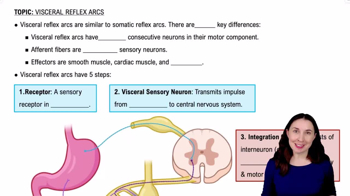
This term emphasizes the ANS's involvement in emotional responses by regulating visceral organs. Emotional states like stress or fear trigger autonomic changes, linking emotions to physiological reactions such as increased heart rate or sweating.
Video consigliato:
Visceral Reflex Arcs
Pratica correlata
Domanda del libro di testo
663
views
Domanda del libro di testo
Collateral sympathetic ganglia are involved with innervating
a. abdominal organs
b. thoracic organs
c. head
d. arrector pili
e. all of these
879
views
Domanda del libro di testo
Which ANS fibers release acetylcholine? Which release norepinephrine?
1042
views
Domanda del libro di testo
Describe the anatomical relationship of the white and gray rami communicantes to the spinal nerve, and indicate the kind of fibers found in each ramus type.
895
views
1
rank
Domanda del libro di testo
Indicate the results of sympathetic activation of the following structures: sweat glands, eye pupils, adrenal medullae, heart, bronchioles of the lungs, liver, blood vessels of vigorously working skeletal muscles, blood vessels of digestive viscera, salivary glands.
960
views
Domanda del libro di testo
Where are the cell bodies of visceral sensory neurons?
1119
views