Ch. 14 The Autonomic Nervous System
Marieb - Human Anatomy & Physiology 7th Edition
Marieb, Hoehn7th EditionHuman Anatomy & PhysiologyISBN: 9780805359091Non è quello che usi tu?Cambia libro di testo
Capitolo 14, Problema 4

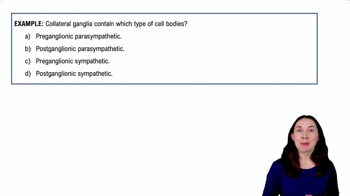
Collateral sympathetic ganglia are involved with innervating
a. abdominal organs
b. thoracic organs
c. head
d. arrector pili
e. all of these

Guida verificata passo dopo passo
1
Step 1: Understand the role of collateral sympathetic ganglia. These ganglia are part of the sympathetic nervous system and are located anterior to the vertebral column, unlike the paravertebral ganglia which lie alongside the vertebral column.
Step 2: Recall that collateral ganglia primarily innervate organs in the abdominal and pelvic regions, providing sympathetic input to these areas.
Step 3: Review the options: (a) abdominal organs, (b) thoracic organs, (c) head, (d) arrector pili muscles, and (e) all of these. Consider which organs or structures each type of ganglia typically innervates.
Step 4: Recognize that thoracic organs and head structures are generally innervated by paravertebral ganglia or other specific ganglia, not collateral ganglia. Arrector pili muscles are innervated by postganglionic fibers from paravertebral ganglia.
Step 5: Conclude that collateral sympathetic ganglia are specifically involved with innervating abdominal organs, making option (a) the correct choice.

Risposta video verificata per un problema simile:

Questa soluzione video è stata consigliata dai nostri tutor come utile per risolvere questo problema.
Durata del video:
1m

Concetti chiave

Ecco i concetti essenziali che devi comprendere per rispondere correttamente alla domanda.

Collateral Sympathetic Ganglia

Collateral sympathetic ganglia are clusters of nerve cell bodies located anterior to the vertebral column. They differ from paravertebral ganglia and primarily innervate organs in the abdominal and pelvic regions by sending postganglionic fibers to these targets.
Video consigliato:
1:23
Sympathetic Nervous System Example 5

Sympathetic Innervation of Abdominal Organs

Sympathetic nerves from collateral ganglia regulate functions of abdominal organs such as the stomach, intestines, liver, and kidneys. These ganglia modulate activities like blood flow, digestion, and secretion through autonomic control.
Video consigliato:
3:09
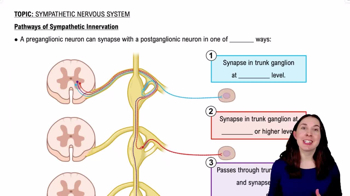
Pathways of Sympathetic Innervation

Distinction Between Sympathetic Targets

Different sympathetic ganglia innervate specific body regions: paravertebral ganglia mainly serve thoracic organs and structures like arrector pili muscles, while collateral ganglia target abdominal and pelvic organs. Understanding this helps identify which ganglia control which organs.
Video consigliato:
2:50
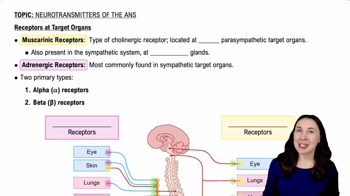
Receptors at Target Organs
Pratica correlata
Domanda del libro di testo

Which ANS fibers release acetylcholine? Which release norepinephrine?

1042
views
Domanda del libro di testo

The white rami communicantes contain what kind of fibers?

a. Preganglionic parasympathetic

b. Postganglionic parasympathetic

c. Preganglionic sympathetic

d. Postganglionic sympathetic

986
views
Domanda del libro di testo

Relate each of the following terms or phrases to either the sympathetic (S) or parasympathetic (P) division of the autonomic nervous system: 

______ (7) Generally short-duration action 

______ (8) Increases heart rate and blood pressure 

______ (9) Increases gastric motility and secretion of lacrimal, salivary, and digestive juices 

______ (10) Innervates blood vessels 

______ (11) Most active when you are relaxing in a hammock 

______ (12) Active when you are running in the Boston Marathon

765
views
Domanda del libro di testo

Where are the cell bodies of visceral sensory neurons?

1119
views
Domanda del libro di testo

Briefly explain why the following terms are sometimes used to refer to the autonomic nervous system: involuntary nervous system and emotional-visceral system.

815
views
1
rank
Domanda del libro di testo

Relate each of the following terms or phrases to either the sympathetic (S) or parasympathetic (P) division of the autonomic nervous system: 

______ (1) Short preganglionic, long postganglionic fibers 

______ (2) Intramural ganglia 

______ (3) Craniosacral part 

______ (4) Adrenergic fibers 

______ (5) Cervical ganglia 

______ (6) Otic and ciliary ganglia

874
views