Distinguish between the anulus fibrosus and nucleus pulposus regions of a disc. Which provides durability and strength? Which provides resilience? Which part is involved in a 'slipped' disc?
Ch. 7 The Skeleton

Marieb, Hoehn7th EditionHuman Anatomy & PhysiologyISBN: 9780805359091Non è quello che usi tu?Cambia libro di testo
Capitolo 7, Problema 10
Justiniano worked in a poultry-packing plant where his job was cutting open chickens and stripping out their visceral organs. After work, he typed for long hours on his computer keyboard, writing a book about his work in the plant. Soon, his wrist and hand began to hurt whenever he flexed it, and he began to awaken at night with pain and tingling on the thumb half of his hand. What condition did he probably have?
Guida verificata passo dopo passo1
Step 1: Identify the symptoms described: pain when flexing the wrist, nighttime pain, and tingling on the thumb side of the hand. These symptoms suggest nerve involvement, particularly in the wrist area.
Step 2: Understand the anatomy involved: the median nerve passes through the carpal tunnel in the wrist and provides sensation to the thumb, index, middle, and part of the ring finger. Compression of this nerve causes characteristic symptoms.
Step 3: Recognize that repetitive wrist movements, such as typing and manual labor involving wrist flexion, can lead to inflammation and swelling in the carpal tunnel, compressing the median nerve.
Step 4: Connect the symptoms and occupational activities to the likely diagnosis: carpal tunnel syndrome, which is caused by median nerve compression at the wrist.
Step 5: Conclude that the condition Justiniano probably has is carpal tunnel syndrome, characterized by pain, tingling, and numbness in the median nerve distribution, often worsened by wrist flexion and occurring at night.

Risposta video verificata per un problema simile:
Questa soluzione video è stata consigliata dai nostri tutor come utile per risolvere questo problema.
Durata del video:
2mConcetti chiave
Ecco i concetti essenziali che devi comprendere per rispondere correttamente alla domanda.
Carpal Tunnel Syndrome
Carpal Tunnel Syndrome is a condition caused by compression of the median nerve as it passes through the carpal tunnel in the wrist. It leads to pain, numbness, and tingling, especially in the thumb, index, middle, and half of the ring finger. Repetitive wrist movements, like typing or manual labor, often trigger symptoms.
Video consigliato:
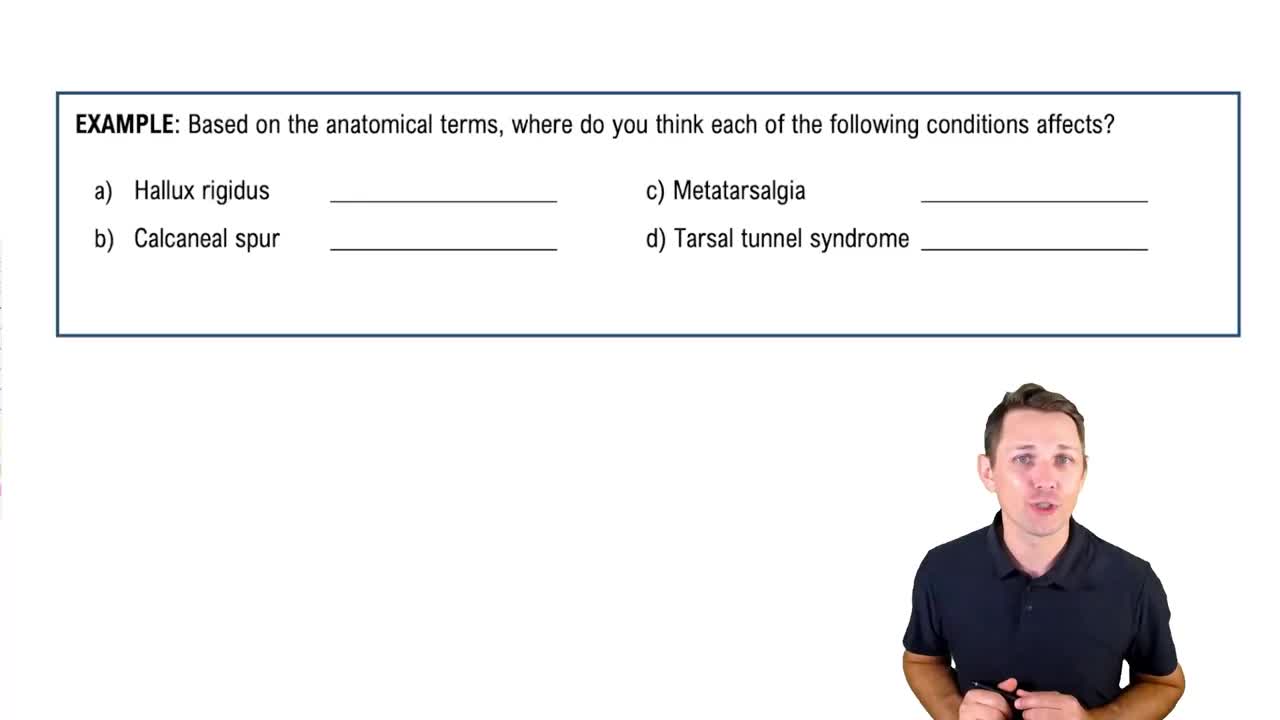
Anatomical Terms for the Leg and Foot Example 2
Median Nerve Anatomy and Function
The median nerve runs through the carpal tunnel and controls sensation in the thumb, index, middle, and part of the ring finger, as well as motor function to some hand muscles. Understanding its pathway helps explain why compression causes specific symptoms in these areas.
Video consigliato:
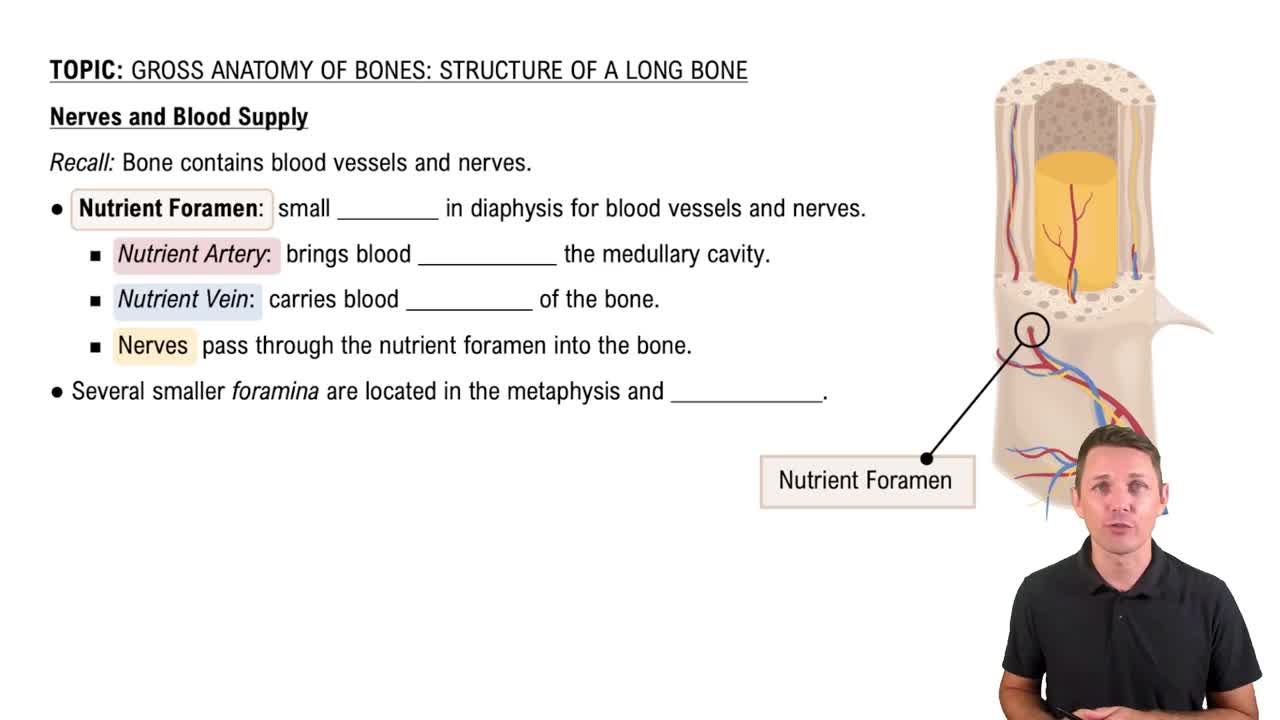
Nerves and Blood Supply
Repetitive Strain Injury (RSI)
Repetitive Strain Injury refers to damage caused by repetitive motions or sustained postures, often affecting muscles, tendons, and nerves. Jobs involving repetitive hand and wrist movements, like poultry processing and typing, increase the risk of conditions like Carpal Tunnel Syndrome.
Video consigliato:
Stretch Reflex
Pratica correlata
Domanda del libro di testo
1116
views
Domanda del libro di testo
How do the relative proportions of the cranium and face of a fetus compare with those of an adult skull?
1297
views
Domanda del libro di testo
Mr. Wright had polio as a boy and was partially paralyzed in one lower limb for over a year. Although no longer paralyzed, he now has a severe lateral curvature of the lumbar spine. Explain what has happened and identify his condition.
1066
views
Domanda del libro di testo
List at least two specific anatomical characteristics each for typical cervical, thoracic, and lumbar vertebrae that would allow anyone to identify each type correctly.
1304
views
Domanda del libro di testo
Which ribs are floating ribs and why are they called that?
1895
views
Domanda del libro di testo
Name the cranial and facial bones and compare and contrast the functions of the cranial and facial skeletons.
1845
views
1
rank