Ch. 7 The Skeleton
Marieb - Human Anatomy & Physiology 7th Edition
Marieb, Hoehn7th EditionHuman Anatomy & PhysiologyISBN: 9780805359091Non è quello che usi tu?Cambia libro di testo
Capitolo 7, Problema 5

Which ribs are floating ribs and why are they called that?

Guida verificata passo dopo passo
1
Identify the total number of ribs in the human rib cage, which is 12 pairs, and understand their general classification into true ribs, false ribs, and floating ribs.
Recognize that floating ribs are specifically the 11th and 12th pairs of ribs in the rib cage.
Understand that floating ribs are called 'floating' because they do not attach to the sternum or to other ribs via cartilage, unlike true and false ribs.
Note that floating ribs are only attached to the vertebrae at the back and have free anterior ends, which is why they appear to 'float' without anterior connection.
Summarize that the floating ribs provide protection to the kidneys and other posterior organs but have more mobility due to their lack of anterior attachment.

Risposta video verificata per un problema simile:

Questa soluzione video è stata consigliata dai nostri tutor come utile per risolvere questo problema.
Durata del video:
1m

Concetti chiave

Ecco i concetti essenziali che devi comprendere per rispondere correttamente alla domanda.

Floating Ribs

Floating ribs are the last two pairs of ribs (11th and 12th) in the rib cage that do not attach to the sternum or to other ribs in the front of the body. They are shorter and only connected to the vertebrae at the back.
Video consigliato:
2:45
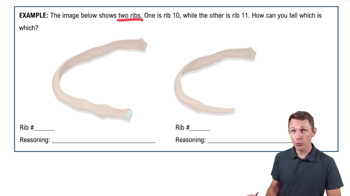
The Thoracic Cage Example 1

Anatomical Attachment of Ribs

Ribs typically connect to the thoracic vertebrae at the back and to the sternum at the front via costal cartilage. Floating ribs lack this anterior attachment, which distinguishes them from true and false ribs.
Video consigliato:
02:33
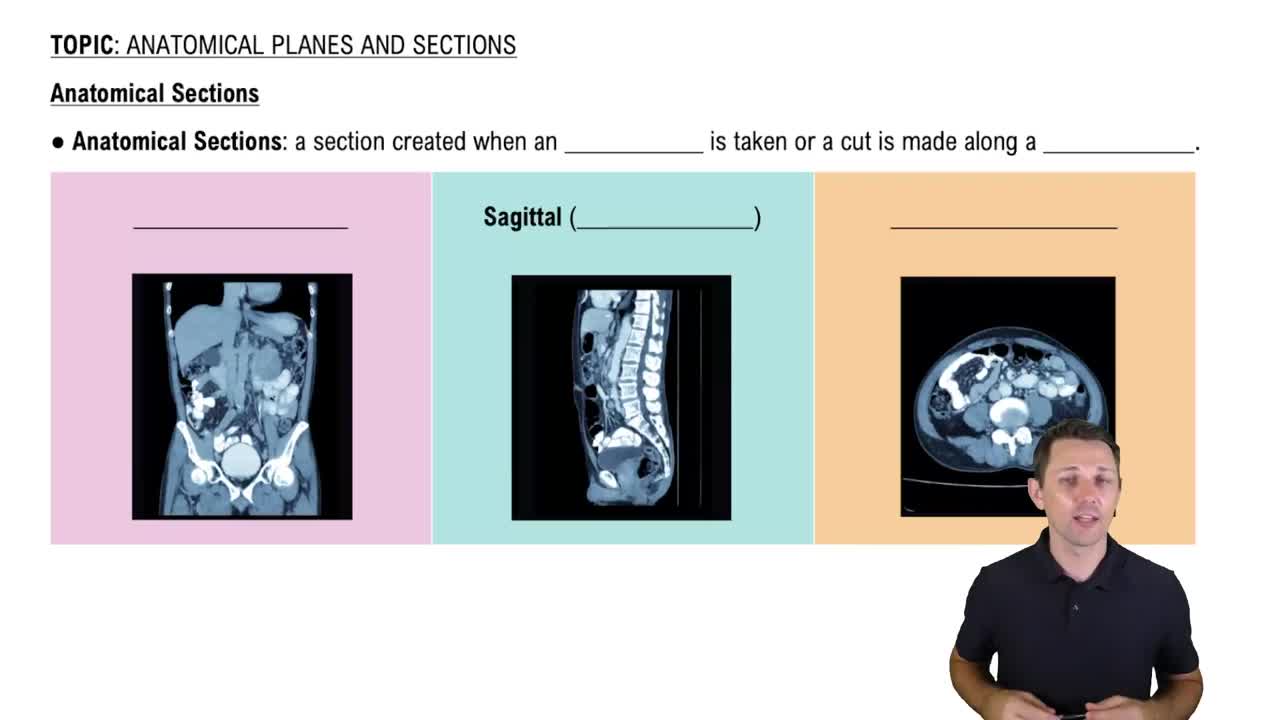
Anatomical Sections

Reason for the Term 'Floating'

They are called 'floating' ribs because their anterior ends are free and do not connect to the sternum or other ribs, giving the appearance that they 'float' without a front anchor.
Video consigliato:
03:00
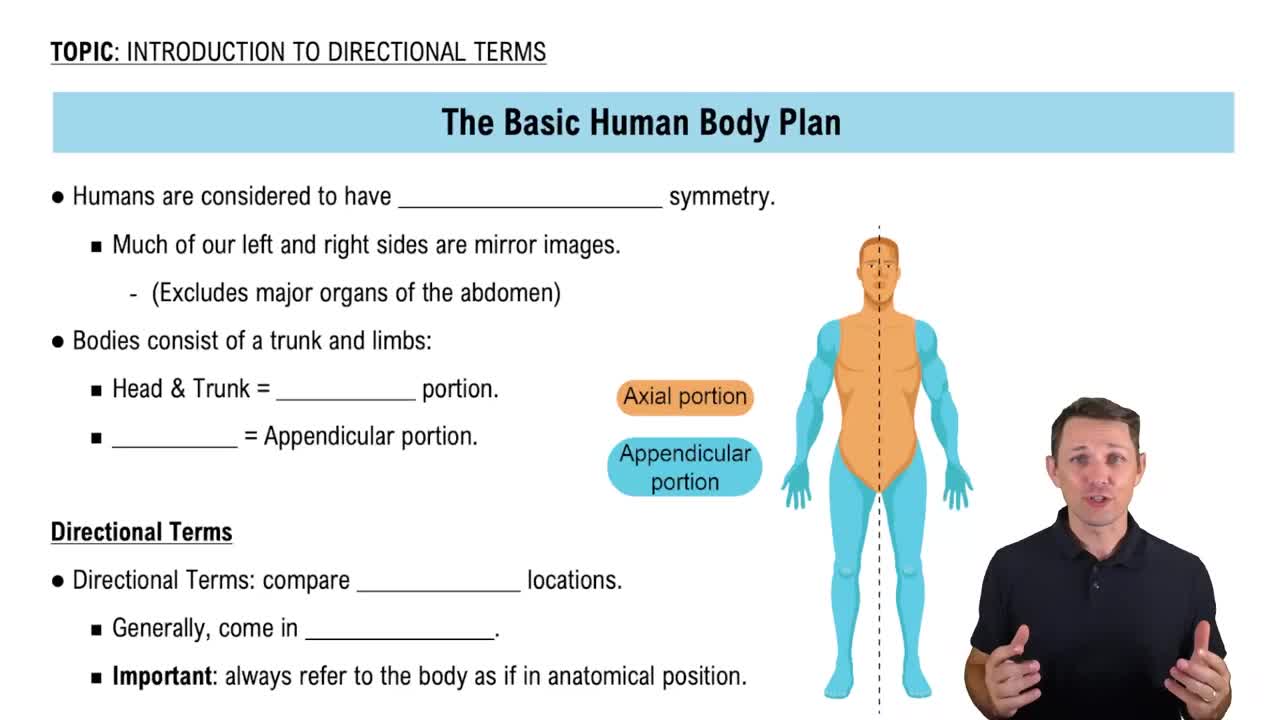
Introduction to Directional Terms
Pratica correlata
Domanda del libro di testo

Match the bones in column B with their description in column A. (Note that some descriptions require more than a single choice.)

Column A

_____ (1) connected by the coronal suture

_____ (2) keystone bone of cranium

_____ (3) keystone bone of the face

_____ (4) form the hard palate

_____ (5) allows the spinal cord to pass

_____ (6) forms the chin

_____  (7) contain paranasal sinuses

_____  (8) contains mastoid sinuses

Column B

a. ethmoid

b. frontal

c. mandible

d. maxillary

e. occipital

f. palatine

g. parietal

h. sphenoid

i. temporal

1787
views
Domanda del libro di testo

What is the function of the intervertebral discs?

1358
views
Domanda del libro di testo

Distinguish between the anulus fibrosus and nucleus pulposus regions of a disc. Which provides durability and strength? Which provides resilience? Which part is involved in a 'slipped' disc?

1116
views
Domanda del libro di testo

Use key choices to identify the bone descriptions that follow.

Key:

a. carpals

b. femur

c. fibula

d. humerus

e. radius

f. tarsals

g. tibia

h. ulna  

______ (1) articulates with the acetabulum and the tibia     

______ (2) forms the lateral aspect of the ankle     

______ (3) bone that 'carries' the hand     

______ (4) the wrist bones     

______ (5) end shaped like a monkey wrench     

______ (6) articulates with the capitulum of the humerus     

______ (7) largest bone of this 'group' is the calcaneus

1172
views
Domanda del libro di testo

How do the relative proportions of the cranium and face of a fetus compare with those of an adult skull?

1297
views
Domanda del libro di testo

Justiniano worked in a poultry-packing plant where his job was cutting open chickens and stripping out their visceral organs. After work, he typed for long hours on his computer keyboard, writing a book about his work in the plant. Soon, his wrist and hand began to hurt whenever he flexed it, and he began to awaken at night with pain and tingling on the thumb half of his hand. What condition did he probably have?

863
views
1
rank