Indietro
Problema 1
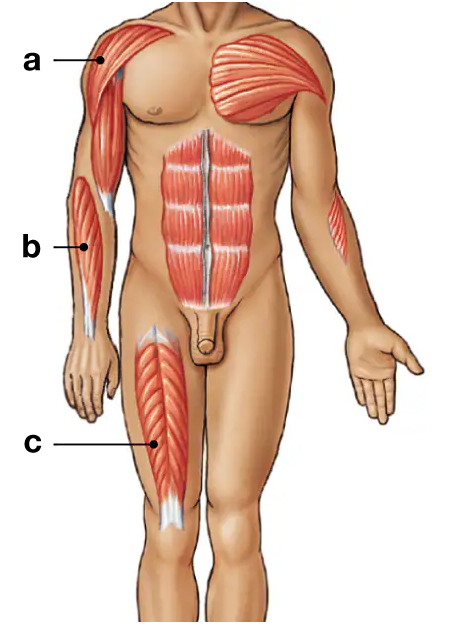
Name the three pennate muscles in the following figure, and for each muscle indicate the type of pennate muscle based on the relationship of muscle fascicles to the tendon.
a. ___
b. ___
c. ___
d. ___
e. ___
f. ___
Problema 2
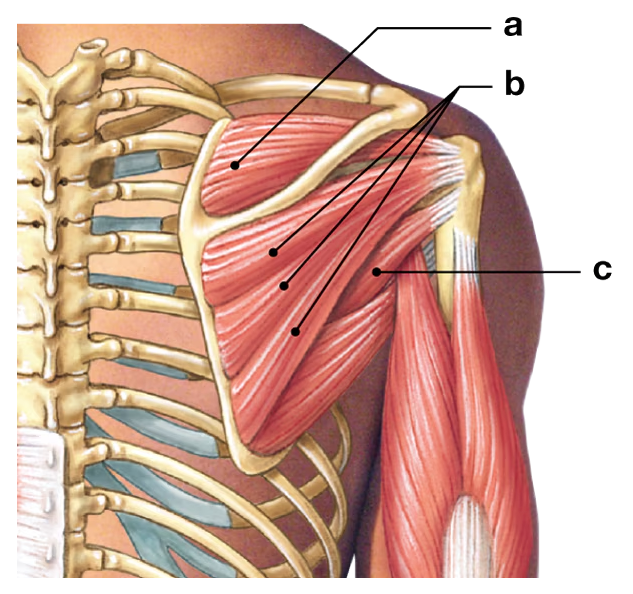
Label the three visible muscles of the rotator cuff in the following posterior view of the deep muscles that move the arm.
a. ___
b. ___
c. ___
Problema 4
Levers make action more versatile by all of the following, except
(a) Changing the location of the muscle's insertion
(b) Changing the speed of movement produced by an applied force
(c) Changing the distance of movement produced by an applied force
(d) Changing the strength of an applied force
(e) Changing the direction of an applied force
Problema 5
The more movable end of a muscle is the
(a) Insertion
(b) Belly
(c) Origin
(d) Proximal end
(e) Distal end
Problema 6
The muscles of facial expression are innervated by cranial nerve
(a) VII
(b) V
(c) IV
(d) VI
Problema 7
The strongest masticatory muscle is the
(a) Pterygoid
(b) Masseter
(c) Temporalis
(d) Mandible
Problema 8
The muscle that rotates the eye medially is the
(a) Superior oblique
(b) Inferior rectus
(c) Medial rectus
(d) Lateral rectus
Problema 9
Important flexors of the vertebral column that act in opposition to the erector spinae are the
(a) Rectus abdominis
(b) Longus capitis
(c) Longus colli
(d) Scalene
Problema 10
The major extensor of the elbow is the
(a) Triceps brachii
(b) Biceps brachii
(c) Deltoid
(d) Subscapularis
Problema 11
The muscles that rotate the radius without producing either flexion or extension of the elbow are the
(a) Brachialis and brachioradialis
(b) Pronator teres and supinator
(c) Biceps brachii and triceps brachii
(d) a, b, and c.
Problema 12
The powerful flexor of the hip is the
(a) Piriformis
(b) Obturator
(c) Pectineus
(d) Iliopsoas
Problema 13
Knee extensors known as the quadriceps femoris consist of the
(a) Three vastus muscles and the rectus femoris
(b) Biceps femoris, gracilis, and sartorius
(c) Popliteus, iliopsoas, and gracilis
(d) Gastrocnemius, tibialis, and peroneus
Problema 14
List the four patterns of fascicle arrangement used to classify the different types of skeletal muscles.
Problema 15
What is an aponeurosis? Give two examples.
Problema 16
Which four muscle groups make up the axial musculature?
Problema 17
What three functions are accomplished by the muscles of the pelvic floor?
Problema 18
On which bones do the four rotator cuff muscles originate and insert?
Problema 19
What three functional groups make up the muscles of the lower limbs?
Problema 21
Compartment syndrome can result from all of the following except
(a) Compressing a nerve in the wrist
(b) Compartments swelling with blood due to an injury involving blood vessels
(c) Torn ligaments in a given compartment
(d) Pulled tendons in the muscles of a given compartment
(e) Torn muscles in a particular compartment
Problema 22
A(n)____develops when an organ protrudes through an abnormal opening.
Problema 23
Elongated bursae that reduce friction and surround the tendons that cross the posterior and anterior surfaces of the wrist form___.
Problema 24
The muscles of the vertebral column include many posterior extensors but few anterior flexors. Why?
Problema 25
Why does a convergent muscle exhibit more versatility when contracting than does a parallel muscle?
Problema 26
Why can a pennate muscle generate more tension than can a parallel muscle of the same size?
Problema 27
Why is it difficult to lift a heavy object when the elbow is at full extension?
Problema 29
Mary sees Jill coming toward her and immediately contracts her frontalis and procerus. She also contracts her right levator labii. Is Mary glad to see Jill? How can you tell?
Problema 30
Mary's newborn is having trouble suckling. The doctor suggests that it may be a problem with a particular muscle. What muscle is the doctor probably referring to?
(a) Orbicularis oris
(b) Buccinator
(c) Masseter
(d) Risorius
(e) Zygomaticus
Problema 31
While unloading her car trunk, Amy strains a muscle and as a result has difficulty moving her arm. The doctor in the emergency room tells her that she strained her pectoralis major. Amy tells you that she thought the pectoralis major was a chest muscle and doesn't understand what that has to do with her arm. What should you tell her?