Ch. 19 Blood
Martini - Fundamentals of Anatomy & Physiology 12th Edition
Martini, Nath, Bartholomew12th EditionFundamentals of Anatomy & PhysiologyISBN: 9780137854011Non è quello che usi tu?Cambia libro di testo
Capitolo 19, Problema 16

What is the difference between prothrombin and thrombin?

Guida verificata passo dopo passo
1
Step 1: Understand that both prothrombin and thrombin are proteins involved in the blood clotting process, also known as coagulation.
Step 2: Recognize that prothrombin is an inactive precursor protein (a zymogen) produced by the liver and circulates in the blood plasma.
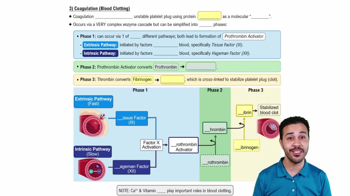
Step 3: Learn that thrombin is the active enzyme form that is generated when prothrombin is cleaved by activated factor X (also called prothrombinase complex) during the coagulation cascade.
Step 4: Know that thrombin's main function is to convert soluble fibrinogen into insoluble fibrin strands, which form the meshwork of a blood clot.
Step 5: Summarize the difference: prothrombin is the inactive precursor, while thrombin is the active enzyme that directly participates in clot formation.

Risposta video verificata per un problema simile:

Questa soluzione video è stata consigliata dai nostri tutor come utile per risolvere questo problema.

Concetti chiave

Ecco i concetti essenziali che devi comprendere per rispondere correttamente alla domanda.

Prothrombin

Prothrombin is an inactive plasma protein produced by the liver that serves as a precursor to thrombin. It circulates in the blood and is converted into thrombin during the coagulation process, playing a crucial role in blood clot formation.
Video consigliato:
Percorso guidato
3:40
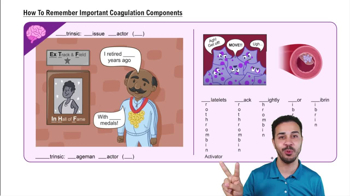
How To Remember Important Coagulation Components

Thrombin

Thrombin is an active enzyme formed from prothrombin during blood coagulation. It catalyzes the conversion of fibrinogen into fibrin, which forms the structural basis of a blood clot, thus playing a central role in stopping bleeding.
Video consigliato:
Percorso guidato
3:40
How To Remember Important Coagulation Components

Coagulation Cascade

The coagulation cascade is a series of enzymatic reactions that lead to blood clotting. It involves the activation of prothrombin to thrombin, which then converts fibrinogen to fibrin, stabilizing the clot and preventing excessive bleeding.
Video consigliato:
Percorso guidato
10:05
Coagulation (Blood Clotting)