Ch. 19 Blood
Martini - Fundamentals of Anatomy & Physiology 12th Edition
Martini, Nath, Bartholomew12th EditionFundamentals of Anatomy & PhysiologyISBN: 9780137854011Non è quello che usi tu?Cambia libro di testo
Capitolo 19, Problema 14

Which kinds of WBCs contribute to the body's nonspecific defenses?

Guida verificata passo dopo passo
1
Step 1: Understand that white blood cells (WBCs) are part of the immune system and can be divided into those involved in specific (adaptive) immunity and nonspecific (innate) immunity.
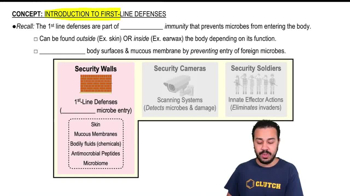
Step 2: Recall that nonspecific defenses are the body's first line of defense and respond to pathogens in a general way, without targeting specific invaders.
Step 3: Identify the types of WBCs that participate in nonspecific defenses, such as neutrophils, eosinophils, basophils, monocytes/macrophages, and natural killer (NK) cells.
Step 4: Recognize the roles of these cells: neutrophils and macrophages perform phagocytosis to engulf pathogens; eosinophils combat parasites; basophils release histamine to promote inflammation; NK cells destroy infected or abnormal cells.
Step 5: Summarize that these WBCs contribute to the body's nonspecific defenses by providing rapid, generalized responses to a wide range of pathogens.

Risposta video verificata per un problema simile:

Questa soluzione video è stata consigliata dai nostri tutor come utile per risolvere questo problema.

Concetti chiave

Ecco i concetti essenziali che devi comprendere per rispondere correttamente alla domanda.

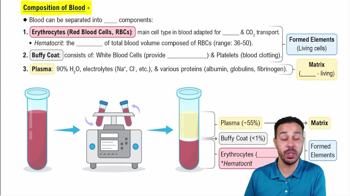
White Blood Cells (WBCs)

White blood cells are immune system cells that protect the body against infections. They are divided into various types, each with specific roles in immune defense, including both nonspecific (innate) and specific (adaptive) immunity.
Video consigliato:
Percorso guidato
7:49
Composition of Blood

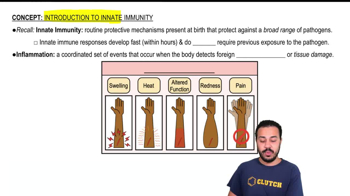
Nonspecific (Innate) Immune Defense

Nonspecific defenses are the body's first line of protection against pathogens, acting quickly and broadly without targeting specific invaders. This includes physical barriers, chemical signals, and immune cells that respond to a wide range of threats.
Video consigliato:
Percorso guidato
2:30
Innate Immunity

Types of WBCs Involved in Nonspecific Defense

Certain WBCs like neutrophils, macrophages, and natural killer cells play key roles in nonspecific defense by engulfing pathogens, destroying infected cells, and releasing chemicals to recruit other immune cells, providing rapid and generalized protection.
Video consigliato:
Percorso guidato
1:56
First-Line Defenses