Ch. 2 The Chemical Level of Organization
Martini - Fundamentals of Anatomy & Physiology 12th Edition
Martini, Nath, Bartholomew12th EditionFundamentals of Anatomy & PhysiologyISBN: 9780137854011Non è quello che usi tu?Cambia libro di testo
Capitolo 2, Problema 26

Explain the differences among nonpolar covalent bonds, polar covalent bonds, and ionic bonds.

Guida verificata passo dopo passo
1
Start by defining a covalent bond: it is a chemical bond where atoms share pairs of electrons to achieve stability.
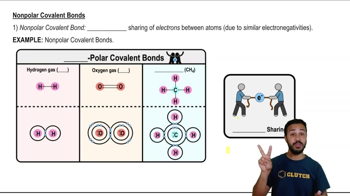
Explain nonpolar covalent bonds: these occur when two atoms share electrons equally because they have similar electronegativities, resulting in no partial charges on the atoms.
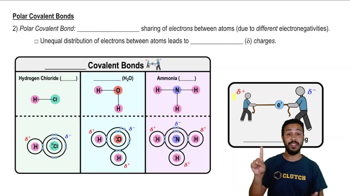
Describe polar covalent bonds: these happen when electrons are shared unequally between two atoms due to a difference in electronegativity, causing partial positive and negative charges (dipoles) on the atoms.
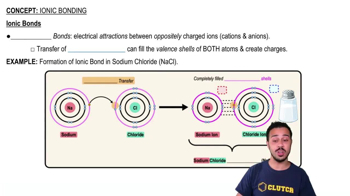
Define ionic bonds: these form when one atom donates one or more electrons to another atom, creating positively charged cations and negatively charged anions that attract each other due to opposite charges.
Summarize the key difference: nonpolar covalent bonds share electrons equally, polar covalent bonds share electrons unequally, and ionic bonds involve the transfer of electrons and electrostatic attraction between ions.

Risposta video verificata per un problema simile:

Questa soluzione video è stata consigliata dai nostri tutor come utile per risolvere questo problema.
Durata del video:
3m

Concetti chiave

Ecco i concetti essenziali che devi comprendere per rispondere correttamente alla domanda.

Nonpolar Covalent Bonds

Nonpolar covalent bonds occur when two atoms share electrons equally due to similar electronegativities. This equal sharing results in a balanced distribution of electrical charge, typically found between identical atoms or atoms with very close electronegativity values.
Video consigliato:
Percorso guidato
05:58
Nonpolar Covalent Bonds

Polar Covalent Bonds

Polar covalent bonds form when electrons are shared unequally between two atoms with different electronegativities. This causes a partial positive charge on one atom and a partial negative charge on the other, creating a dipole moment within the molecule.
Video consigliato:
Percorso guidato
06:59
Polar Covalent Bonds

Ionic Bonds

Ionic bonds arise from the complete transfer of electrons from one atom to another, resulting in oppositely charged ions. These ions attract each other due to electrostatic forces, typically forming between metals and nonmetals with large differences in electronegativity.
Video consigliato: