 Indietro
Chapter 1: Introduction to Algebra – Foundations and Operations
Guida di studio - Note intelligenti
 Appunti personalizzati basati sui tuoi materiali, ampliati con definizioni chiave, esempi e contesto.
Introduction to Algebra
Vocabulary and Basic Concepts
Algebra is a branch of mathematics that uses symbols, usually letters, to represent numbers and express mathematical relationships. Understanding the foundational vocabulary is essential for success in algebra.
Variable: A letter that represents a number (e.g., x, y).
Constant: A number that does not change.
Operation: Mathematical actions such as addition, subtraction, multiplication, and division.
Evaluate: To substitute values for variables and calculate the result.
Algebraic Expression: A combination of constants, variables, and operations (e.g., 2x + 3).
Algebraic Equation: An algebraic expression set equal to another expression (e.g., 2x + 3 = 7).
Translation of Words to Algebraic Expressions:
Addition: "added to," "sum of," "plus," "more than," "increased by" (e.g., "three more than x" is x + 3).
Subtraction: "subtracted," "minus," "difference," "less than," "decreased by" (e.g., "difference of our ages").
Multiplication: "multiplied by," "product of," "times," "twice," "of" (e.g., "double the cost" is 2c).
Division: "divided by," "quotient of," "ratio of," "per" (e.g., "divide the bag of candy between 5 friends" is c/5).
Equality: "equal," "is," "are" (e.g., "what number added to 73 is 201?" is x + 73 = 201).
Examples:
The product of 9 and twice m: 9 × (2m) = 18m
Thirteen less than one quarter of some number: (1/4)x – 13
What number added to 73 is 201? x + 73 = 201
Common Laws Found in Algebra
Properties of Real Numbers
Algebra relies on several fundamental laws that govern the manipulation of numbers and expressions.
Commutative Law:
Addition:
Multiplication:
Associative Law:
Addition:
Multiplication:
Distributive Law:
Examples:
Commutative Law:
Associative Law:
Distributive Law:
Factoring:
Fraction Notation
Prime and Composite Numbers
Understanding fractions begins with recognizing prime and composite numbers.
Prime Number: A number greater than 1 with only two factors: 1 and itself (e.g., 2, 3, 5, 7, 11).
Composite Number: A number with more than two factors (e.g., 4, 6, 8, 9, 10).
Examples:
Prime Factorization of 180:
Prime Factorization of 210:
Fraction Notation and Properties
Numerator: The top number in a fraction.
Denominator: The bottom number in a fraction.
Identity Property of 1:
Examples:
Simplify:
Simplify:
Operations with Fractions
Multiplication:
Division:
Addition/Subtraction (same denominator):
Examples:
Positive and Negative Real Numbers
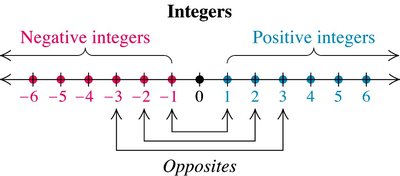
Integers and Their Opposites
Integers include all positive and negative whole numbers, as well as zero. Each integer has an opposite, which is the same distance from zero on the number line but in the opposite direction.
Inequalities and Absolute Value
Inequality Symbols:
<: Less than (e.g., x < 3)
≤: Less than or equal to (e.g., x ≤ -4)
>: Greater than (e.g., x > 0)
≥: Greater than or equal to (e.g., x ≥ -3)
Absolute Value: The distance a number is from zero on the number line, always non-negative.
Examples:
Adding and Subtracting Real Numbers
Using the Number Line
To add on a number line, start at the first number and move right for positive numbers or left for negative numbers. Subtraction is interpreted as adding the opposite.
Add:
Subtract:
Without the Number Line
Add:
Subtract:
Subtract:
Simplify:
Combine like terms:
Combine like terms:
Rules for Addition and Subtraction
Positive numbers: Add as usual; the answer is positive.
Negative numbers: Add absolute values and make the answer negative.
One positive and one negative: Subtract the smaller absolute value from the larger, and use the sign of the larger number.
Identity Property of 0:
Removing Parentheses:
Like Signs: ,
Unlike Signs: ,
Multiplying and Dividing Real Numbers
Rules and Examples
Multiply:
Divide:
Multiply:
Divide: is undefined;
Rules for Multiplication and Division:
Multiply or divide the absolute values.
If the signs are the same, the answer is positive.
If the signs are different, the answer is negative.
Division Involving Zero:
For any real number , is undefined.
For , .
Exponential Notation and Order of Operations
Exponents
Exponential notation is a way to represent repeated multiplication of the same factor.
For any natural number , means (n factors).
Order of Operations
To evaluate expressions correctly, follow the order of operations:
Simplify inside grouping symbols: ( ), [ ], { }, | |, and fraction bars.
Simplify all exponential expressions.
Perform all multiplications and divisions from left to right.
Perform all additions and subtractions from left to right.
Opposite of a Sum:
Examples:
Simplify:
Evaluate: when ,
Simplify:
Simplify:
