 Indietro
Aqueous Chemistry: Water and Noncovalent Interactions in Biochemistry
Guida di studio - Note intelligenti
 Appunti personalizzati basati sui tuoi materiali, ampliati con definizioni chiave, esempi e contesto.
Aqueous Chemistry: Water
Noncovalent Interactions Define the Structure and Function of Biomolecules
Noncovalent interactions are fundamental to the structure and function of biomolecules, including proteins, nucleic acids, and cellular membranes. These interactions are weaker than covalent bonds but are essential for dynamic biological processes.
Noncovalent bonds are weak and can be continually broken and reformed, allowing for flexibility and regulation in biological systems.
Types include hydrogen bonds, ionic interactions, van der Waals forces, and dipole-dipole interactions.
Noncovalent interactions are critical in processes such as enzyme-substrate binding, DNA base pairing, and protein folding.
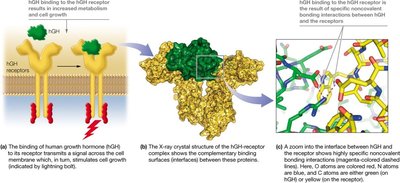
Example: Human growth hormone binding to its receptor involves multiple noncovalent interactions, facilitating signal transduction and cell growth.
Covalent and Noncovalent Bond Energies
The energy required to break or form bonds varies significantly between covalent and noncovalent interactions. Understanding these energies is crucial for interpreting biochemical reactions and molecular stability.
Covalent bonds (e.g., O-H, C-H, C-C) are strong, with energies ranging from 348 to 460 kJ/mol.
Noncovalent bonds (e.g., ionic, hydrogen, van der Waals) are much weaker, typically 0.3 to 86 kJ/mol.
Biological processes often rely on the cumulative effect of many weak noncovalent interactions.
Example: Thermal motion at physiological temperature (~37°C) is sufficient to disrupt weak noncovalent bonds, enabling dynamic molecular interactions.
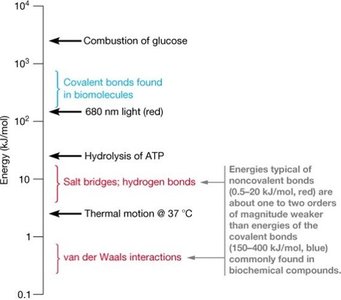
Type of Bond | Example | Bond Strength (kJ/mol) |
|---|---|---|
Covalent | O–H | 460 |
Covalent | C–H | 414 |
Covalent | C–C | 348 |
Noncovalent (Ionic) | COO–...NH3+ | 86 |
Hydrogen bond | O–H...O | 20 |
Dipole-dipole | C=O...C=O | 9.3 |
London dispersion | C–H...H–C | 0.3 |
Types of Noncovalent Interactions
Noncovalent interactions are classified based on the nature of the interacting groups. Each type plays a distinct role in biomolecular structure and function.
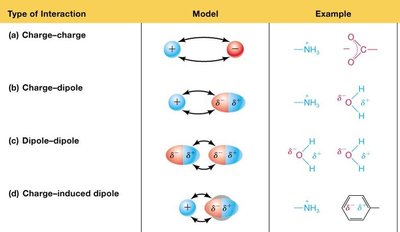
Charge-charge interactions: Occur between fully charged groups (e.g., ionic bonds).
Charge-dipole interactions: Involve a charged group and a polar molecule.
Dipole-dipole interactions: Occur between two polar molecules.
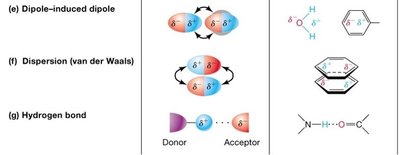
Charge-induced dipole and dipole-induced dipole: Involve temporary polarization of nonpolar molecules.
Dispersion (van der Waals) forces: Weak, transient interactions due to fluctuating charge distributions.
Hydrogen bonds: Special dipole-dipole interactions involving a hydrogen atom bonded to an electronegative atom.
Type of Interaction | Model | Example |
|---|---|---|
Charge-charge | + / – | NH3+ / COO– |
Charge-dipole | + / δ– | NH3+ / H2O |
Dipole-dipole | δ+ / δ– | H2O / H2O |
Charge-induced dipole | + / δ | NH3+ / benzene |
Dipole-induced dipole | δ+ / δ | H2O / benzene |
Dispersion (van der Waals) | δ / δ | benzene / benzene |
Hydrogen bond | Donor / Acceptor | N–H...O=C |
Hydrogen Bonding
Hydrogen Bonding in Biomolecules
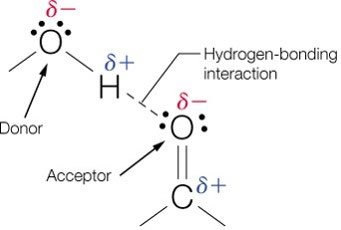
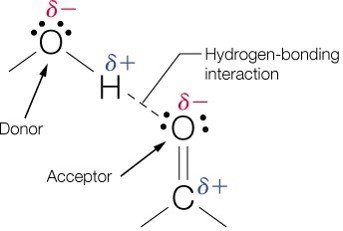
Hydrogen bonds are a key type of noncovalent interaction, especially prevalent in water and biological macromolecules. They occur when a hydrogen atom covalently bonded to an electronegative atom (such as O or N) interacts with another electronegative atom.
Donor: The atom to which hydrogen is covalently bonded (e.g., O or N).
Acceptor: The atom with a lone pair of electrons (e.g., O, N, or S).
Hydrogen bonds are directional and have a typical bond distance of ~1.8 Å.
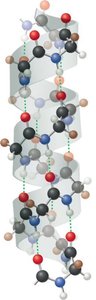
They are essential for the stability of protein secondary structures (e.g., α-helices, β-sheets) and DNA base pairing.
Example: Water molecules form extensive hydrogen bonding networks, contributing to its unique properties.
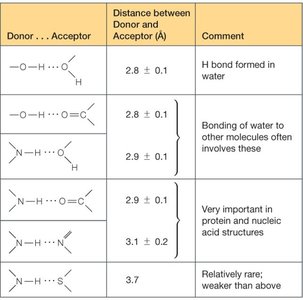
Donor...Acceptor | Distance (Å) | Comment |
|---|---|---|
O–H...O | 2.8 ± 0.1 | H bond formed in water |
O–H...N | 2.8 ± 0.1 | Bonding of water to other molecules |
N–H...O | 2.9 ± 0.1 | Important in protein and nucleic acid structures |
N–H...N | 3.1 ± 0.2 | Weaker than above |
N–H...S | 3.7 | Relatively rare; weaker |
Hydrogen Bonding in Biological Molecules
Hydrogen bonds are not limited to water-water interactions; they are also crucial in macromolecules such as proteins and nucleic acids.
In proteins, hydrogen bonds stabilize secondary structures like α-helices and β-sheets.
In DNA, hydrogen bonds between base pairs (A-T, G-C) maintain the double helix structure.
Hydrogen bonds can form between water and functional groups in biomolecules, such as alcohols, amines, and carbonyls.
Structure and Properties of Water
Unique Properties of Water
Water is essential for life due to its unique physical and chemical properties, which arise from its molecular structure and hydrogen bonding capabilities.
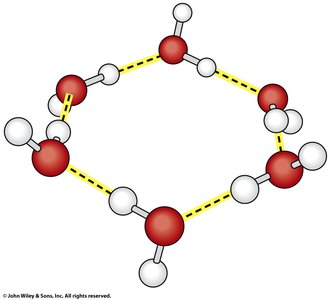
Water has two hydrogen bond donor sites and two acceptor sites, allowing for extensive hydrogen bonding.
It possesses a permanent dipole, high heat capacity, high dielectric constant, and a density greater in liquid than in solid form.
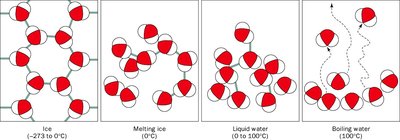
Solid water (ice) is less dense than liquid water, enabling ice to float and providing insulation for aquatic life.
Water's high surface tension and boiling point are direct results of hydrogen bonding.
Molecular Structure of Water
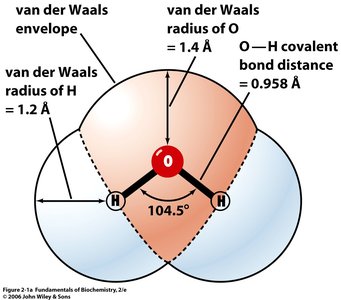
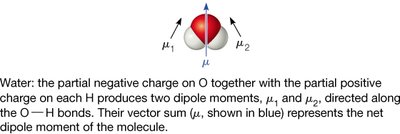
The molecular structure of water is characterized by a bent geometry with a bond angle of 104.5°, resulting from sp3 hybridization of the oxygen atom. This structure leads to a polar molecule with significant dipole moment.
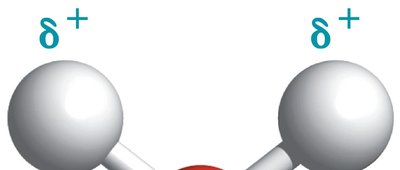
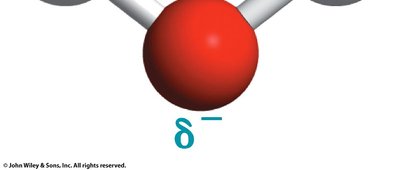
Electronegativity difference: Oxygen is more electronegative than hydrogen, creating partial charges (δ– on O, δ+ on H).
Polarity: The asymmetric distribution of charge makes water an excellent solvent for polar and ionic compounds.
Hydrogen Bonding in Water
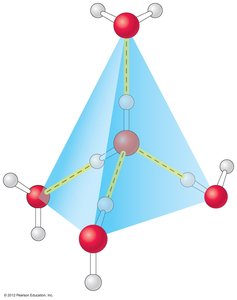
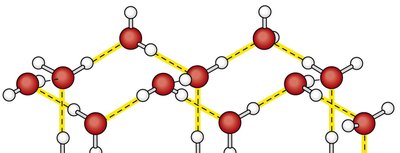
Due to its tetrahedral geometry, a single water molecule can form up to four hydrogen bonds with neighboring molecules. This extensive hydrogen bonding network is responsible for many of water's anomalous properties.
In ice, water molecules are arranged in a tetrahedral lattice, maximizing hydrogen bonds.
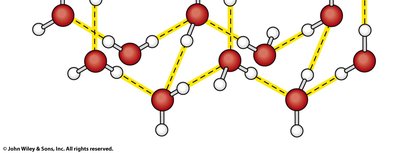
In liquid water, hydrogen bonds are transient, forming flickering clusters.
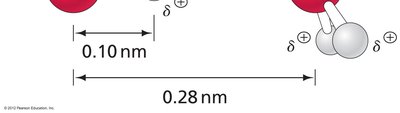
Hydrogen bond distance in water is approximately 1.8 Å.
Properties of Water Compared to Other Compounds
Water's physical properties are distinct from other low-molecular-weight compounds due to its hydrogen bonding.
Compound | Heat of Vaporization (kJ/mol) | Boiling Point (°C) | Melting Point (°C) | Molecular Weight |
|---|---|---|---|---|
CH4 | 8.16 | -164 | -182 | 16.04 |
NH3 | 23.26 | -33 | -78 | 17.03 |
H2O | 40.71 | +100 | 0 | 18.02 |
H2S | 18.66 | -61 | -86 | 34.08 |
Water as a Solvent
Water and Ionic Solutes
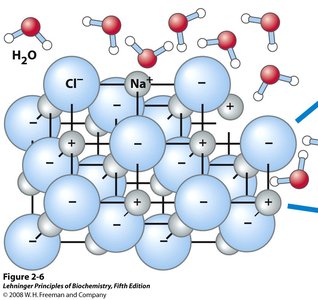
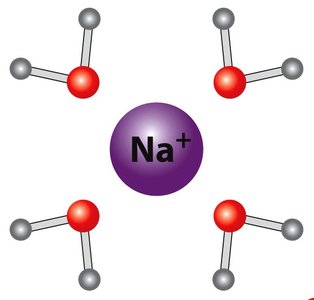
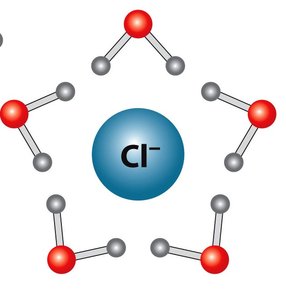
Water is an excellent solvent for ionic compounds due to its high dielectric constant and ability to surround ions with hydration shells, weakening ionic interactions.
Each ion (e.g., Na+, Cl–) is surrounded by a network of ordered water molecules.
Interactions between ions are weakened, facilitating dissolution and transport in biological systems.
Water and Biological Functional Groups
Water interacts with various functional groups in biomolecules, forming hydrogen bonds and influencing solubility and reactivity.
w.
These interactions are critical for protein folding, enzyme activity, and molecular recognition.
Water and Nonpolar Solutes: Hydrophobic Effect
Nonpolar solutes do not form hydrogen bonds with water. çThe hydrophobic effect drives the exclusion of nonpolar substances from aqueous solution, crucial for protein folding and membrane formation.
Amphipathic molecules (containing both polar and nonpolar regions) can form micelles, monolayers, or bilayers in water.
Hydrophilicity, Hydrophobicity, and Amphipathic Molecules
Hydrophilic and Hydrophobic Molecules
Hydrophilic molecules interact favorably with water and dissolve well, while hydrophobic molecules do not and are excluded from aqueous environments.
Hydrophilic: "Water loving"; forms favorable interactions with water.
Hydrophobic: "Water fearing"; does not interact favorably with water.
Hydrophobic effect: The exclusion of nonpolar substances from water by releasing constrained water molecules.
Amphipathic Molecules in Aqueous Solution
Amphipathic molecules contain both hydrophilic and hydrophobic regions. In water, they can form structures such as micelles and bilayers, which are fundamental to biological membranes.
Phospholipid bilayers are the primary component of cellular membranes.
Polar groups orient toward water, while nonpolar groups cluster away from water.
Fatty acids and detergents (e.g., sodium dodecyl sulfate) form micelles in water.
Additional info: Amphipathic lipids form bilayers and vesicles, creating barriers to diffusion and compartmentalizing cellular contents.
----------------------------------------
