 Indietro
Chapter 2: The Chemical Foundation of Life – Weak Interactions in an Aqueous Environment
Guida di studio - Note intelligenti
 Appunti personalizzati basati sui tuoi materiali, ampliati con definizioni chiave, esempi e contesto.
Types and Strengths of Noncovalent Interactions
Overview of Noncovalent Interactions
Noncovalent interactions are fundamental to the structure and function of biomolecules. They are weaker than covalent bonds but essential for dynamic biological processes such as molecular recognition, protein folding, and enzyme catalysis.
Charge-charge interactions: Occur between fully charged particles (ions), often called salt bridges.
Dipole-dipole interactions: Occur between molecules with permanent dipoles.
Induced dipole interactions: Temporary dipoles induced by nearby charges or dipoles.
Hydrogen bonding: A special type of dipole-dipole interaction involving hydrogen atoms bonded to electronegative atoms.
van der Waals interactions: Weak, non-specific interactions due to transient dipoles.
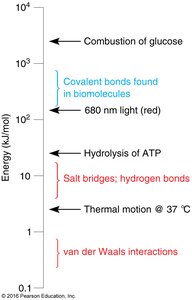
Relative Energies of Noncovalent Interactions
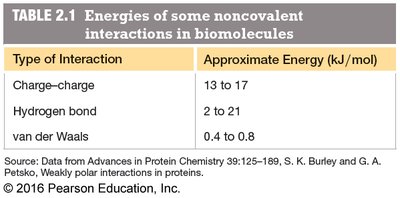
The strength of noncovalent interactions varies, influencing their biological roles.
Charge-charge: 13–17 kJ/mol
Hydrogen bond: 2–21 kJ/mol
van der Waals: 0.4–0.8 kJ/mol
Type of Interaction | Approximate Energy (kJ/mol) |
|---|---|
Charge–charge | 13–17 |
Hydrogen bond | 2–21 |
van der Waals | 0.4–0.8 |
Electrostatic Interactions and Dipoles
Permanent and Induced Dipoles
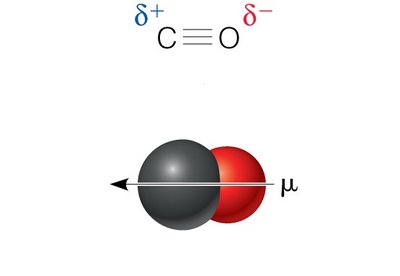
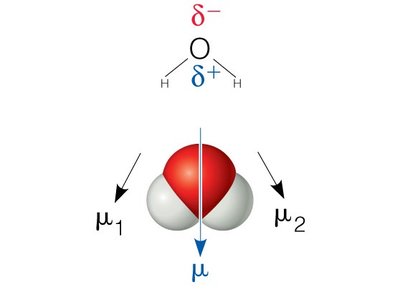
Dipoles arise from the separation of opposite electrical charges within a molecule. Permanent dipoles exist in molecules like carbon monoxide and water, while induced dipoles are temporary and result from nearby charges.
Permanent dipole: Molecules with uneven charge distribution (e.g., CO, H2O).
Induced dipole: Temporary shift in electron density due to external influence.
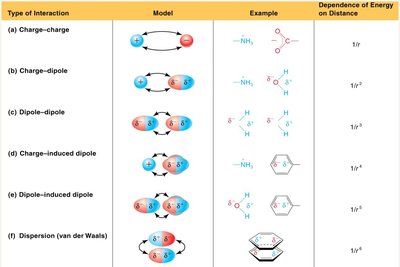
Types of Noncovalent Interactions
All noncovalent interactions are fundamentally electrostatic. Their strength depends on the nature of the interacting particles and their distance.
Type of Interaction | Model | Example | Dependence of Energy on Distance |
|---|---|---|---|
Charge–charge | Ion pairs | NH3+ and COO– | 1/r |
Charge–dipole | Ion and dipole | NH3+ and H2O | 1/r2 |
Dipole–dipole | Two dipoles | H2O and H2O | 1/r3 |
Charge–induced dipole | Ion and induced dipole | NH3+ and benzene | 1/r4 |
Dipole–induced dipole | Dipole and induced dipole | H2O and benzene | 1/r5 |
Dispersion (van der Waals) | Transient dipoles | Benzene rings | 1/r6 |
Coulomb’s Law and Dielectric Constant
Coulomb’s Law in Biological Systems
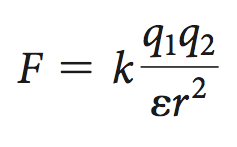
The force between two charged particles is described by Coulomb’s Law. In biological systems, the medium (usually water) screens these interactions, reducing their strength.
Coulomb’s Law (vacuum):
Coulomb’s Law (in solution): , where is the dielectric constant.
Water’s dielectric constant: 80, making it an excellent solvent for ions.
van der Waals Interactions and Radii
van der Waals Forces
van der Waals interactions are weak, non-specific forces that arise from transient dipoles. They are significant when molecules are in close proximity.
van der Waals radii: The effective size of atoms or groups when interacting noncovalently.
Energy profile: Attraction increases as molecules approach, but repulsion dominates at very close distances.
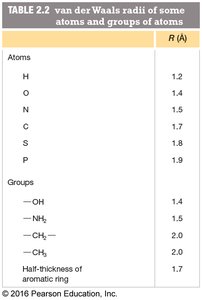
Atom/Group | van der Waals Radius (Å) |
|---|---|
H | 1.2 |
O | 1.4 |
N | 1.5 |
C | 1.7 |
S | 1.8 |
P | 1.9 |
–OH | 1.4 |
–NH2 | 1.5 |
–CH2– | 2.0 |
–CH3 | 2.0 |
Half-thickness of aromatic ring | 1.7 |
Hydrogen Bonding
Hydrogen Bond Characteristics
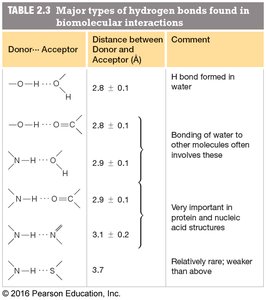
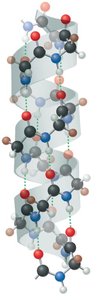
Hydrogen bonds are directional interactions between a hydrogen atom (bonded to an electronegative atom) and another electronegative atom. They are crucial for stabilizing protein and nucleic acid structures.
Donor: Atom to which hydrogen is covalently bonded.
Acceptor: Atom with lone pair electrons that interacts with hydrogen.
Bond length: Typically 2.8–3.1 Å.
Donor...Acceptor | Distance (Å) | Comment |
|---|---|---|
O–H...O | 2.8 ± 0.1 | H bond formed in water |
O–H...N | 2.8 ± 0.1 | Bonding of water to other molecules |
N–H...O | 2.9 ± 0.1 | Important in protein/nucleic acid |
N–H...N | 3.1 ± 0.2 | Relatively rare |
O...H–N | 3.7 | Weaker |
Properties of Water
Unique Properties of Water
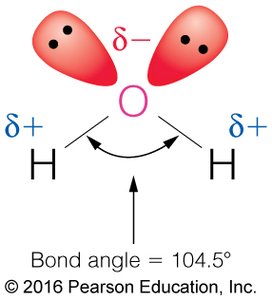
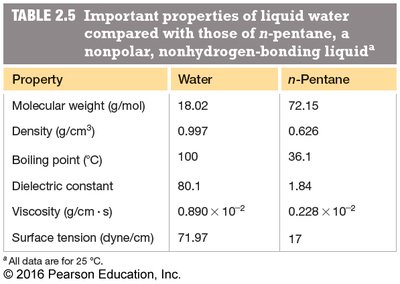
Water is the medium of life due to its unique physical and chemical properties.
High heat capacity
High boiling point
High dielectric constant
Density greater in liquid than solid
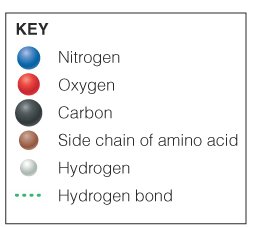
Permanent dipole
Ability to form four hydrogen bonds
Compound | Molecular Weight | Melting Point (°C) | Boiling Point (°C) | Heat of Vaporization (kJ/mol) |
|---|---|---|---|---|
CH4 | 16.04 | –182 | –164 | 8.16 |
NH3 | 17.03 | –78 | –33 | 23.26 |
H2O | 18.02 | 0 | 100 | 40.71 |
H2S | 34.08 | –86 | –61 | 18.66 |
Hydrophilic, Hydrophobic, and Amphipathic Molecules
Hydrophilic Molecules
Hydrophilic molecules interact favorably with water, often forming hydrogen bonds or ionic interactions. Water can compete with intramolecular hydrogen bonds, disrupting structures. 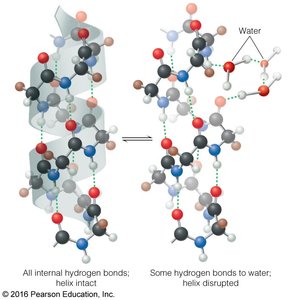
Hydrophobic Molecules
Hydrophobic molecules are nonpolar and do not interact favorably with water. Water forms clathrate structures around them, decreasing entropy and driving the hydrophobic effect, which stabilizes protein structures. 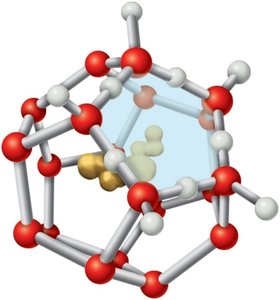
Amphipathic Molecules
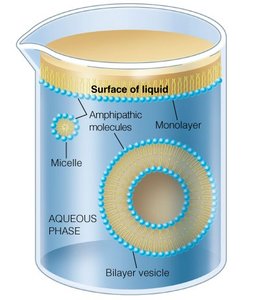
Amphipathic molecules contain both hydrophilic and hydrophobic regions. In aqueous solution, they can form monolayers, micelles, or bilayers, which are fundamental to membrane structure. 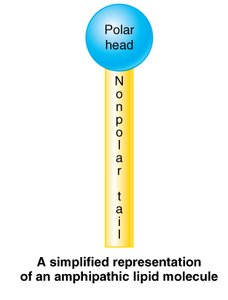
Acids, Bases, and pH Calculations
Bronsted-Lowry Definitions
Acid: Proton donor
Base: Proton acceptor
Strong acid: Completely dissociates
Weak acid: Partially dissociates
Ionization of Water and pH Scale
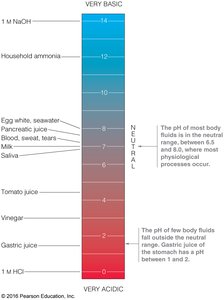
Water ionizes to produce H+ and OH–. The ion product () is at 25°C.
pH calculation:
Neutral pH: 7 at 25°C
Henderson-Hasselbalch Equation
The Henderson-Hasselbalch equation relates pH, pKa, and the ratio of conjugate base to acid.
Equation:
Buffering range: pKa ± 1
Isoelectric Point (pI) and Net Charge Calculations
Isoelectric Point of Amino Acids
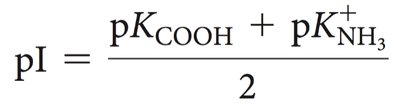
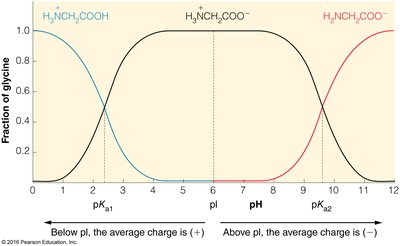
The isoelectric point (pI) is the pH at which the net charge of a molecule is zero. For amino acids like glycine, pI is calculated as the average of the two pKa values surrounding the neutral species.
Formula:
Biological Relevance of Ionic Properties
Ionic Properties of Amino Acid Side Chains
The ionic properties of amino acid side chains affect protein solubility, ligand binding, and purification processes.
Surface properties: Charged side chains are often solvent-exposed.
Protein-ligand binding: Electrostatic interactions are crucial for specificity.
Electrophoresis and Isoelectric Focusing
Agarose and Acrylamide Gel Electrophoresis
Agarose gel: Used for large molecules (DNA, RNA).
Acrylamide gel: Used for smaller molecules (proteins, short nucleotides).
Isoelectric Focusing
Proteins migrate in a pH gradient gel to the region corresponding to their pI, allowing separation based on net charge. Additional info: Isoelectric focusing is a powerful technique for protein purification and analysis, as it separates proteins based on their unique isoelectric points.
