 Indietro
Enzymes and Catalytic Mechanisms: Biochemistry Study Notes
Guida di studio - Note intelligenti
 Appunti personalizzati basati sui tuoi materiali, ampliati con definizioni chiave, esempi e contesto.
Enzymes: Biological Catalysts
Introduction to Enzymes
Enzymes are specialized globular proteins that act as biological catalysts, accelerating chemical reactions in living organisms. The only exception to protein-based enzymes is self-splicing RNA, known as ribozymes. Eduard Buchner's experiments in 1897 demonstrated that cell-free yeast extracts could ferment sugar to alcohol, leading to the discovery and naming of enzymes.
Definition: Enzymes are proteins (or RNA in rare cases) that catalyze biochemical reactions.
Function: Increase reaction rates by up to 1020 times compared to uncatalyzed reactions.
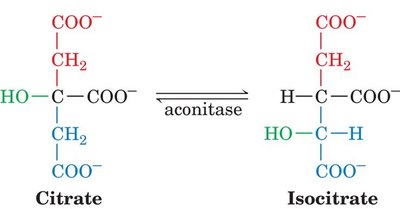
Specificity: Enzymes are highly specific, often distinguishing between stereoisomers.
Regulation: Enzyme activity is finely regulated by cellular processes.

Enzyme-Substrate Interaction
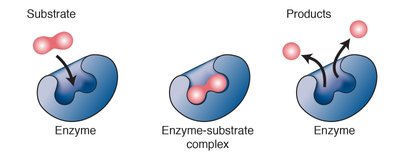
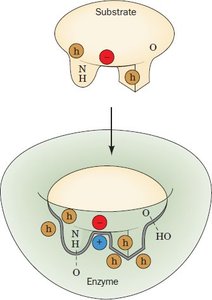
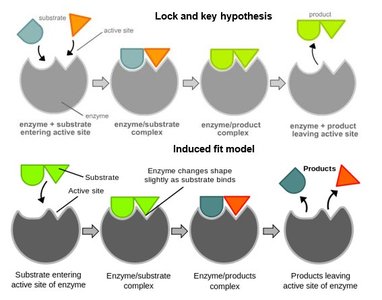
Enzymes bind to specific substrates through noncovalent interactions, forming an enzyme-substrate complex. This binding is dictated by geometric and electronic complementarity, ensuring high specificity.
Geometric Complementarity: The active site is shaped to fit the substrate.
Electronic Complementarity: Amino acid residues in the active site attract the substrate.
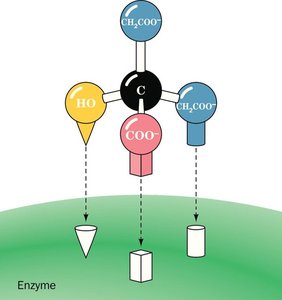
Stereospecificity: Enzymes bind and catalyze reactions of chiral substrates due to their own chirality.
Thermodynamic Principles of Enzyme Catalysis
Reaction Energetics
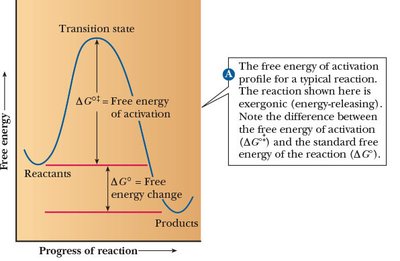
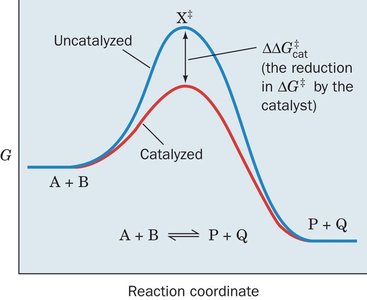
The rate of a reaction and its thermodynamics are related but distinct. Enzymes do not alter the equilibrium constant or the free energy change (ΔG°) of a reaction, but they lower the activation energy (ΔG°‡), making reactions proceed faster.
Standard Free Energy Change (ΔG°): Difference in energy between reactants and products under standard conditions.
Activation Energy (ΔG°‡): Energy required to reach the transition state.
Effect of Catalysts: Catalysts (including enzymes) lower ΔG°‡, increasing the concentration of the transition state and speeding up the reaction.
Comparison of Catalytic Efficiency
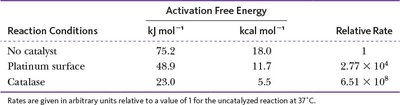
Enzymes are much more efficient than nonenzymatic catalysts, such as platinum surfaces. The table below compares activation free energy and relative rates for different catalytic conditions.
Reaction Conditions | kJ mol-1 | kcal mol-1 | Relative Rate |
|---|---|---|---|
No catalyst | 75.2 | 18.0 | 1 |
Platinum surface | 48.9 | 11.7 | 2.77 × 10⁴ |
Catalase | 28.0 | 5.5 | 6.51 × 10⁸ |
General Properties and Classification of Enzymes
Properties of Enzymes
Enzymes differ from ordinary chemical catalysts in several ways:
High Reaction Rates: Enzymes exhibit remarkable catalytic power.
Milder Reaction Conditions: Function under physiological conditions (temperature, pressure, pH).
Greater Specificity: High substrate specificity, rarely producing side products.
Regulation: Enzyme activity can be modulated by allosteric controls, covalent modifications, and synthesis levels.
Enzyme Classification
Enzymes are classified based on the type of reaction they catalyze:
Oxidoreductases: Catalyze oxidation–reduction reactions.
Transferases: Transfer functional groups.
Hydrolases: Catalyze hydrolysis reactions.
Lyases: Eliminate groups to form double bonds.
Isomerases: Catalyze isomerization.
Ligases: Form bonds coupled with ATP hydrolysis.
Enzyme Specificity
Substrate Specificity
Enzymes act on specific substrates, dictated by noncovalent interactions and the structure of the active site. Most enzymes are selective about the chemical groups on their substrates (geometric specificity), and some are highly stereospecific.
Example: Alcohol dehydrogenase oxidizes ethanol faster than methanol due to substrate specificity.
Enzyme Cofactors
Role of Cofactors
Many enzymes require cofactors to expand their catalytic capabilities. Cofactors can be inorganic ions or organic molecules (coenzymes), and are sometimes referred to as "chemical teeth." Cofactors are essential for the function of many enzymes.
Inorganic Ions: Examples include Cu2+, Fe2+/3+, Zn2+, Mg2+, Mn2+, Mo, Ni2+, K+.
Coenzymes: Organic molecules that act as transient carriers of atoms or functional groups.
Cosubstrates: Coenzymes that are transiently associated with the enzyme.
Prosthetic Groups: Coenzymes permanently associated with the enzyme, often by covalent bonds.
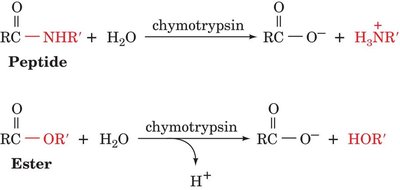
Catalytic Mechanisms
Types of Catalysis
Enzymes employ several catalytic mechanisms to accelerate reactions:
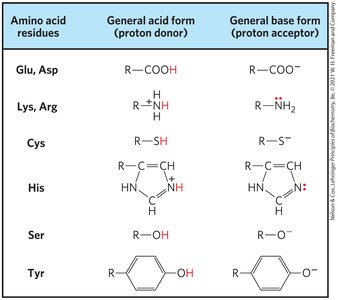
Acid-Base Catalysis: Amino acid side chains donate or accept protons.
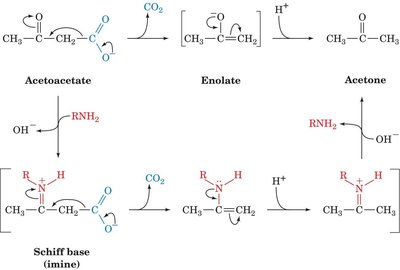
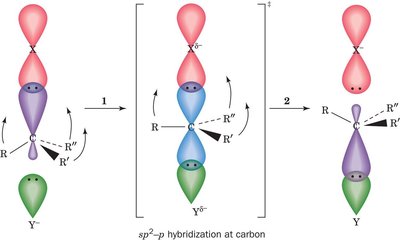
Covalent Catalysis: Nucleophilic groups form transient covalent bonds with the substrate.
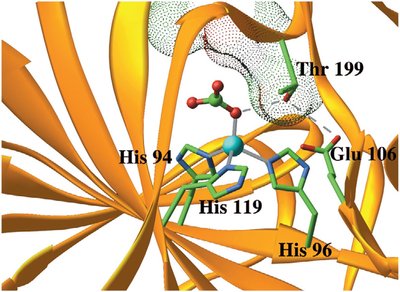
Metal Ion Catalysis: Metal ions facilitate reactions through electronic properties.
Proximity and Orientation Effects: Enzymes bring substrates together and orient them for reaction.
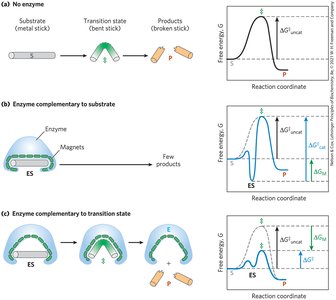
Transition State Stabilization: Enzymes preferentially bind the transition state, lowering activation energy.
Acid-Base Catalysis
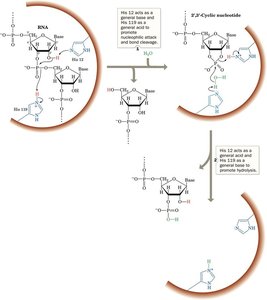
Acid-base catalysis involves amino acid residues acting as proton donors or acceptors. This mechanism is common in many enzymes.
Example: RNase A uses His residues for concerted acid-base catalysis.
Transition State Stabilization and Inhibition
Enzymes often bind the transition state with greater affinity than substrates or products, straining substrates into the transition state. Transition state analogs, which mimic the transition state, are potent enzyme inhibitors and are used in drug design.
Summary Table: Enzyme Catalytic Mechanisms
Mechanism | Description | Example |
|---|---|---|
Acid-Base Catalysis | Proton transfer by amino acid side chains | RNase A |
Covalent Catalysis | Transient covalent bond formation | Decarboxylation of acetoacetate |
Metal Ion Catalysis | Metal ions facilitate reaction | Carbonic anhydrase |
Proximity & Orientation | Substrate positioning and motion restriction | General enzyme catalysis |
Transition State Stabilization | Preferential binding of transition state | Drug design with transition state analogs |
Additional info: These notes expand on brief points from the original materials, providing academic context and examples for clarity and completeness.
