 Indietro
Foundations of Biochemistry: The Animal Cell, Biomolecules, and Physical Principles
Guida di studio - Note intelligenti
 Appunti personalizzati basati sui tuoi materiali, ampliati con definizioni chiave, esempi e contesto.
Chapter 1: Foundations of Biochemistry
Introduction to Biochemistry
Biochemistry is the study of the chemical processes and substances that occur within living organisms. This field bridges biology and chemistry, focusing on the molecular mechanisms that underlie cellular structure, function, and regulation. In this course, the primary emphasis is on the biochemistry of the animal cell, its structural components, and the chemical properties of biomolecules.
The Animal Cell
Key Structural Components
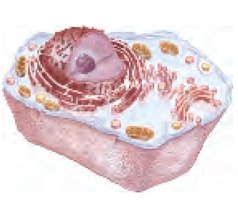
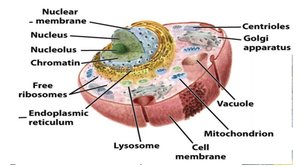
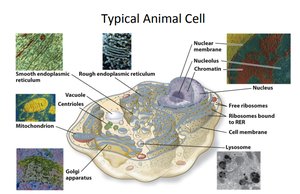
The animal cell is a eukaryotic cell, typically 10–100 µm in diameter, and contains a variety of organelles with specialized functions. The cell membrane regulates transport, while internal organelles carry out essential biochemical processes.
Nucleus: Contains genetic material (DNA) and controls cellular activities.
Mitochondria: Site of ATP (energy) production via cellular respiration.
Endoplasmic Reticulum (ER): Synthesizes proteins (rough ER) and lipids (smooth ER).
Golgi Apparatus: Modifies, sorts, and packages proteins and lipids.
Lysosomes: Contain digestive enzymes for breakdown of macromolecules.
Cell Membrane: Phospholipid bilayer that controls entry and exit of substances.
The Physical Laws of Life
Application of Physical Principles
All living organisms, including animal cells, obey the fundamental laws of physics and chemistry. These include:
Conservation of Mass and Energy: Matter and energy cannot be created or destroyed, only transformed.
Laws of Thermodynamics: Govern energy changes and the direction of biochemical reactions.
Chemical Kinetics: Describes the rates of chemical reactions.
Principles of Chemical Reactions: Underlie metabolic pathways and cellular processes.
Composition of Biomolecules
Elements Essential for Life
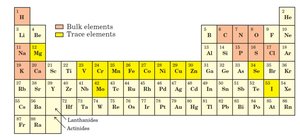
The human body is primarily composed of a small number of elements. The most abundant are carbon (C), nitrogen (N), oxygen (O), hydrogen (H), calcium (Ca), phosphorus (P), potassium (K), and sulfur (S), which together account for nearly 97% of the body's dry weight.
Element | Dry Weight (%) |
|---|---|
C | 61.7 |
N | 11.0 |
O | 9.3 |
H | 5.7 |
Ca | 5.0 |
P | 3.3 |
K | 1.3 |
S | 1.0 |
Cl | 0.7 |
Na | 0.7 |
Mg | 0.3 |
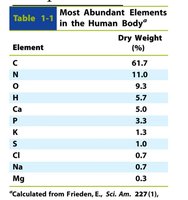
Other elements, such as titanium (Ti) and cadmium (Cd), have recently been shown to have biological importance. Elements are classified as bulk elements or trace elements based on their abundance and necessity for life.
Classes of Biomolecules
Major Biomolecule Types and Their Functions
Carbohydrates: Main source of energy; includes sugars and starches.
Lipids: Provide stored energy, form biological membranes, and serve as signaling molecules.
Proteins: Serve as enzymes (catalysts), structural components, signaling molecules, and transporters.
Nucleic Acids: Store and transmit genetic information; blueprint for protein synthesis.
Important Functional Groups in Biomolecules
Common Functional Groups and Linkages
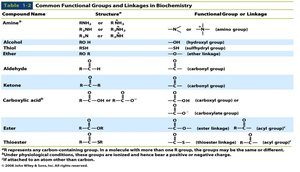
Functional groups are specific groups of atoms within molecules that are responsible for the characteristic chemical reactions of those molecules. Understanding these groups is essential for studying biochemical reactions.
Compound Name | Structure | Functional Group or Linkage |
|---|---|---|
Amine | R-NH2, R2NH, R3N | Amino group |
Alcohol | R-OH | Hydroxyl group |
Thiol | R-SH | Sulfhydryl group |
Aldehyde | R-CHO | Aldehyde group |
Ketone | R-CO-R' | Keto group |
Carboxylic acid | R-COOH | Carboxyl group |
Ester | R-COOR' | Ester linkage |
Thioester | R-COSR' | Thioester linkage |
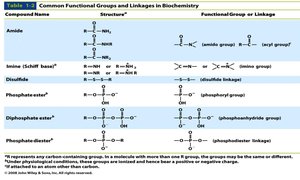
Compound Name | Structure | Functional Group or Linkage |
|---|---|---|
Amide | R-CONH2 | Amide group |
Imine (Schiff base) | R-CH=NH | Imine group |
Disulfide | R-S-S-R' | Disulfide linkage |
Phosphate ester | R-O-PO32- | Phosphoester linkage |
Diphosphate ester | R-O-P-O-P-O-R' | Phosphoanhydride linkage |
Important Intermolecular Forces
Bonding and Nonbonding Forces
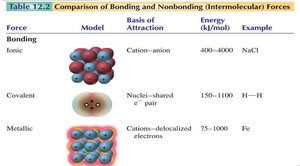
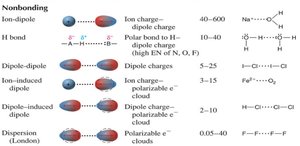
Intermolecular forces are critical in determining the structure and function of biomolecules. They include both bonding (ionic, covalent, metallic) and nonbonding (ion-dipole, hydrogen bonds, dipole-dipole, dispersion) interactions.
Force | Model | Basis of Attraction | Energy (kJ/mol) | Example |
|---|---|---|---|---|
Ionic | Cation–anion | Electrostatic attraction | 400–4000 | NaCl |
Covalent | Nuclei–shared e- pair | Electron sharing | 150–1100 | H2 |
Metallic | Cations–delocalized electrons | Electron sea | 75–1000 | Fe |
Force | Model | Basis of Attraction | Energy (kJ/mol) | Example |
|---|---|---|---|---|
Ion-dipole | Ion charge–dipole charge | Electrostatic | 40–600 | Na+–H2O |
H bond | Polar bond to H–dipole charge | High EN of N, O, F | 10–40 | H2O |
Dipole-dipole | Dipole charges | Electrostatic | 5–25 | HCl |
Dipole-induced dipole | Dipole charge–polarizable e- cloud | Induced | 2–10 | HCl–Cl2 |
Dispersion (London) | Polarizable e- cloud | Induced | 0.05–40 | F2–F2 |
Thermodynamic Principles in Biochemistry
Thermodynamics of Biochemical Reactions
Biochemical reactions are governed by the laws of thermodynamics. The spontaneity of a reaction is determined by the change in Gibbs free energy ():
First Law (Conservation of Energy): Energy can be converted between forms but not created or destroyed.
Second Law (Entropy): The entropy (disorder) of the universe tends to increase.
Third Law (Absolute Zero): At absolute zero (0 K), the entropy of a perfect crystal is zero.
The Gibbs free energy equation is:
If , the reaction is spontaneous (exergonic).
If , the reaction is non-spontaneous (endergonic).
Example: The decomposition of hydrogen peroxide is a thermodynamically favorable process and can be catalyzed by substances such as manganese dioxide (MnO2) or iron oxide.
Hierarchy of Cell Organization
Levels of Biological Structure
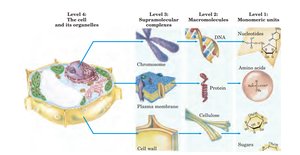
Cells are organized in a hierarchical manner, from simple monomeric units to complex organelles and supramolecular assemblies:
Level 1: Monomeric units (nucleotides, amino acids, sugars, fatty acids)
Level 2: Macromolecules (DNA, proteins, cellulose)
Level 3: Supramolecular complexes (chromosomes, plasma membrane, cell wall)
Level 4: The cell and its organelles
Additional info: This foundational overview prepares students for deeper study into the structure, function, and interactions of biomolecules in subsequent chapters.
