 Indietro
Noncovalent Interactions in Biological Molecules
Guida di studio - Note intelligenti
 Appunti personalizzati basati sui tuoi materiali, ampliati con definizioni chiave, esempi e contesto.
Important Noncovalent Interactions in Biochemistry
Types of Noncovalent Interactions
Noncovalent interactions are essential for the structure and function of biological macromolecules. These interactions, though weaker than covalent bonds, collectively stabilize the three-dimensional structures of proteins, nucleic acids, and other biomolecules, and mediate molecular recognition events.
Electrostatic (Ionic) Interactions: Occur between charged groups or ions. The strength of these interactions depends on the distance between charges and the dielectric constant of the medium.
Dipole Interactions: Molecules with uneven electron distribution possess dipoles, which can interact with ions or other dipoles.
Hydrogen Bonds: Special dipole-dipole interactions involving a hydrogen atom covalently bonded to an electronegative atom (such as N or O) and another electronegative atom as the acceptor.
van der Waals Interactions: Weak attractions due to transient induced dipoles in adjacent atoms or molecules.
Hydrophobic Effect: The tendency of nonpolar molecules to aggregate in aqueous solution, driven by entropy increase of water molecules.
Electric Dipoles and Their Interactions
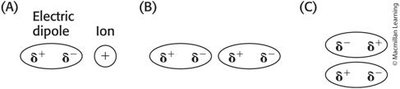
Electric dipoles can form a variety of noncovalent interactions:
Ion–Dipole Interactions: An ion interacts with the partial charges of a dipole.
Dipole–Dipole Interactions: Two dipoles align so that opposite partial charges attract.
Dipole–Induced Dipole Interactions: A dipole induces a dipole in a nearby nonpolar molecule, leading to attraction.
Hydrogen Bonding
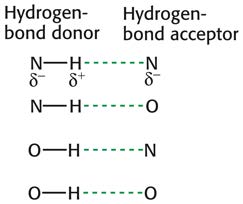
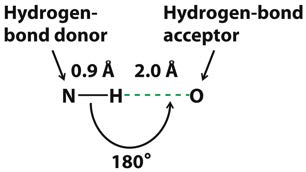
Hydrogen bonds are a key stabilizing force in biological molecules, especially in protein secondary structures and nucleic acids. They occur when a hydrogen atom covalently bonded to an electronegative atom (donor) interacts with another electronegative atom (acceptor).
Donor: N–H or O–H group
Acceptor: N or O atom with a lone pair
Geometry: Strongest when the donor, hydrogen, and acceptor are colinear (180° angle)
Hydrogen Bonding in Water
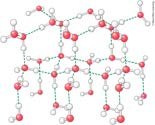
Hydrogen bonding gives water its unique properties, such as high boiling point, surface tension, and solvent capabilities. In biological systems, water can compete with intramolecular hydrogen bonds, influencing protein folding and stability.
Summary Table: Types of Noncovalent Interactions
Type of Interaction | Participants | Relative Strength | Biological Importance |
|---|---|---|---|
Electrostatic (Ionic) | Charged groups/ions | Strongest (noncovalent) | Stabilizes protein structure, enzyme-substrate binding |
Hydrogen Bond | H bonded to N/O, acceptor N/O | Moderate | Protein secondary structure, DNA base pairing |
van der Waals | All atoms | Weakest | Fine-tunes molecular fit, stabilizes macromolecules |
Hydrophobic Effect | Nonpolar molecules | Variable | Protein folding, membrane formation |
