 Indietro
Protein Function and Enzyme Kinetics: Structured Study Notes
Guida di studio - Note intelligenti
 Appunti personalizzati basati sui tuoi materiali, ampliati con definizioni chiave, esempi e contesto.
Protein Function: Enzymes and Catalysis
Introduction to Enzymes
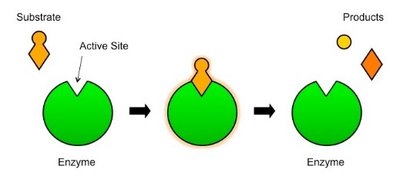
Enzymes are biological catalysts, typically globular proteins, that accelerate the rate of chemical reactions without being consumed in the process. They are essential for maintaining life by facilitating reactions under mild cellular conditions.
Enzyme Definition: Globular proteins that speed up reactions by lowering the activation energy.
Ribozyme: RNA molecules with catalytic activity.
Substrate: The reactant that binds to the enzyme's active site.
Active Site: The region of the enzyme where substrate binding and catalysis occur.
Example: Hexokinase uses ATP to convert glucose into glucose-6-phosphate during glycolysis.
Enzymes and Reaction Equilibrium
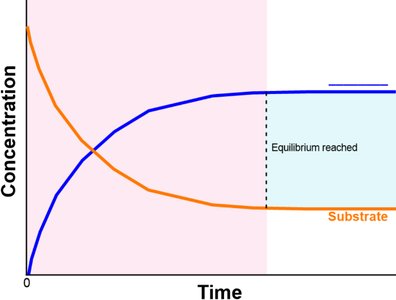
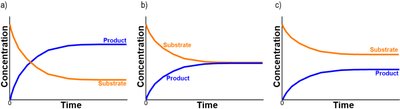
Enzymes do not alter the equilibrium constant (Keq) or the thermodynamic favorability (ΔG) of a reaction. Instead, they accelerate the rate at which equilibrium is reached.
Key Point: Enzymes only help reactions reach equilibrium faster; they do not convert 100% of substrate to product.
Equilibrium Constant (Keq): Indicates the ratio of product to substrate at equilibrium.
Enzyme Mechanism and Catalysis
Lowering Activation Energy
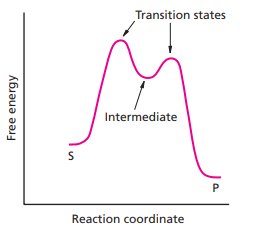
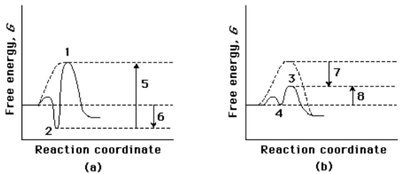
Enzymes speed up reactions by lowering the activation energy (EA or ΔG‡), which is the energy barrier between substrates and the transition state.
Activation Energy (EA): The energy required to initiate a reaction.
Transition State (‡): An unstable, high-energy intermediate.
Enzyme Effect: Enzymes stabilize the transition state, lowering EA and increasing reaction rate.
Enzymes do NOT affect: ΔG (thermodynamic favorability) or Keq (equilibrium constant).
Enzyme-Substrate Complex and Binding Energy
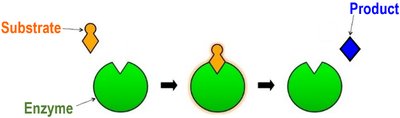
The enzyme-substrate (ES) complex is a transient intermediate formed when an enzyme binds its substrate. Binding energy (ΔGB) is the energy released from noncovalent interactions in the ES complex, which helps stabilize the transition state.
ES Complex: Intermediate formed during catalysis.
Binding Energy (ΔGB): Energy difference between uncatalyzed and catalyzed transition states.
Driving Force: Weak noncovalent forces provide the driving force for catalysis.
Models of Enzyme-Substrate Specificity
Lock & Key vs. Induced Fit Models
Enzyme-substrate specificity is explained by two main models:
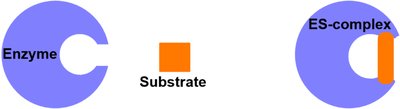
Lock & Key Model: The active site is rigid and complementary to the substrate shape, like a puzzle piece.
Induced Fit Model: The active site is flexible and adjusts to better fit and stabilize the transition state.
Modern View: Induced fit is more likely for catalysis, as it prioritizes transition state stabilization and lowers EA.
Optimal Enzyme Conditions
Optimal pH and Temperature
Enzymes require specific conditions for optimal activity, including pH and temperature. Each enzyme has its own optimal pH and temperature, which affects its catalytic efficiency.
Optimal pH: Most enzymes have a pH at which they are most active. Changes in pH can alter ionizable amino acids and denature the enzyme.
Optimal Temperature: Enzymes also have a temperature at which they are most active. Too high or too low temperatures can reduce activity or denature the enzyme.

Enzyme Kinetics
Reaction Rate and Initial Velocity
Reaction rate (v) is the speed at which a reaction proceeds, typically measured as the change in product concentration over time. Initial velocity (V0) is measured at the beginning of a reaction when substrate concentration is highest and reverse reaction is negligible.
Reaction Rate (v): Expressed in units of concentration per time (e.g., M/s).
Initial Velocity (V0): The best chance for a reaction to approach its maximum velocity (Vmax).
Michaelis-Menten Kinetics
The Michaelis-Menten equation describes the relationship between initial velocity (V0), substrate concentration ([S]), maximum velocity (Vmax), and the Michaelis constant (Km):
Michaelis-Menten Equation:
Km: Substrate concentration at which V0 = ½ Vmax; measures enzyme affinity for substrate.
Vmax: Maximum reaction velocity at saturating substrate concentration.
Lineweaver-Burk Plot
The Lineweaver-Burk plot is a double reciprocal plot used to determine Vmax and Km graphically:
Lineweaver-Burk Equation:
Y-intercept: 1/Vmax
X-intercept: -1/Km
Enzyme Inhibition
Types of Enzyme Inhibitors
Enzyme inhibitors are compounds that decrease enzyme activity. They are classified as irreversible or reversible, with reversible inhibitors further divided into competitive, uncompetitive, mixed, and noncompetitive types.
Irreversible Inhibitors: Bind tightly and permanently to the enzyme, inactivating it.
Reversible Inhibitors: Bind loosely and temporarily, allowing enzyme activity to be restored.
Competitive Inhibitors: Compete with substrate for the active site; increase Km but do not affect Vmax.
Uncompetitive Inhibitors: Bind only to the ES complex; decrease both Km and Vmax.
Mixed Inhibitors: Bind to either free enzyme or ES complex; affect both Km and Vmax variably.
Noncompetitive Inhibitors: Bind to allosteric sites on both free enzyme and ES complex; decrease Vmax but do not affect Km.
Allosteric Regulation
Allosteric Enzymes and Effectors
Allosteric enzymes are regulated by molecules called allosteric effectors, which bind to sites other than the active site and modulate enzyme activity. These enzymes often display sigmoidal (S-shaped) kinetics and are critical in metabolic pathways.
Allosteric Effectors: Can be activators (+) or inhibitors (-), and are classified as homotropic (substrate itself) or heterotropic (different molecule).
Cooperativity: Binding of one substrate molecule affects the binding of others, leading to positive or negative cooperativity.
Post-Translational Modifications
Regulation of Enzyme Activity
Enzyme activity can be regulated by post-translational modifications such as phosphorylation, methylation, acetylation, ubiquitination, and proteolytic cleavage. These modifications alter enzyme function, stability, or localization.
Phosphorylation: Addition of phosphate groups, often mediated by kinases and reversed by phosphatases.
Ubiquitination: Attachment of ubiquitin to target proteins, marking them for degradation by proteasomes.
Proteolytic Cleavage: Activation of zymogens (inactive enzyme precursors) by cleavage of peptide bonds.
Summary Table: Types of Enzyme Inhibition
Type | Binding Site | Km Change | Vmax Change | Michaelis-Menten Plot | Lineweaver-Burk Plot |
|---|---|---|---|---|---|
Competitive | Active site (free enzyme) | Increase | No change | Curve shifts right | Slope increases, x-intercept changes |
Uncompetitive | ES complex | Decrease | Decrease | Curve shifts down | Parallel lines |
Mixed | Free enzyme or ES complex | Increase or decrease | Decrease | Curve shifts variably | Slope and intercepts change |
Noncompetitive | Allosteric site (E and ES) | No change | Decrease | Curve shifts down | Slope increases, x-intercept unchanged |
*Additional info: Academic context and explanations have been expanded for clarity and completeness. Only directly relevant images have been included to reinforce key concepts.*
