 Indietro
Cell Membrane Structure and Transport Mechanisms
Guida di studio - Note intelligenti
 Appunti personalizzati basati sui tuoi materiali, ampliati con definizioni chiave, esempi e contesto.
Cell Membrane Structure and Function
Overview of the Cell Membrane
The cell membrane, also known as the plasma membrane, is a selectively permeable barrier that surrounds all cells. It regulates the movement of substances into and out of the cell, maintaining homeostasis and enabling communication with the environment.
Structure: Composed primarily of a phospholipid bilayer with embedded proteins, cholesterol, and carbohydrates.
Function: Provides structural support, protection, and facilitates cell signaling and transport of materials.
Lipids and Membrane Fluidity
Membrane fluidity refers to the viscosity of the lipid bilayer, affecting the movement of proteins and lipids within the membrane.
Fluidity: The ease with which lipid molecules move within the plane of the bilayer.
Factors Affecting Fluidity:
Adding saturated fatty acid tails: Increases membrane rigidity due to straight chains that pack tightly together.
Adding unsaturated fatty acid tails: Increases fluidity because kinks in the tails prevent tight packing.
Cholesterol: Acts as a fluidity buffer, stabilizing the membrane by preventing extremes of fluidity or rigidity.
Proteins at the Membrane
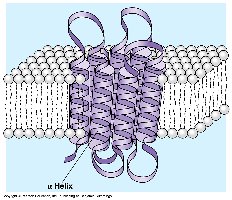
Membrane proteins perform various functions, including transport, signaling, and structural support. They are classified based on their location and association with the membrane.
Protein Type | Description of Location |
|---|---|
Integral (Transmembrane) Proteins | Span the entire membrane; have hydrophobic regions within the bilayer and hydrophilic regions exposed to aqueous environments. |
Peripheral Proteins | Loosely attached to the membrane surface, often bound to integral proteins or phospholipids. |
Hydrophobic amino acids: Found within the membrane-spanning regions, interacting with lipid tails.
Hydrophilic amino acids: Located on the exterior regions, interacting with the aqueous environment.
Carbohydrates at the Membrane
Location: Membrane-associated carbohydrates are found on the extracellular surface of the plasma membrane.
Role: Function in cell recognition, signaling, and adhesion (e.g., glycoproteins and glycolipids).
Distinguishing carbohydrates and cholesterol: Carbohydrates are attached to proteins or lipids on the membrane surface, while cholesterol is embedded within the lipid bilayer.
Transport of Solutes Across the Membrane
Passive and Active Transport
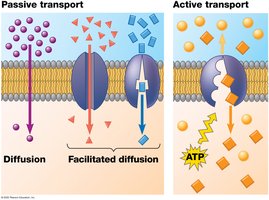
Transport across the membrane can be passive (no energy required) or active (requires energy input, usually from ATP).
Diffusion (Passive Transport)
Definition: Movement of molecules from an area of higher concentration to an area of lower concentration (down the concentration gradient).
Equilibrium: Diffusion continues until dynamic equilibrium is reached, where concentrations are equal on both sides.
Simple Diffusion
Energy needed? No
Proteins needed? No
Molecules transported: Small, nonpolar molecules (e.g., O2, CO2)
Facilitated Diffusion
Energy needed? No
Proteins needed? Yes
Types of proteins:
Channel proteins: Form hydrophilic pores for specific molecules or ions (analogy: tunnel).
Carrier proteins: Change shape to move substances across the membrane (analogy: revolving door).
Active Transport of Solutes
Definition: Movement of molecules against their concentration gradient (from low to high concentration), requiring energy input.
Importance: Maintains concentration gradients essential for cellular processes (e.g., nerve impulses, nutrient uptake).
Pumps
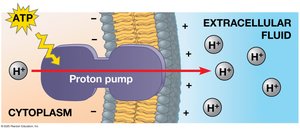
Active transport is often carried out by protein pumps that use ATP to move ions or molecules.
Proton Pump
Molecule | # in Cytosol | Arrow on Diagram | # Extracellular Side | Up or Down Gradient | Active or Passive |
|---|---|---|---|---|---|
H+ | Lower | Outward | Higher | Up | Active |
Na+/K+ Pump
Molecule | More or Less in Cytosol | Arrow on Diagram | More or Less in Extracellular Side | Up or Down Gradient | Active or Passive |
|---|---|---|---|---|---|
Na+ | Less | Outward | More | Up | Active |
K+ | More | Inward | Less | Up | Active |
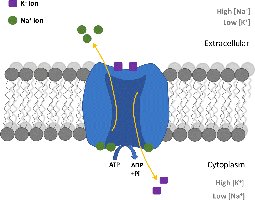
Charge difference: The extracellular side becomes more positively charged due to the export of Na+.
Role of ATP: ATP provides energy for the conformational change in the pump, enabling ion transport.
Coupled Transport (Cotransport)
Molecule | # in Cytosol | Arrow on Diagram | # Outside Cell | Up or Down Gradient | Active or Passive |
|---|---|---|---|---|---|
Sucrose | Lower | Inward | Higher | Up | Active |
H+ | Lower | Inward | Higher | Down | Passive |
Direct energy source for sucrose transport: The H+ gradient (potential energy) drives sucrose uptake.
How H+ gradient is made: By the proton pump using ATP.
Osmosis
Definition and Mechanism
Osmosis: The diffusion of water molecules across a selectively permeable membrane.
Types of water movement: Simple diffusion and facilitated diffusion (via aquaporins).
Water channel name: Aquaporin
Osmosis Vocabulary
Sketches | Solute Concentration | Water Concentration | Solution Type |
|---|---|---|---|
Arrow toward cell | Lower outside | Higher outside | Hypotonic |
No net movement | Equal | Equal | Isotonic |
Arrow out of cell | Higher outside | Lower outside | Hypertonic |
Solutions of equal concentrations: Isotonic
Osmosis in Animal and Plant Cells
Type of Cell | Hypotonic | Isotonic | Hypertonic |
|---|---|---|---|
Animal | Cell swells and may burst (lysis) | Normal (preferred) | Cell shrinks (crenation) |
Plant | Cell becomes turgid (preferred) | Flaccid | Plasmolysis (membrane pulls away from wall) |
Plant cell structure preventing excess water uptake: Cell wall
Plant cell structure storing water and solutes: Central vacuole (creates turgor pressure)
Bulk Transport
Mechanisms of Bulk Transport
Definition: Movement of large particles or volumes of substances across the membrane via vesicles.
Energy requirement: Yes, bulk transport requires energy (ATP).
Exocytosis
Vesicles fuse with the plasma membrane to release contents outside the cell (e.g., secretion of hormones).
Endocytosis
Cell takes in substances by forming vesicles from the plasma membrane.
Types of Endocytosis
Phagocytosis: "Cell eating"; cell engulfs large particles or cells (e.g., white blood cells engulfing bacteria).
Pinocytosis: "Cell drinking"; cell engulfs extracellular fluid and dissolved solutes.
Receptor-mediated endocytosis: Specific molecules are taken in after binding to receptors on the cell surface.
Additional info: Where original notes were incomplete, standard textbook explanations and terminology were added for clarity and completeness.
