 Indietro
Chapter 10: Photosynthesis – Harnessing Sunlight to Make Carbohydrates
Guida di studio - Note intelligenti
 Appunti personalizzati basati sui tuoi materiali, ampliati con definizioni chiave, esempi e contesto.
Photosynthesis: The Foundation of Life
Introduction to Photosynthesis
Photosynthesis is a fundamental biological process by which autotrophic organisms, such as plants, algae, and some bacteria, convert sunlight into chemical energy. This process sustains life on Earth by producing carbohydrates and oxygen, which are essential for heterotrophic organisms.
Autotrophs (“self-feeders”): Organisms capable of synthesizing their own food from inorganic substances using sunlight.
Heterotrophs (“different-feeders”): Organisms that must obtain organic molecules by consuming other organisms.
Photosynthesis requires sunlight, carbon dioxide (CO2), and water (H2O).
Produces oxygen (O2) as a by-product.
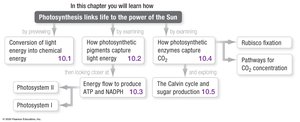
Chapter Roadmap: Linking Life to the Power of the Sun
This chapter explores how photosynthesis connects the energy of the sun to life on Earth. Key topics include the conversion of light energy, the function of photosynthetic pigments, the role of photosynthetic enzymes, and the Calvin cycle.
Conversion of light energy into chemical energy
How photosynthetic pigments capture light energy
Energy flow to produce ATP and NADPH
The Calvin cycle and sugar production
Rubisco fixation and pathways for CO2 concentration
10.1 Photosynthesis Harnesses Sunlight to Make Carbohydrates
Overview of Photosynthesis
Photosynthesis is the process by which electromagnetic energy from sunlight is converted into chemical energy stored in carbohydrates. The overall reaction is essentially the reverse of cellular respiration.
General equation for photosynthesis:
Sunlight provides the energy needed to drive the reaction.
CO2 and H2O are the reactants; glucose and O2 are the products.
Two Linked Sets of Reactions
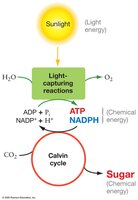
Photosynthesis consists of two interconnected sets of reactions: the light-capturing reactions and the Calvin cycle reactions.
Light-capturing reactions: Occur in the thylakoid membranes; water is split to form O2, and electrons are excited by light energy. High-energy electrons are transferred to NADP+, forming NADPH.
Calvin cycle reactions: Occur in the stroma; use ATP and NADPH to reduce CO2 to sugar, regenerating ADP, Pi, and NADP+ for the photosystems.
Photosynthetic Pathways and Mechanisms
Photosystems and Electron Flow
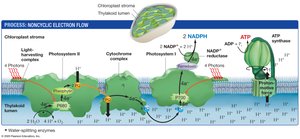
Photosynthesis involves two main photosystems (Photosystem II and Photosystem I) embedded in the thylakoid membrane. These photosystems work together to capture light energy and drive the flow of electrons, resulting in the production of ATP and NADPH.
Photosystem II: Initiates the splitting of water and the release of O2. Electrons are transferred through an electron transport chain, generating a proton gradient used to synthesize ATP.
Photosystem I: Receives electrons from Photosystem II and further excites them with light energy. These high-energy electrons reduce NADP+ to NADPH.
ATP synthase: Utilizes the proton gradient to produce ATP from ADP and Pi.
The Calvin Cycle
The Calvin cycle is the set of reactions that use ATP and NADPH produced by the light-capturing reactions to reduce CO2 and synthesize sugars. It also regenerates ADP, Pi, and NADP+ for continued photosynthetic activity.
Key steps: Carbon fixation, reduction, and regeneration.
Rubisco: The enzyme responsible for carbon fixation in the Calvin cycle.
Products: Sugar (chemical energy), ADP, Pi, and NADP+.
Summary Table: Photosynthesis Components
Component | Location | Main Function |
|---|---|---|
Light-capturing reactions | Thylakoid membrane | Produce ATP, NADPH, and O2 |
Calvin cycle | Chloroplast stroma | Reduce CO2 to sugar |
Photosystem II | Thylakoid membrane | Splits water, releases O2, initiates electron flow |
Photosystem I | Thylakoid membrane | Produces NADPH |
ATP synthase | Thylakoid membrane | Synthesizes ATP |
Key Terms and Concepts
Autotroph: An organism that produces its own food from inorganic substances.
Heterotroph: An organism that obtains food by consuming other organisms.
Photosystem: A complex of proteins and pigments that captures light energy.
Calvin cycle: The set of reactions that convert CO2 into sugar using ATP and NADPH.
ATP: Adenosine triphosphate, the primary energy carrier in cells.
NADPH: Nicotinamide adenine dinucleotide phosphate, an electron carrier used in photosynthesis.
Rubisco: The enzyme responsible for carbon fixation in the Calvin cycle.
Example: Application of Photosynthesis
Photosynthesis is essential for the survival of most life forms. Plants use photosynthesis to produce glucose, which serves as an energy source for themselves and for heterotrophic organisms that consume them. Oxygen released during photosynthesis is vital for aerobic respiration in animals and other organisms.
Additional info: The notes expand on brief points by providing definitions, context, and a summary table for clarity. The images included directly reinforce the explanation of photosynthetic processes and mechanisms.
