 Indietro
Diversity and Evolution of Prokaryotes and Protists (Chapters 27 & 28)
Guida di studio - Note intelligenti
 Appunti personalizzati basati sui tuoi materiali, ampliati con definizioni chiave, esempi e contesto.
Chapter 27: Bacteria and Archaea
Overview of the Three Domains of Life
The three domains of life—Bacteria, Archaea, and Eukarya—represent the broadest divisions in the tree of life. Each domain is defined by unique structural, genetic, and biochemical characteristics.
Bacteria: Prokaryotic, cell walls contain peptidoglycan, diverse metabolic pathways.
Archaea: Prokaryotic, cell walls lack peptidoglycan, unique membrane lipids, often extremophiles.
Eukarya: Eukaryotic, membrane-bound organelles, includes protists, fungi, plants, and animals.
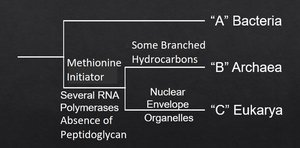
Key distinguishing features:
Feature | Bacteria | Archaea | Eukarya |
|---|---|---|---|
Cell Type | Prokaryotic | Prokaryotic | Eukaryotic |
Cell Wall | Peptidoglycan | No peptidoglycan | Varies (cellulose, chitin, or none) |
Membrane Lipids | Unbranched hydrocarbons | Some branched hydrocarbons | Unbranched hydrocarbons |
RNA Polymerases | One kind | Several kinds | Several kinds |
Initiator Amino Acid | Formyl-methionine | Methionine | Methionine |
Organelles | Absent | Absent | Present |
Example: Archaea are often found in extreme environments such as hot springs (thermophiles) or high-salinity waters (halophiles).
Prokaryote Diversity and Phylogeny
Prokaryotes are highly diverse and occupy nearly every habitat on Earth. Phylogenetic trees (cladograms) are used to illustrate evolutionary relationships among major groups.
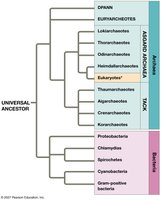
Ongoing research continues to refine our understanding of the evolutionary relationships among prokaryotes and eukaryotes.
Major Groups of Bacteria
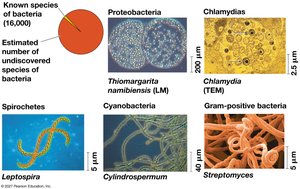
Bacteria are classified into several major groups based on genetic and phenotypic characteristics.
Proteobacteria (e.g., Thiomargarita namibiensis)
Chlamydias (e.g., Chlamydia)
Spirochetes (e.g., Leptospira)
Cyanobacteria (e.g., Cylindrospermum)
Gram-positive bacteria (e.g., Streptomyces)
Prokaryote Structure
Prokaryotes are unicellular organisms with simple cell structure, lacking membrane-bound organelles. Their cell walls provide shape and protection.
Size: Typically 1–5 µm, but some (e.g., Thiomargarita namibiensis) can be much larger.
Chromosomes: Circular DNA, often with plasmids.
Cell Wall: Bacteria have peptidoglycan; Archaea have chemically distinct walls.
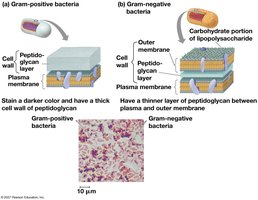
Gram-positive bacteria have thick peptidoglycan layers, while Gram-negative bacteria have a thin peptidoglycan layer and an outer membrane.
Motility and Internal Structures
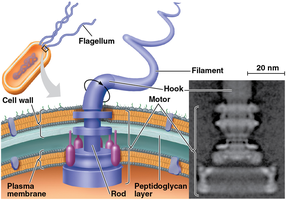
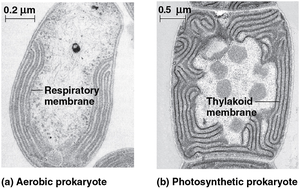
Many prokaryotes are motile, moving by means of flagella, which are structurally distinct from eukaryotic flagella. Some prokaryotes have specialized internal membranes for metabolic functions.
Genetic Material and Genome Organization
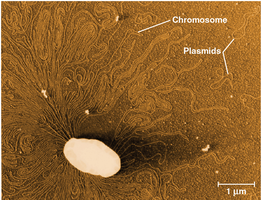
Prokaryotic genomes are compact, with circular DNA and often additional plasmids. Bacterial DNA is typically "naked" (not associated with histones), though some Archaea have histone-like proteins.
Growth, Reproduction, and Genetic Variation
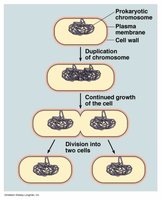
Prokaryotes reproduce asexually by binary fission, allowing for rapid population growth. Despite asexual reproduction, genetic variation arises through mutations and genetic recombination.
Binary Fission: Simple cell division process.
Genetic Variation: High mutation rates and large population sizes contribute to diversity.
Genetic Recombination: Occurs via transformation, transduction, and conjugation.
Transformation: Uptake of foreign DNA from the environment. Transduction: Transfer of DNA by bacteriophages. Conjugation: Direct transfer of DNA between cells via a pilus.
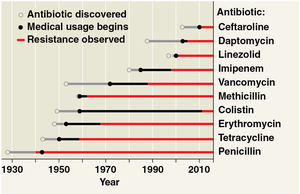
Antibiotic Resistance
Antibiotic resistance arises through genetic variation and selection. Resistance genes can spread rapidly in bacterial populations, posing a major public health challenge.
Nutritional Modes of Prokaryotes
Prokaryotes display diverse nutritional strategies, classified by energy and carbon sources.
Mode | Energy Source | Carbon Source | Example |
|---|---|---|---|
Photoautotroph | Light | CO2 | Cyanobacteria |
Chemoautotroph | Inorganic chemicals | CO2 | Sulfolobus |
Photoheterotroph | Light | Organic compounds | Rhodobacter |
Chemoheterotroph | Organic compounds | Organic compounds | Most bacteria |
Ecological Roles and Symbiosis
Prokaryotes are essential to ecosystems as decomposers, nitrogen fixers, and symbionts. Many form mutualistic or commensal relationships with other organisms, including humans (the microbiome).
Chapter 28: Protists
Defining Protists and Their Diversity
Protists are a diverse group of mostly unicellular eukaryotes. They are not a monophyletic group, meaning they do not all share a single common ancestor exclusive to them. Instead, protists are spread across several major eukaryotic lineages.
Unifying features: Eukaryotic, mostly unicellular, highly diverse in form and function.
Not monophyletic: The kingdom Protista is paraphyletic or polyphyletic.
Major Supergroups of Protists
Modern classification divides protists into four "supergroups" based on molecular and morphological evidence:
Excavata: Characterized by an "excavated" feeding groove; includes diplomonads, parabasalids, and euglenozoans.
SAR: Includes Stramenopiles, Alveolates, and Rhizarians; defined by DNA similarities.
Archaeplastida: Includes red algae, green algae, and plants; plastids originated from cyanobacterial endosymbionts.
Unikonta: Includes amoebozoans and opisthokonts (animals, fungi, and related protists).
Diversity of Nutrition, Movement, and Reproduction
Protists exhibit a wide range of nutritional modes, movement mechanisms, and reproductive strategies.
Nutrition: Photoautotrophs (e.g., algae), heterotrophs (e.g., amoebas), mixotrophs (e.g., Euglena).
Movement: Flagella (e.g., Euglena), cilia (e.g., Paramecium), pseudopodia (e.g., Amoeba).
Reproduction: Asexual (binary fission), sexual (gamete fusion), alternation of generations.
Examples: Dinoflagellates cause red tides; Plasmodium (malaria parasite) has a complex life cycle involving two hosts.
Why Protista Is Not Monophyletic
The traditional kingdom Protista is not monophyletic because its members are more closely related to plants, animals, or fungi than to each other. This is reflected in the modern supergroup classification.
Summary Table: Key Features of Major Protist Supergroups
Supergroup | Key Features | Examples |
|---|---|---|
Excavata | Feeding groove, modified mitochondria | Euglena, Giardia |
SAR | DNA similarities, diverse forms | Diatoms, Paramecium, Plasmodium |
Archaeplastida | Plastids from cyanobacteria | Red algae, green algae, plants |
Unikonta | Amoeboid movement, includes animals/fungi | Amoeba, slime molds, animals, fungi |
Life Cycles in Protists
Protists have diverse life cycles, including:
Zygotic life cycle: Haploid cells become gametes, fuse to form zygotes (e.g., Plasmodium).
Alternation of generations: Alternation between multicellular haploid and diploid forms (e.g., many algae).
Additional info: The diversity of protists makes them important models for studying eukaryotic evolution and cellular complexity.
