 Indietro
Membrane Structure and Function: Study Notes for General Biology
Guida di studio - Note intelligenti
 Appunti personalizzati basati sui tuoi materiali, ampliati con definizioni chiave, esempi e contesto.
Membrane Structure & Function
Overview of the Plasma Membrane
The plasma membrane is the boundary that separates the living cell from its surroundings. It is selectively permeable, allowing certain substances to pass while restricting others. This selective permeability is essential for maintaining cellular homeostasis.
Cellular membranes are primarily composed of amphipathic phospholipids and proteins, with carbohydrates and other lipids also playing important roles.
Phospholipids form a bilayer: hydrophobic tails face inward, hydrophilic heads face outward toward water.
Hydrophilic regions of membrane proteins are oriented toward the cytosol and extracellular fluid.
The fluid mosaic model describes the membrane as a mosaic of proteins floating in a fluid phospholipid bilayer.
Membranes are held together mainly by weak hydrophobic interactions, allowing lateral movement of lipids and some proteins.
Membrane Fluidity
Membrane fluidity is influenced by temperature, fatty acid composition, and cholesterol content.
As temperature decreases, membranes transition from fluid to solid.
Membranes rich in unsaturated fatty acids are more fluid; those rich in saturated fatty acids are less fluid.
Cholesterol acts as a fluidity buffer in animal cells: restrains movement at high temperatures, prevents tight packing at low temperatures.
Plants use related steroid lipids to regulate membrane fluidity.
Membrane Proteins
Membrane proteins are essential for various functions, including transport, cell recognition, and signaling.
Peripheral proteins are bound to the membrane surface.
Integral proteins penetrate the hydrophobic core; transmembrane proteins span the entire membrane.
Hydrophobic regions of integral proteins often consist of nonpolar amino acids coiled into α helices.
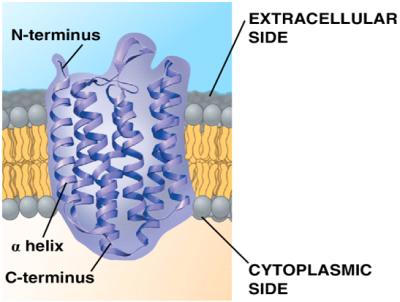
Cell recognition occurs via binding to molecules on the membrane surface, often involving carbohydrates attached to lipids (glycolipids) or proteins (glycoproteins).
Selective Permeability of the Lipid Bilayer
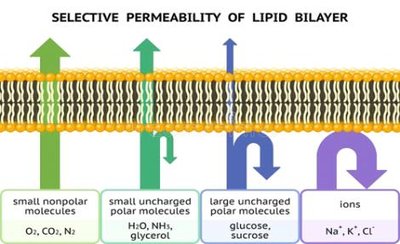
The plasma membrane regulates molecular traffic based on the chemical properties of substances.
Small, hydrophobic (nonpolar) molecules (e.g., hydrocarbons, CO2, O2) pass rapidly through the membrane.
Hydrophilic (polar) molecules (e.g., sugars, water, ions) pass slowly or not at all.
Transport Proteins
Transport proteins facilitate the movement of hydrophilic substances across the membrane.
Channel proteins provide hydrophilic tunnels for specific molecules or ions.
Aquaporins are channel proteins that increase water transport.
Carrier proteins bind to molecules and change shape to shuttle them across.
Diffusion and Osmosis
Diffusion is the movement of particles from high to low concentration, leading to equilibrium. Osmosis is the diffusion of water across a selectively permeable membrane.
At equilibrium, molecules cross the membrane equally in both directions.
Water Balance of Cells
Cells Without Cell Walls
Tonicity describes the effect of solute concentration on water movement:
Isotonic: Equal solute concentration inside and outside; water diffuses equally.
Hypertonic: Higher solute concentration outside; cell loses water.
Hypotonic: Lower solute concentration outside; cell gains water.
Organisms use osmoregulation to control water and solute balance.
Cells With Cell Walls (Plants)
In hypotonic solutions, plant cells become turgid (firm) due to water uptake and turgor pressure.
In isotonic solutions, plant cells become flaccid (limp).
In hypertonic solutions, plant cells undergo plasmolysis (membrane pulls away from wall).
Facilitated Diffusion
Facilitated diffusion uses transport proteins to speed passive movement of molecules across the membrane.
Includes channel and carrier proteins.
Ion channels allow ions to pass; some are gated channels that respond to stimuli.
Carrier proteins change shape to move solutes down their concentration gradient; no energy required.
Active Transport
Active transport moves substances against their concentration gradients, requiring energy (usually ATP).
Allows cells to maintain internal concentrations different from the environment.
Example: Sodium-potassium pump uses ATP to move K+ in and Na+ out.
Membrane potential is created by ion distribution; inside is negative relative to outside.
The electrochemical gradient combines chemical and electrical forces driving ion diffusion.
Equation for membrane potential:
Bulk Transport: Exocytosis and Endocytosis
Large molecules cross the membrane via vesicles in processes called exocytosis and endocytosis.
Exocytosis: Vesicles fuse with the membrane to release contents outside the cell.
Endocytosis: Cell takes in macromolecules by forming vesicles from the membrane.
Phagocytosis: Cell engulfs particles, forming a food vacuole.
Pinocytosis: Cell "gulps" extracellular fluid; nonspecific uptake.
Receptor-mediated endocytosis: Specific solute binding triggers vesicle formation; receptors are recycled.
Example: Cholesterol uptake by cells occurs via receptor-mediated endocytosis.
