 Indietro
Photosynthesis and Cellular Respiration: Core Concepts and Mechanisms
Guida di studio - Note intelligenti
 Appunti personalizzati basati sui tuoi materiali, ampliati con definizioni chiave, esempi e contesto.
Photosynthesis
Introduction to Photosynthesis
Photosynthesis is the process by which autotrophic organisms, such as plants, algae, and some bacteria, convert light energy into chemical energy stored in carbohydrates. This process is fundamental to life on Earth, providing the organic molecules and oxygen required by most living organisms.
Autotrophs: Organisms that produce organic molecules from CO2 and other inorganic materials. They are also known as producers.
Heterotrophs: Organisms that consume organic compounds produced by other organisms. They are known as consumers.
Photoautotrophs: Use light as an energy source (e.g., plants, algae, cyanobacteria).
Chemoautotrophs: Harvest energy from inorganic substances (e.g., some bacteria).

Chloroplast Structure and Function
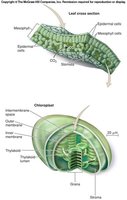
Photosynthesis occurs in the chloroplasts, which contain internal membranes called thylakoids, often stacked into grana. The fluid surrounding the thylakoids is the stroma, where the Calvin cycle takes place.
Thylakoids: Site of the light-dependent reactions.
Stroma: Site of the Calvin cycle (light-independent reactions).
Overview of Photosynthesis
The overall chemical equation for photosynthesis is:
Light-dependent reactions: Convert solar energy to chemical energy (ATP and NADPH), releasing O2 as a byproduct.
Calvin cycle (light-independent reactions): Use ATP and NADPH to reduce CO2 to carbohydrate (G3P, a precursor to glucose).
The Light Reactions
Light reactions occur in the thylakoid membranes and involve the absorption of light by pigments, primarily chlorophylls, which excites electrons and initiates electron transport chains.
Photosystems: Complexes of pigments and proteins that capture light energy (Photosystem II and Photosystem I).
Electron Transport Chain (ETC): Transfers excited electrons, generating a proton gradient used to produce ATP (photophosphorylation).
NADP+ reduction: Electrons are ultimately transferred to NADP+, forming NADPH.
Photosynthetic Pigments
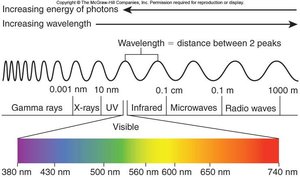
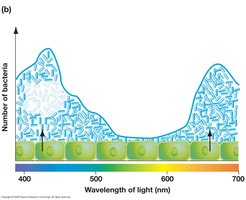
Pigments absorb specific wavelengths of light. Chlorophyll a and b absorb mainly blue and red light, while carotenoids absorb other wavelengths, extending the range of light usable for photosynthesis and protecting chlorophyll from damage.
Action spectrum: Shows the effectiveness of different wavelengths in driving photosynthesis.
Absorption spectrum: Shows which wavelengths are absorbed by each pigment.
Photosystems and Electron Flow
Photosystems I and II work together in a process called the Z scheme. Photosystem II splits water, releasing O2, and passes electrons through an ETC to Photosystem I, which then reduces NADP+ to NADPH. Cyclic electron flow can occur to produce additional ATP.
Photophosphorylation: ATP synthesis driven by light-induced proton gradients.
Oxygenic photosynthesis: Water is split to provide electrons, producing O2 as a byproduct.
The Calvin Cycle
The Calvin cycle occurs in the stroma and consists of three phases:
Carbon fixation: CO2 is attached to ribulose bisphosphate (RuBP) by the enzyme rubisco, forming 3-phosphoglycerate (3-PGA).
Reduction: 3-PGA is phosphorylated by ATP and reduced by NADPH to form glyceraldehyde-3-phosphate (G3P).
Regeneration: Some G3P is used to regenerate RuBP, enabling the cycle to continue.
Three turns of the cycle are required to produce one G3P molecule.
Photorespiration and Adaptations
Rubisco can also add O2 to RuBP, leading to photorespiration, which decreases photosynthetic efficiency. Plants have evolved adaptations to minimize photorespiration:
C3 plants: Use the Calvin cycle directly (most plants).
C4 plants: Fix CO2 into a four-carbon compound in mesophyll cells, then release CO2 in bundle-sheath cells for the Calvin cycle (e.g., corn, sugarcane).
CAM plants: Open stomata at night to fix CO2 into organic acids, which release CO2 during the day for the Calvin cycle (e.g., cacti, pineapples).
Fate of Photosynthetic Products
G3P produced by the Calvin cycle is used to synthesize glucose, fructose, and ultimately sucrose and starch. Sucrose is transported throughout the plant, while starch serves as a storage form of carbohydrate.
Cellular Respiration
Introduction to Cellular Respiration
Cellular respiration is the process by which cells extract energy from organic molecules, primarily glucose, to produce ATP. It involves a series of redox reactions and occurs in both prokaryotic and eukaryotic cells.
Overall equation:
Redox reactions: Involve the transfer of electrons; oxidation is the loss of electrons, reduction is the gain of electrons.
Stages of Cellular Respiration
Glycolysis: Occurs in the cytosol; glucose is split into two molecules of pyruvate, producing a net gain of 2 ATP and 2 NADH.
Pyruvate Processing: Pyruvate is transported into the mitochondria and converted to acetyl-CoA, producing NADH and CO2.
Krebs Cycle (Citric Acid Cycle): Acetyl-CoA is oxidized to CO2 in the mitochondrial matrix, generating NADH, FADH2, and ATP (or GTP).
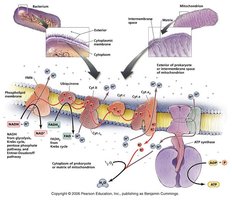
Electron Transport Chain (ETC) and Oxidative Phosphorylation: NADH and FADH2 donate electrons to the ETC, which powers ATP synthesis via chemiosmosis. Oxygen is the final electron acceptor, forming water.
ATP Production Mechanisms
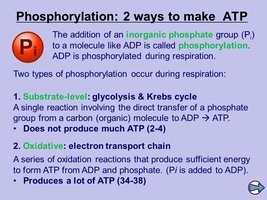
Substrate-level phosphorylation: Direct transfer of a phosphate group to ADP from a substrate (occurs in glycolysis and Krebs cycle).
Oxidative phosphorylation: ATP synthesis powered by the proton gradient generated by the ETC (main source of ATP in aerobic respiration).
Fermentation
When oxygen is not available, cells can regenerate NAD+ through fermentation, allowing glycolysis to continue. Fermentation produces much less ATP than aerobic respiration.
Lactic acid fermentation: Pyruvate is reduced to lactate (e.g., in muscle cells).
Alcohol fermentation: Pyruvate is converted to ethanol and CO2 (e.g., in yeast).
Regulation and Integration of Metabolism
Cellular respiration is tightly regulated by feedback inhibition, especially at key enzymes such as phosphofructokinase in glycolysis and enzymes in the Krebs cycle. Other macromolecules (fats, proteins) can also enter the respiration pathway at various points, and intermediates are used for biosynthesis (anabolism).
Summary Table: Comparison of Photosynthesis and Cellular Respiration
Process | Location | Inputs | Outputs | Main Purpose |
|---|---|---|---|---|
Photosynthesis | Chloroplasts | CO2, H2O, Light | Glucose, O2 | Convert light energy to chemical energy |
Cellular Respiration | Cytosol & Mitochondria | Glucose, O2 | CO2, H2O, ATP | Extract energy from organic molecules |
