 Indietro
Photosynthesis: Mechanisms, Pigments, and Adaptations
Guida di studio - Note intelligenti
 Appunti personalizzati basati sui tuoi materiali, ampliati con definizioni chiave, esempi e contesto.
Photosynthesis: An Overview
Introduction to Photosynthesis
Photosynthesis is the process by which plants, algae, and some bacteria convert light energy from the Sun into chemical energy stored in organic molecules. This process is fundamental to life on Earth, as it provides the energy and organic matter required by most living organisms.
Oxygenic photosynthesis produces oxygen and is carried out by cyanobacteria, algae, and all land plants.
Anoxygenic photosynthesis does not produce oxygen and is performed by certain groups of bacteria.

Two Sets of Reactions
Photosynthesis consists of two main sets of reactions:
Light-dependent reactions: Capture energy from sunlight to produce ATP and NADPH, and generate O2 by oxidizing water.
Carbon fixation (Light-independent reactions): Use ATP and NADPH to synthesize organic molecules from CO2.
General Equation for Photosynthesis
The overall process of photosynthesis can be summarized by the following equation:
CO2 is reduced to glucose using electrons from the oxidation of water. This equation is the reverse of cellular respiration.
Leaf and Chloroplast Structure
Organization of Photosynthetic Tissues
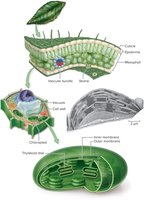
Photosynthesis primarily occurs in the leaves of plants, specifically within the mesophyll cells that contain chloroplasts. Chloroplasts are specialized organelles with an internal system of membranes called thylakoids, which are stacked into grana.
Thylakoid membrane: Contains photosynthetic pigments and enzymes for ATP synthesis.
Stroma: The fluid-filled space outside the thylakoids where the Calvin cycle occurs.
Overview of Photosynthetic Processes
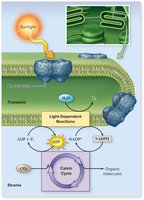
Light-dependent reactions occur in the thylakoid membrane, where sunlight is used to split water, releasing oxygen and generating ATP and NADPH. The Calvin cycle (light-independent reactions) takes place in the stroma, using ATP and NADPH to fix CO2 into organic molecules.
The Discovery of Photosynthetic Processes
Key Historical Experiments
Jan Baptista van Helmont: Demonstrated that plant mass is not derived solely from soil.
Joseph Priestly: Showed that plants add something to the air (oxygen).
Jan Ingenhousz: Proposed that sunlight is required for plants to purify air.
F.F. Blackman: Distinguished between light-dependent and light-independent reactions, showing that photosynthesis is a multistage process.
Pigments and Light Absorption
The Electromagnetic Spectrum
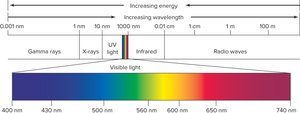
Light is a form of energy, and its energy content is inversely proportional to its wavelength. The visible spectrum (400–740 nm) is the range used in photosynthesis.
Pigments in Photosynthesis
Pigments are molecules that absorb light energy. The main pigments in green plants are:
Chlorophyll a: The primary pigment, absorbs violet-blue and red light.
Chlorophyll b: Accessory pigment, broadens the range of absorbed light.
Carotenoids: Accessory pigments that absorb different wavelengths and protect against oxidative damage.
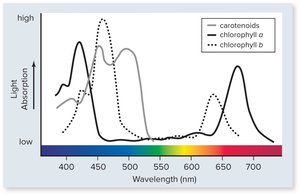
Absorption Spectrum
The absorption spectrum shows the range and efficiency of photons a pigment can absorb. Chlorophylls absorb mainly blue and red light, while carotenoids absorb in the blue-green range.
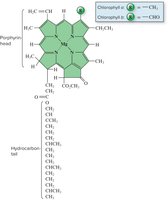
Structure of Chlorophyll
Chlorophyll molecules have a porphyrin ring with a central magnesium ion and a long hydrocarbon tail. The ring structure allows for the absorption of light and excitation of electrons.
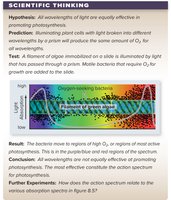
Action Spectrum
The action spectrum measures the effectiveness of different wavelengths in driving photosynthesis. It closely matches the absorption spectrum of chlorophylls.
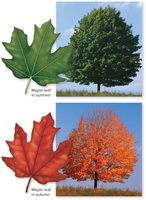
Seasonal Changes in Leaf Pigments
During autumn, chlorophyll degrades, revealing carotenoids and other pigments, which give leaves their characteristic fall colors.
Photosystem Organization and Light-Dependent Reactions
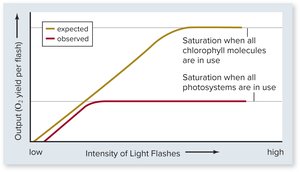
Saturation of Photosynthesis
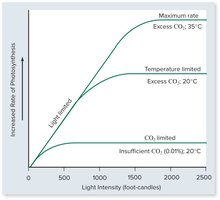
Photosynthetic output increases with light intensity up to a point, after which it plateaus due to saturation of the photosystems.
Photosystem Structure and Function
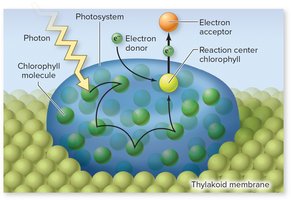
Photosystems are complexes of pigments and proteins that capture light energy. Each photosystem has:
Antenna complex: Collects photons and transfers energy to the reaction center.
Reaction center: Contains chlorophyll a molecules that transfer excited electrons to an electron acceptor.
Energy Conversion in Photosystems
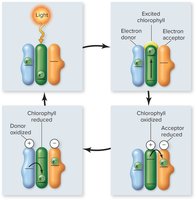
When a photon excites a chlorophyll molecule, an electron is elevated to a higher energy state and transferred to an acceptor, initiating electron transport.
Photosynthetic Electron Transport and ATP Synthesis
Electron Transport in Bacteria and Plants
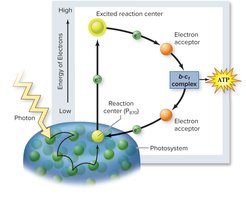
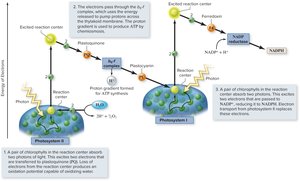
Some bacteria use a single photosystem for cyclic photophosphorylation, generating ATP but not NADPH or O2. Plants use two photosystems (I and II) in series for noncyclic photophosphorylation, producing both ATP and NADPH and releasing O2.
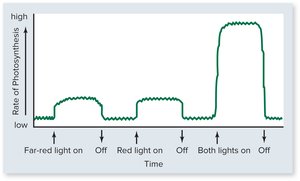
Evidence for Two Photosystems
Experiments using different wavelengths of light demonstrated the enhancement effect, supporting the existence of two photosystems working together.
Z Diagram of Photosystems I and II
The Z diagram illustrates the flow of electrons from water through photosystem II, the cytochrome b6-f complex, photosystem I, and finally to NADP+, forming NADPH. This process also generates a proton gradient used to synthesize ATP.
Photosynthetic Electron Transport Chain
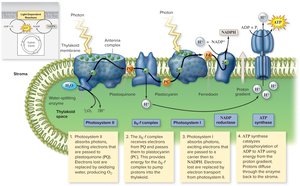
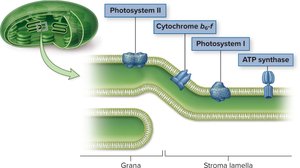
The electron transport chain in the thylakoid membrane involves the sequential action of photosystem II, the b6-f complex, photosystem I, and ATP synthase, resulting in the production of ATP and NADPH.
Experimental Evidence: The Jagendorf Acid Bath Experiment
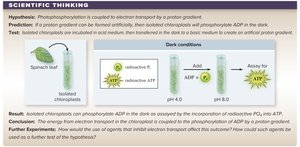
This experiment demonstrated that ATP synthesis in chloroplasts is driven by a proton gradient across the thylakoid membrane, supporting the chemiosmotic hypothesis.
Arrangement of Complexes within the Thylakoid
Photosystem II is primarily located in the grana, while photosystem I and ATP synthase are found in the stroma lamella. The cytochrome b6-f complex is found at the borders between these regions.
Carbon Fixation: The Calvin Cycle
Phases of the Calvin Cycle
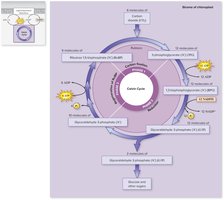
The Calvin cycle, also known as C3 photosynthesis, occurs in the stroma and consists of three phases:
Carbon fixation: CO2 is attached to ribulose 1,5-bisphosphate (RuBP) by the enzyme rubisco, forming 3-phosphoglycerate (3PG).
Reduction: 3PG is reduced to glyceraldehyde 3-phosphate (G3P) using ATP and NADPH.
Regeneration: G3P is used to regenerate RuBP, enabling the cycle to continue.
Output of the Calvin Cycle
The direct product of the Calvin cycle is G3P, a three-carbon sugar. G3P is used to synthesize glucose, sucrose, and starch for energy storage and transport in plants.
Energy Cycle in Plants
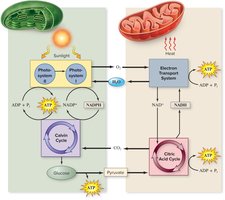
Photosynthesis and respiration are interconnected. The products of one process serve as the substrates for the other, illustrating the cyclical nature of energy flow in cells.
Photorespiration and Adaptations
Photorespiration
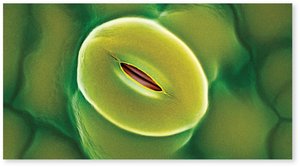
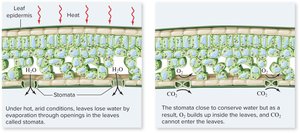
Rubisco, the enzyme responsible for carbon fixation, can also catalyze the addition of O2 to RuBP, especially under hot, dry conditions when stomata close. This process, called photorespiration, reduces the efficiency of photosynthesis by releasing CO2.
Adaptations to Minimize Photorespiration
Plants have evolved two main strategies to reduce photorespiration:
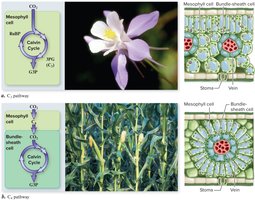
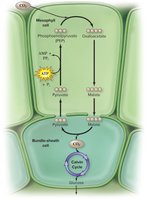
C4 pathway: Spatial separation of initial CO2 fixation and the Calvin cycle. CO2 is first fixed in mesophyll cells by PEP carboxylase, forming a 4-carbon compound that is transported to bundle-sheath cells for decarboxylation and entry into the Calvin cycle.
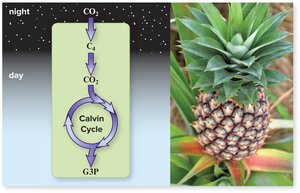
CAM pathway: Temporal separation of steps. CO2 is fixed at night and stored as organic acids, which are decarboxylated during the day to provide CO2 for the Calvin cycle.
Comparison of C3, C4, and CAM Pathways
Pathway | CO2 Fixation Site | Key Enzyme | Adaptation | Examples |
|---|---|---|---|---|
C3 | Mesophyll cells | Rubisco | Efficient under cool, moist conditions | Most plants |
C4 | Mesophyll → Bundle-sheath cells | PEP carboxylase & Rubisco | Reduces photorespiration in hot, dry climates | Corn, sugarcane |
CAM | Mesophyll cells (night/day separation) | PEP carboxylase & Rubisco | Reduces water loss, adapted to arid environments | Cacti, pineapple |
Additional info: The conversion of pyruvate back to PEP in C4 and CAM plants requires additional ATP, making these pathways more energy-intensive than C3 photosynthesis under optimal conditions.
