Ch. 16 - The Molecular Basis of Inheritance
Campbell - Campbell Biology 12th Edition
Urry12th EditionCampbell BiologyISBN: 9785794169850Non è quello che usi tu?Cambia libro di testo
Capitolo 16, Problema 9

Although the proteins that cause the E. coli chromosome to coil are not histones, what property would you expect them to share with histones, given their ability to bind to DNA (see Figure 5.14)?

Guida verificata passo dopo passo
1
Understand the role of histones: Histones are proteins that help package DNA into structural units called nucleosomes, allowing the DNA to coil and fit within the cell nucleus. They achieve this by binding to DNA, which is negatively charged due to its phosphate backbone.
Identify the key property of histones: Histones are positively charged, which allows them to interact with the negatively charged DNA. This electrostatic attraction is crucial for the binding process.
Consider the proteins in E. coli: Although E. coli does not use histones, it uses other proteins to coil its chromosome. These proteins must also be able to bind to DNA effectively.
Determine the shared property: Given the need to bind to DNA, the proteins in E. coli likely share the property of being positively charged, similar to histones. This positive charge would facilitate the binding to the negatively charged DNA.
Connect the concept: The ability to bind to DNA through electrostatic interactions is a fundamental property shared by both histones and the proteins in E. coli, despite their structural differences.

Risposta video verificata per un problema simile:

Questa soluzione video è stata consigliata dai nostri tutor come utile per risolvere questo problema.
Durata del video:
1m

Concetti chiave

Ecco i concetti essenziali che devi comprendere per rispondere correttamente alla domanda.

DNA Binding Proteins

DNA binding proteins are molecules that have the ability to attach to DNA sequences, influencing the structure and function of the DNA. These proteins often have specific domains that allow them to interact with the negatively charged phosphate backbone of DNA, facilitating processes like replication, transcription, and chromosomal organization.
Video consigliato:
02:50
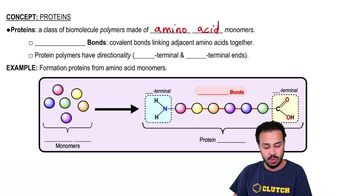
Proteins

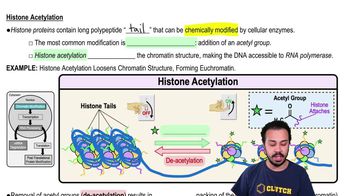
Histones

Histones are proteins that play a crucial role in the organization of DNA in eukaryotic cells. They are positively charged, which allows them to bind tightly to the negatively charged DNA, helping to package it into a compact, organized structure called chromatin. This interaction is essential for DNA stability and regulation of gene expression.
Video consigliato:
04:14
Histone Acetylation

Electrostatic Interactions

Electrostatic interactions are forces between charged particles, such as the attraction between positively charged proteins and negatively charged DNA. These interactions are fundamental in biological systems, as they help stabilize structures like the DNA-protein complexes, ensuring proper DNA packaging and accessibility for cellular processes.
Video consigliato:
04:25
Interspecific Interactions