Ch. 16 - The Molecular Basis of Inheritance
Campbell - Campbell Biology 12th Edition
Urry12th EditionCampbell BiologyISBN: 9785794169850Non è quello che usi tu?Cambia libro di testo
Capitolo 16, Problema 6

E. coli cells grown on 15N medium are transferred to 14N medium and allowed to grow for two more generations (two rounds of DNA replication). DNA extracted from these cells is centrifuged. What density distribution of DNA would you expect in this experiment?
a. One high-density and one low-density band
b. One intermediate-density band
c. One high-density and one intermediate-density band
d. One low-density and one intermediate-density band

Guida verificata passo dopo passo
1
Understand the concept of DNA replication in E. coli: E. coli cells replicate their DNA semi-conservatively, meaning each new DNA molecule consists of one old (parental) strand and one new (daughter) strand.
Consider the initial conditions: E. coli cells are initially grown in a medium containing 15N, a heavy isotope of nitrogen, which is incorporated into the DNA, making it denser.
Analyze the first generation after transfer to 14N medium: After one round of replication in the 14N medium, each DNA molecule will consist of one strand with 15N and one strand with 14N, resulting in an intermediate density.
Examine the second generation: In the second round of replication, each intermediate-density DNA molecule will replicate to produce two DNA molecules. Each will have one strand with 14N and one strand with 15N, and the new strands will be entirely 14N, resulting in one intermediate-density and one low-density DNA molecule.
Predict the density distribution: After two generations, you would expect to see one intermediate-density band (from the hybrid DNA molecules) and one low-density band (from the DNA molecules with both strands containing 14N).

Risposta video verificata per un problema simile:

Questa soluzione video è stata consigliata dai nostri tutor come utile per risolvere questo problema.
Durata del video:
1m

Concetti chiave

Ecco i concetti essenziali che devi comprendere per rispondere correttamente alla domanda.

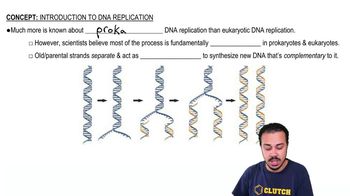
DNA Replication

DNA replication is the process by which a cell duplicates its DNA, resulting in two identical copies. It is semi-conservative, meaning each new DNA molecule consists of one original strand and one newly synthesized strand. This concept is crucial for understanding how isotopic labeling affects DNA density during replication.
Video consigliato:
03:37
Introduction to DNA Replication

Isotopic Labeling

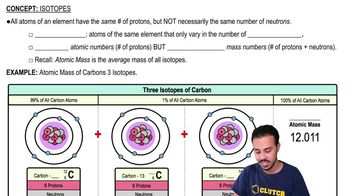
Isotopic labeling involves incorporating isotopes, such as 15N and 14N, into molecules to track biological processes. In this experiment, E. coli initially grown in 15N medium will have 'heavy' DNA, which changes density when switched to 14N medium, affecting the DNA's buoyant density during centrifugation.
Video consigliato:
06:50
Isotopes

Density Gradient Centrifugation

Density gradient centrifugation is a technique used to separate molecules based on their density. DNA molecules with different isotopic labels will form distinct bands in a centrifuge tube, allowing researchers to observe the distribution of DNA densities after replication, which is key to predicting the expected results in this experiment.
Video consigliato:
04:51
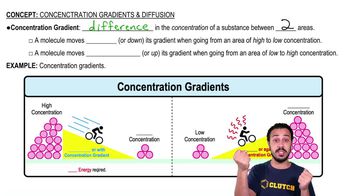
Concentration Gradients and Diffusion
Pratica correlata
Domanda del libro di testo

A biochemist isolates, purifies, and combines in a test tube a variety of molecules needed for DNA replication. When she adds some DNA to the mixture, replication occurs, but each DNA molecule consists of a normal strand paired with numerous segments of DNA a few hundred nucleotides long. What has she probably left out of the mixture?

a. DNA polymerase

b. DNA ligase

c. Okazaki fragments

d. Primase

3761
views
Domanda del libro di testo

In a nucleosome, the DNA is wrapped around

a. Histones

b. Ribosomes

c. Polymerase molecules

d. A thymine dimer

1333
views
1
rank
Domanda del libro di testo

The elongation of the leading strand during DNA synthesis

a. Progresses away from the replication fork

b. Occurs in the 3′→5′ direction

c. Produces Okazaki fragments

d. Depends on the action of DNA polymerase

1754
views
Domanda del libro di testo

The spontaneous loss of amino groups from adenine in DNA results in hypoxanthine, an uncommon base, opposite thymine. What combination of proteins could repair such damage?

a. Nuclease, DNA polymerase, DNA ligase

b. Telomerase, primase, DNA polymerase

c. Telomerase, helicase, single-strand binding protein

d. DNA ligase, replication fork proteins, adenylyl cyclase

2928
views
Domanda del libro di testo

Although the proteins that cause the E. coli chromosome to coil are not histones, what property would you expect them to share with histones, given their ability to bind to DNA (see Figure 5.14)?

767
views
Domanda del libro di testo

In analyzing the number of different bases in a DNA sample, which result would be consistent with the ­ base-pairing rules?

a. A=G

b. A+G=C+T

c. A+T=G+C

d. A=C

1571
views