
Ch. 16 - The Molecular Basis of Inheritance
Campbell - Campbell Biology 12th Edition
Urry12th EditionCampbell BiologyISBN: 9785794169850Non è quello che usi tu?Cambia libro di testo
Capitolo 16, Problema 4

The elongation of the leading strand during DNA synthesis
a. Progresses away from the replication fork
b. Occurs in the 3′→5′ direction
c. Produces Okazaki fragments
d. Depends on the action of DNA polymerase

Guida verificata passo dopo passo
1
Understand the process of DNA replication: DNA replication involves the synthesis of new DNA strands from a template strand. This occurs at the replication fork, where the DNA double helix is unwound.
Identify the role of the leading strand: During DNA replication, the leading strand is synthesized continuously in the direction of the replication fork. This is because it is oriented in the 5′ to 3′ direction, which is the direction in which DNA polymerase can add nucleotides.
Recognize the function of DNA polymerase: DNA polymerase is the enzyme responsible for adding nucleotides to the growing DNA strand. It can only add nucleotides to the 3′ end of the strand, thus synthesizing DNA in the 5′ to 3′ direction.
Differentiate between leading and lagging strands: The leading strand is synthesized continuously, while the lagging strand is synthesized in short segments called Okazaki fragments, which are later joined together.
Evaluate the options: Based on the understanding of DNA replication, determine which option correctly describes the elongation of the leading strand. Consider the direction of synthesis and the role of DNA polymerase.

Risposta video verificata per un problema simile:

Questa soluzione video è stata consigliata dai nostri tutor come utile per risolvere questo problema.
Durata del video:
26s

Concetti chiave

Ecco i concetti essenziali che devi comprendere per rispondere correttamente alla domanda.

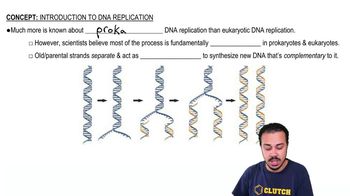
DNA Replication

DNA replication is the process by which a cell duplicates its DNA, ensuring that each daughter cell receives an exact copy of the genetic material. It involves unwinding the double helix and synthesizing new strands using the original strands as templates. This process is crucial for cell division and is highly regulated to maintain genetic fidelity.
Video consigliato:
03:37
Introduction to DNA Replication

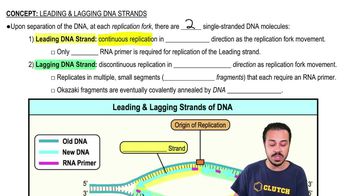
Leading Strand Synthesis

During DNA replication, the leading strand is synthesized continuously in the direction of the replication fork movement. DNA polymerase adds nucleotides in the 5′ to 3′ direction, which is complementary to the template strand. This continuous synthesis contrasts with the lagging strand, which is synthesized in short segments called Okazaki fragments.
Video consigliato:
05:15
Leading & Lagging DNA Strands

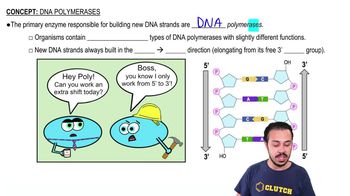
Role of DNA Polymerase

DNA polymerase is an enzyme responsible for synthesizing new DNA strands by adding nucleotides to a growing chain. It requires a primer to initiate synthesis and works in the 5′ to 3′ direction. DNA polymerase also has proofreading abilities to correct errors, ensuring high fidelity during DNA replication, which is essential for accurate genetic transmission.
Video consigliato:
04:01
DNA Polymerases
Pratica correlata
Domanda del libro di testo

A biochemist isolates, purifies, and combines in a test tube a variety of molecules needed for DNA replication. When she adds some DNA to the mixture, replication occurs, but each DNA molecule consists of a normal strand paired with numerous segments of DNA a few hundred nucleotides long. What has she probably left out of the mixture?

a. DNA polymerase

b. DNA ligase

c. Okazaki fragments

d. Primase

3761
views
Domanda del libro di testo

In a nucleosome, the DNA is wrapped around

a. Histones

b. Ribosomes

c. Polymerase molecules

d. A thymine dimer

1333
views
1
rank
Domanda del libro di testo

In his work with pneumonia-causing bacteria and mice, Griffith found that

a. The protein coat from pathogenic cells was able to transform nonpathogenic cells.

b. Heat-killed pathogenic cells caused pneumonia.

c. Some substance from pathogenic cells was transferred to nonpathogenic cells, making them pathogenic.

d. The polysaccharide coat of bacteria caused pneumonia.

1821
views
Domanda del libro di testo

E. coli cells grown on 15N medium are transferred to 14N medium and allowed to grow for two more generations (two rounds of DNA replication). DNA extracted from these cells is centrifuged. What density distribution of DNA would you expect in this experiment?

a. One high-density and one low-density band

b. One intermediate-density band

c. One high-density and one intermediate-density band

d. One low-density and one intermediate-density band

3200
views
Domanda del libro di testo

What is the basis for the difference in how the leading and lagging strands of DNA molecules are synthesized?

a. The origins of replication occur only at the 5′ end.

b. Helicases and single-strand binding proteins work at the 5′ end.

c. DNA polymerase can join new nucleotides only to the 3′ end of a pre-existing strand, and the strands are antiparallel.

d. DNA ligase works only in the 3′→5′ direction.

2538
views
1
rank
Domanda del libro di testo

In analyzing the number of different bases in a DNA sample, which result would be consistent with the ­ base-pairing rules?

a. A=G

b. A+G=C+T

c. A+T=G+C

d. A=C

1571
views