Ch. 28 - Protists
Campbell - Campbell Biology 12th Edition
Urry12th EditionCampbell BiologyISBN: 9785794169850Non è quello che usi tu?Cambia libro di testo
Capitolo 28, Problema 5

In a life cycle with alternation of generations, multicellular haploid forms alternate with
a. Unicellular haploid forms
b. Unicellular diploid forms
c. Multicellular haploid forms
d. Multicellular diploid forms

Guida verificata passo dopo passo
1
Understand the concept of alternation of generations: This is a reproductive cycle found in plants, algae, and some fungi, where there is a regular alternation between two distinct forms - one haploid and one diploid.
Identify the haploid and diploid stages: In alternation of generations, the haploid stage is known as the gametophyte, which produces gametes, and the diploid stage is known as the sporophyte, which produces spores.
Recognize the multicellular nature of these stages: Both the gametophyte and sporophyte stages are typically multicellular, meaning they consist of multiple cells working together.
Determine the correct alternation: Since the question asks about multicellular haploid forms alternating with another form, consider that the multicellular haploid gametophyte alternates with the multicellular diploid sporophyte.
Select the correct answer: Based on the understanding that multicellular haploid forms alternate with multicellular diploid forms, choose option d.

Risposta video verificata per un problema simile:

Questa soluzione video è stata consigliata dai nostri tutor come utile per risolvere questo problema.
Durata del video:
1m

Concetti chiave

Ecco i concetti essenziali che devi comprendere per rispondere correttamente alla domanda.

Alternation of Generations

Alternation of generations is a biological process in which an organism alternates between two distinct forms: a multicellular haploid phase (gametophyte) and a multicellular diploid phase (sporophyte). This cycle is common in plants, algae, and some fungi, allowing for genetic diversity through sexual reproduction.
Video consigliato:
04:09
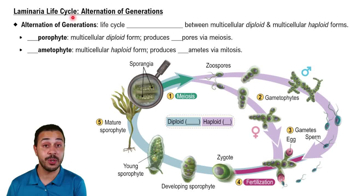
Laminaria Life Cycle: Alternation of Generations

Haploid and Diploid Forms

Haploid forms contain a single set of chromosomes (n), while diploid forms have two sets (2n). In the alternation of generations, the haploid gametophyte produces gametes, and the diploid sporophyte arises from the fusion of these gametes, leading to a new generation. Understanding these forms is crucial for grasping the life cycle dynamics.
Video consigliato:
04:14
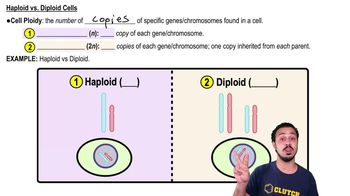
Haploid vs. Diploid Cells

Multicellular Organisms

Multicellular organisms consist of multiple cells that work together, often forming complex structures. In the context of alternation of generations, both the haploid and diploid phases are multicellular, with the gametophyte and sporophyte representing different stages of the organism's life cycle, each with distinct roles and functions.
Video consigliato:
02:09
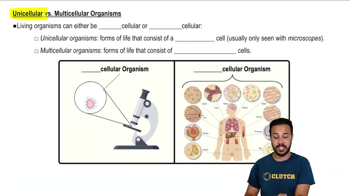
Unicellular vs. Multicellular
Pratica correlata
Domanda del libro di testo

Biologists think that endosymbiosis gave rise to mitochondria before plastids partly because

a. The products of photosynthesis could not be metabolized without mitochondrial enzymes.

b. All eukaryotes have mitochondria (or their remnants), whereas many eukaryotes do not have plastids.

c. Mitochondrial DNA is less similar to prokaryotic DNA than is plastid DNA.

d. Without mitochondrial CO2 production, photosynthesis could not occur.

2328
views
Domanda del libro di testo

Which group is correctly paired with its description?


A. diatoms—important consumers in aquatic communities

B. diplomonads—protists with modified mitochondria

C. apicomplexans—producers with intricate life cycles

D. red algae—acquired plastids by secondary endosymbiosis


401
views
Domanda del libro di testo

Based on the phylogenetic tree in Figure 28.5, which of the following statements is correct?

a. Excavata and SAR form a sister group

b. The most recent common ancestor of SAR is older than that of Unikonta

c. The most basal (first to diverge) eukaryotic supergroup cannot be determined

d. Excavata is the most basal eukaryotic supergroup

2233
views
2
rank
Domanda del libro di testo

According to the phylogeny, which protists are in the same eukaryotic supergroup as plants?

a. Green algae

b. Dinoflagellates

c. Red algae

d. Both A and C

824
views
Domanda del libro di testo

Medical researchers seek to develop drugs that can kill or restrict the growth of human pathogens yet have few harmful effects on patients. These drugs often work by disrupting the metabolism of the pathogen or by targeting its structural features.

Draw and label a phylogenetic tree that includes an ancestral prokaryote and the following groups of organisms: Excavata, SAR, Archaeplastida, Unikonta, and, within Unikonta, amoebozoans, animals, choanoflagellates, fungi, and nucleariids. Based on this tree, hypothesize whether it would be most difficult to develop drugs to combat human pathogens that are prokaryotes, protists, animals, or fungi. (You do not need to consider the evolution of drug resistance by the pathogen.)

1505
views
2
rank