Ch. 28 - Protists
Campbell - Campbell Biology 12th Edition
Urry12th EditionCampbell BiologyISBN: 9785794169850Non è quello che usi tu?Cambia libro di testo
Capitolo 28, Problema 1

Plastids that are surrounded by more than two membranes are evidence of
a. Evolution from mitochondria.
b. Fusion of plastids.
c. Origin of the plastids from archaea.
d. Secondary endosymbiosis.

Guida verificata passo dopo passo
1
Understand the concept of plastids: Plastids are organelles found in the cells of plants and algae, primarily involved in photosynthesis and storage of products like starch. They are typically surrounded by two membranes.
Learn about endosymbiosis: Endosymbiosis is a theory that explains how certain organelles, like mitochondria and plastids, originated from free-living bacteria that were engulfed by ancestral eukaryotic cells.
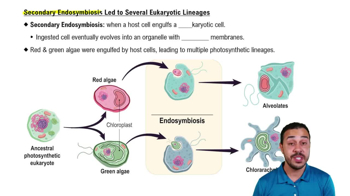
Explore secondary endosymbiosis: Secondary endosymbiosis occurs when a eukaryotic cell engulfs another eukaryotic cell that already contains plastids, leading to plastids with more than two membranes.
Analyze the options: Consider each option in the context of plastids with more than two membranes. Evolution from mitochondria (a) is unlikely as mitochondria are distinct organelles. Fusion of plastids (b) does not typically result in additional membranes. Origin from archaea (c) is not supported by current evidence.
Conclude with secondary endosymbiosis: The presence of more than two membranes around plastids is indicative of secondary endosymbiosis, where additional membranes are acquired during the engulfment process.

Risposta video verificata per un problema simile:

Questa soluzione video è stata consigliata dai nostri tutor come utile per risolvere questo problema.
Durata del video:
1m

Concetti chiave

Ecco i concetti essenziali che devi comprendere per rispondere correttamente alla domanda.

Plastids

Plastids are organelles found in the cells of plants and algae, primarily involved in photosynthesis and storage. They include chloroplasts, chromoplasts, and leucoplasts, each serving different functions. Plastids are typically surrounded by two membranes, but variations exist due to evolutionary processes.
Video consigliato:
07:56
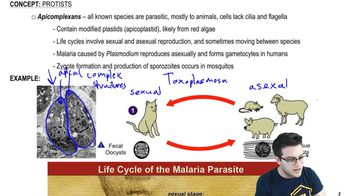
Apicomplexans

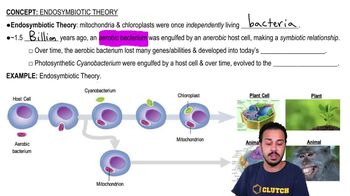
Endosymbiosis

Endosymbiosis is a theory explaining the origin of certain organelles, like mitochondria and plastids, through a symbiotic relationship where one organism lives inside another. Primary endosymbiosis involves the engulfment of a prokaryote, while secondary endosymbiosis involves a eukaryotic cell engulfing another eukaryotic cell, leading to organelles with more than two membranes.
Video consigliato:
06:58
Endosymbiotic Theory

Secondary Endosymbiosis

Secondary endosymbiosis occurs when a eukaryotic cell engulfs another eukaryotic cell that already contains plastids, resulting in plastids surrounded by more than two membranes. This process is a key evolutionary step in the diversification of algae and explains the complex membrane structures found in some plastids.
Video consigliato:
02:37
Secondary Endosymbiosis Led to Several Eukaryotic Lineages