
Ch. 36 - Resource Acquisition and Transport in Vascular Plants
Campbell - Campbell Biology 12th Edition
Urry12th EditionCampbell BiologyISBN: 9785794169850Non è quello che usi tu?Cambia libro di testo
Capitolo 36, Problema 7

Compared with a cell with few aquaporin proteins in its membrane, a cell containing many aquaporin proteins will
a. Have a faster rate of osmosis
b. Have a lower water potential
c. Have a higher water potential
d. Accumulate water by active transport

Guida verificata passo dopo passo
1
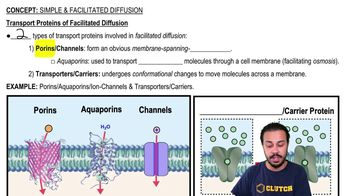
Understand the role of aquaporin proteins: Aquaporins are integral membrane proteins that serve as channels for water molecules to pass through the cell membrane. They facilitate the rapid transport of water across the membrane.
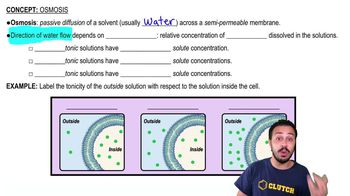
Consider the process of osmosis: Osmosis is the passive movement of water molecules from an area of higher water potential to an area of lower water potential through a selectively permeable membrane.
Analyze the effect of aquaporin quantity on osmosis: A cell with many aquaporin proteins will allow more water molecules to pass through the membrane quickly, compared to a cell with fewer aquaporins.
Evaluate the options: Since aquaporins increase the rate at which water can move across the membrane, the presence of many aquaporins would likely result in a faster rate of osmosis.
Conclude the reasoning: Based on the understanding of aquaporins and osmosis, determine which option correctly describes the effect of having many aquaporin proteins in the cell membrane.

Risposta video verificata per un problema simile:

Questa soluzione video è stata consigliata dai nostri tutor come utile per risolvere questo problema.
Durata del video:
50s

Concetti chiave

Ecco i concetti essenziali che devi comprendere per rispondere correttamente alla domanda.

Aquaporins

Aquaporins are integral membrane proteins that form channels in the cell membrane, facilitating the transport of water molecules. They increase the permeability of the membrane to water, allowing for rapid osmosis. The presence of more aquaporins enhances the rate at which water can move across the cell membrane, crucial for maintaining cellular water balance.
Video consigliato:
04:49
Transport Proteins of Facilitated Diffusion

Osmosis

Osmosis is the passive movement of water molecules across a semipermeable membrane from a region of higher water potential to a region of lower water potential. It is driven by differences in solute concentration and does not require energy. The rate of osmosis can be influenced by the number of aquaporins present, as they provide pathways for water to move more efficiently.
Video consigliato:
05:59
Osmosis

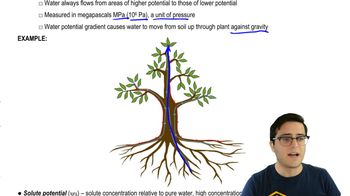
Water Potential

Water potential is a measure of the potential energy of water in a system, influenced by solute concentration and pressure. It determines the direction of water movement during osmosis. A cell with many aquaporins does not inherently change its water potential but allows water to move more freely, affecting the rate of osmosis rather than the water potential itself.
Video consigliato:
11:32
Water Potential