Ch. 37 - Soil and Plant Nutrition
Campbell - Campbell Biology 12th Edition
Urry12th EditionCampbell BiologyISBN: 9785794169850Non è quello che usi tu?Cambia libro di testo
Capitolo 37, Problema 7

The greatest difference in health between two groups of plants of the same species, one group with mycorrhizae and one group without mycorrhizae, would be in an environment
a. Where nitrogen-fixing bacteria are abundant
b. That has soil with poor drainage
c. That has hot summers and cold winters
d. In which the soil is relatively deficient in mineral nutrients

Guida verificata passo dopo passo
1
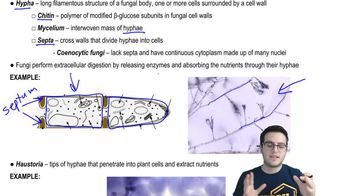
Understand the role of mycorrhizae: Mycorrhizae are symbiotic associations between fungi and plant roots. They enhance the plant's ability to absorb water and nutrients, particularly phosphorus, from the soil.
Consider the environmental conditions: Analyze each option to determine how the presence or absence of mycorrhizae would impact plant health in that specific environment.
Evaluate option a: In an environment with abundant nitrogen-fixing bacteria, plants may already have access to sufficient nitrogen, reducing the relative advantage provided by mycorrhizae.
Evaluate option b: Poor drainage can lead to waterlogged soil, which might not directly relate to the nutrient absorption benefits provided by mycorrhizae.
Evaluate option d: In nutrient-deficient soil, mycorrhizae can significantly enhance nutrient uptake, providing a substantial health advantage to plants with mycorrhizae over those without.

Risposta video verificata per un problema simile:

Questa soluzione video è stata consigliata dai nostri tutor come utile per risolvere questo problema.
Durata del video:
2m

Concetti chiave

Ecco i concetti essenziali che devi comprendere per rispondere correttamente alla domanda.

Mycorrhizae

Mycorrhizae are symbiotic associations between fungi and plant roots, enhancing nutrient and water absorption. The fungi extend the root system, increasing the plant's access to soil nutrients, particularly phosphorus, and improving drought resistance. This relationship is crucial in nutrient-poor soils, where plants without mycorrhizae may struggle to obtain essential minerals.
Video consigliato:
09:57
Fungi - 2

Nutrient Deficiency in Soil

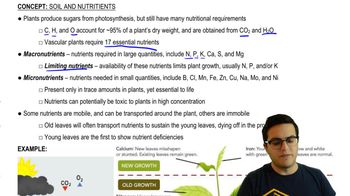
Soil nutrient deficiency refers to the lack of essential minerals and nutrients required for plant growth, such as nitrogen, phosphorus, and potassium. In such conditions, plants may exhibit stunted growth, chlorosis, and reduced yield. Mycorrhizal associations are particularly beneficial in these environments, as they enhance nutrient uptake, especially phosphorus, which is often limited in deficient soils.
Video consigliato:
03:25
Soil Nutrients

Symbiotic Relationships

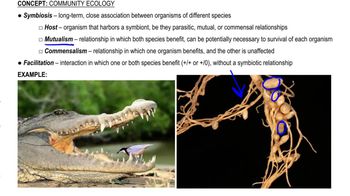
Symbiotic relationships involve close interactions between different species, often providing mutual benefits. In the context of mycorrhizae, the plant supplies carbohydrates to the fungi, while the fungi enhance the plant's nutrient and water absorption. This mutualistic relationship is vital for plant health, particularly in challenging environmental conditions, such as nutrient-poor soils.
Video consigliato:
02:34
Symbiosis
Pratica correlata
Domanda del libro di testo

A mineral deficiency is likely to affect older leaves more than younger leaves if

a. The mineral is a micronutrient

b. The mineral is very mobile within the plant

c. The mineral is required for chlorophyll synthesis

d. The mineral is a macronutrient

1361
views
Domanda del libro di testo

Two groups of tomatoes were grown under laboratory conditions, one with humus added to the soil and one as a control without humus. The leaves of the plants grown without humus were yellowish (less green) compared with those of the plants grown in humus-enriched soil. The best explanation is that

a. The healthy plants used the food in the decomposing leaves of the humus for energy to make chlorophyll.

b. The humus made the soil more loosely packed, so water penetrated more easily to the roots.

c. The humus contained minerals such as magnesium and iron needed for the synthesis of chlorophyll.

d. The heat released by the decomposing leaves of the humus caused more rapid growth and chlorophyll synthesis.
1189
views
Domanda del libro di testo

The specific relationship between a legume and its mutualistic Rhizobium strain probably depends on:

a. Each legume having a chemical dialogue with a fungus

b. Each Rhizobium strain having a form of nitrogenase that works only in the appropriate legume host

c. Each legume being found where the soil has only the Rhizobium specific to that legume

d. Specific recognition between chemical signals and signal receptors of the Rhizobium strain and legume species

1016
views
Domanda del libro di testo

Draw a simple sketch of cation exchange, showing a root hair, a soil particle with anions, and a hydrogen ion displacing a mineral cation.

1162
views
Domanda del libro di testo

Some of the problems associated with intensive irrigation include all of the following except:

a. Soil salinization

b. Overfertilization

c. Land subsidence

d. Aquifer depletion.

748
views
Domanda del libro di testo

A problem with intensive irrigation is

a. Overfertilization.

b. Aquifer depletion.

c. The long-term depletion of soil oxygen.

d. The clogging of waterways by vegetation debris.

1372
views
1
rank