Ch. 37 - Soil and Plant Nutrition
Campbell - Campbell Biology 12th Edition
Urry12th EditionCampbell BiologyISBN: 9785794169850Non è quello che usi tu?Cambia libro di testo
Capitolo 37, Problema 5

A problem with intensive irrigation is
a. Overfertilization.
b. Aquifer depletion.
c. The long-term depletion of soil oxygen.
d. The clogging of waterways by vegetation debris.

Guida verificata passo dopo passo
1
Step 1: Begin by understanding the concept of intensive irrigation. Intensive irrigation refers to the practice of applying large amounts of water to agricultural fields to support crop growth, often in areas with limited natural rainfall.
Step 2: Analyze each option provided in the problem to determine its relevance to intensive irrigation. For example, consider whether overfertilization (option a) is directly caused by irrigation or if it is more related to the excessive use of fertilizers.
Step 3: Evaluate aquifer depletion (option b). Aquifer depletion occurs when groundwater sources are overused, which can be a direct consequence of intensive irrigation practices that rely heavily on groundwater extraction.
Step 4: Examine the long-term depletion of soil oxygen (option c). Consider whether intensive irrigation could lead to waterlogging, which might reduce oxygen availability in the soil, but assess if this is a primary issue compared to aquifer depletion.
Step 5: Assess the clogging of waterways by vegetation debris (option d). Determine if this is a direct result of irrigation or if it is more related to other agricultural practices, such as runoff or improper waste management.

Risposta video verificata per un problema simile:

Questa soluzione video è stata consigliata dai nostri tutor come utile per risolvere questo problema.
Durata del video:
1m

Concetti chiave

Ecco i concetti essenziali che devi comprendere per rispondere correttamente alla domanda.

Intensive Irrigation

Intensive irrigation refers to the practice of applying large amounts of water to crops to maximize yield. While it can enhance agricultural productivity, it often leads to negative environmental impacts, such as soil degradation and water resource depletion. Understanding the balance between water use and crop needs is crucial for sustainable agriculture.
Video consigliato:
03:37
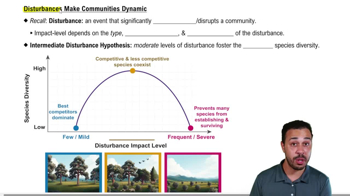
Disturbances Make Communities Dynamic

Aquifer Depletion

Aquifer depletion occurs when groundwater is extracted faster than it can be replenished, often due to excessive irrigation. This can lead to a significant drop in water tables, affecting not only agricultural practices but also drinking water supplies and local ecosystems. Awareness of aquifer health is essential for sustainable water management.

Overfertilization

Overfertilization happens when excessive fertilizers are applied to crops, leading to nutrient runoff into waterways. This can cause environmental issues such as algal blooms, which deplete oxygen in water bodies and harm aquatic life. Understanding the relationship between fertilizer use and environmental health is vital for sustainable farming practices.
Pratica correlata
Domanda del libro di testo

Mycorrhizae enhance plant nutrition mainly by:

a. Absorbing water and minerals through the fungal hyphae

b. Providing sugar to root cells, which have no chloroplasts

c. Converting atmospheric nitrogen to ammonia

d. Enabling the roots to parasitize neighboring plants

1483
views
Domanda del libro di testo

A mineral deficiency is likely to affect older leaves more than younger leaves if

a. The mineral is a micronutrient

b. The mineral is very mobile within the plant

c. The mineral is required for chlorophyll synthesis

d. The mineral is a macronutrient

1361
views
Domanda del libro di testo

Epiphytes are:

a. Fungi that attack plants

b. Fungi that form mutualistic associations with roots

c. Nonphotosynthetic parasitic plants.

d. Plants that grow on other plants.

981
views
Domanda del libro di testo

Two groups of tomatoes were grown under laboratory conditions, one with humus added to the soil and one as a control without humus. The leaves of the plants grown without humus were yellowish (less green) compared with those of the plants grown in humus-enriched soil. The best explanation is that

a. The healthy plants used the food in the decomposing leaves of the humus for energy to make chlorophyll.

b. The humus made the soil more loosely packed, so water penetrated more easily to the roots.

c. The humus contained minerals such as magnesium and iron needed for the synthesis of chlorophyll.

d. The heat released by the decomposing leaves of the humus caused more rapid growth and chlorophyll synthesis.
1189
views
Domanda del libro di testo

The greatest difference in health between two groups of plants of the same species, one group with mycorrhizae and one group without mycorrhizae, would be in an environment

a. Where nitrogen-fixing bacteria are abundant

b. That has soil with poor drainage

c. That has hot summers and cold winters

d. In which the soil is relatively deficient in mineral nutrients

974
views
Domanda del libro di testo

Some of the problems associated with intensive irrigation include all of the following except:

a. Soil salinization

b. Overfertilization

c. Land subsidence

d. Aquifer depletion.

748
views