
Ch. 40 - Basic Principles of Animal Form and Function
Campbell - Campbell Biology 12th Edition
Urry12th EditionCampbell BiologyISBN: 9785794169850Non è quello che usi tu?Cambia libro di testo
Capitolo 40, Problema 6

You are studying a large tropical reptile that has a high and relatively stable body temperature. How do you determine whether this animal is an endotherm or an ectotherm?
a. You know from its high and stable body temperature that it must be an endotherm.
b. You subject this reptile to various temperatures in the lab and find that its body temperature and metabolic rate change with the ambient temperature. You conclude that it is an ectotherm.
c. You note that its environment has a high and stable temperature. Because its body temperature matches the environmental temperature, you conclude that it is an ectotherm.
d. You measure the metabolic rate of the reptile, and because it is higher than that of a related species that lives in temperate forests, you conclude that this reptile is an endotherm and its relative is an ectotherm.

Guida verificata passo dopo passo
1
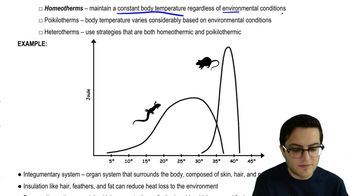
Understand the definitions: Endotherms are animals that regulate their body temperature through internal metabolic processes, while ectotherms rely on external environmental conditions to regulate their body temperature.
Consider option a: A high and stable body temperature alone does not confirm endothermy, as ectotherms can also maintain stable body temperatures in stable environments.
Evaluate option b: If the reptile's body temperature and metabolic rate change with ambient temperature, it suggests that the reptile is an ectotherm, as endotherms typically maintain a constant body temperature regardless of the environment.
Analyze option c: If the reptile's body temperature matches the stable environmental temperature, it indicates that the reptile is likely an ectotherm, as it is relying on the environment to regulate its temperature.
Review option d: A higher metabolic rate compared to a related species does not necessarily indicate endothermy, as metabolic rates can vary due to other factors. Endotherms typically have higher metabolic rates to maintain body temperature, but this alone is not conclusive without considering temperature regulation mechanisms.

Risposta video verificata per un problema simile:

Questa soluzione video è stata consigliata dai nostri tutor come utile per risolvere questo problema.
Durata del video:
4m

Concetti chiave

Ecco i concetti essenziali che devi comprendere per rispondere correttamente alla domanda.

Endothermy

Endothermy refers to the ability of an organism to maintain a stable internal body temperature through metabolic activity, regardless of external environmental conditions. Endotherms, such as mammals and birds, generate heat internally and often have higher metabolic rates to support this thermoregulation. This allows them to remain active in a wide range of temperatures.
Video consigliato:
09:51
Thermoregulation

Ectothermy

Ectothermy is a physiological trait where an organism relies on external environmental heat sources to regulate its body temperature. Ectotherms, like most reptiles and amphibians, have body temperatures that fluctuate with the ambient temperature. Their metabolic rates are generally lower and vary with environmental conditions, which can limit their activity in cooler climates.
Video consigliato:
09:51
Thermoregulation

Metabolic Rate

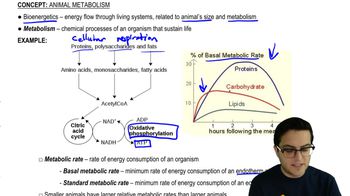
Metabolic rate is the rate at which an organism converts energy from food into energy for biological processes. It is a crucial factor in determining whether an organism is an endotherm or ectotherm. Endotherms typically have higher metabolic rates to sustain internal heat production, while ectotherms have lower rates that change with environmental temperatures, affecting their energy use and activity levels.
Video consigliato:
07:08
Metabolic Rate