Ch. 9 - Cellular Respiration and Fermentation
Campbell - Campbell Biology 12th Edition
Urry12th EditionCampbell BiologyISBN: 9785794169850Non è quello che usi tu?Cambia libro di testo
Capitolo 9, Problema 8

Step 3 in Figure 9.8 is a major point of regulation of glycolysis. The enzyme phosphofructokinase is allosterically regulated by ATP and related molecules (see Concept 8.5). Considering the overall result of glycolysis, would you expect ATP to inhibit or stimulate activity of this enzyme? Explain.
(Hint: Make sure you consider the role of ATP as an allosteric regulator, not as a substrate of the enzyme.)

Guida verificata passo dopo passo
1
Identify the role of phosphofructokinase in glycolysis: It catalyzes the conversion of fructose-6-phosphate to fructose-1,6-bisphosphate, a key regulatory step in glycolysis.
Understand the concept of allosteric regulation: Allosteric regulators bind to an enzyme at a site other than the active site, causing a change in its activity.
Consider the role of ATP as an allosteric regulator: ATP can bind to phosphofructokinase and affect its activity, not just serve as a substrate.
Analyze the effect of ATP levels on glycolysis: High levels of ATP indicate that the cell has sufficient energy, which may lead to the inhibition of phosphofructokinase to slow down glycolysis.
Conclude the expected effect of ATP on phosphofructokinase: Given that ATP is an allosteric inhibitor, it is likely to inhibit the enzyme's activity, reducing the rate of glycolysis when energy is abundant.

Risposta video verificata per un problema simile:

Questa soluzione video è stata consigliata dai nostri tutor come utile per risolvere questo problema.
Durata del video:
3m

Concetti chiave

Ecco i concetti essenziali che devi comprendere per rispondere correttamente alla domanda.

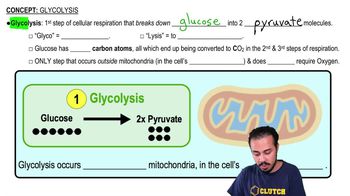
Glycolysis

Glycolysis is a metabolic pathway that converts glucose into pyruvate, generating ATP and NADH in the process. It consists of ten enzymatic steps, with phosphofructokinase playing a crucial role in the third step. This pathway is essential for cellular respiration, providing energy and metabolic intermediates for cells.
Video consigliato:
05:04
Glycolysis

Phosphofructokinase Regulation

Phosphofructokinase (PFK) is a key regulatory enzyme in glycolysis, controlling the conversion of fructose-6-phosphate to fructose-1,6-bisphosphate. It is allosterically regulated by ATP, which can inhibit its activity when ATP levels are high, thus slowing down glycolysis. This regulation ensures that energy production is balanced with the cell's energy needs.
Video consigliato:
03:31
Cell Cycle Regulation

Allosteric Regulation

Allosteric regulation involves the binding of molecules at a site other than the enzyme's active site, causing a conformational change that affects enzyme activity. In the case of phosphofructokinase, ATP acts as an allosteric inhibitor, reducing the enzyme's activity when energy levels are sufficient, thereby preventing unnecessary ATP production.
Video consigliato:
03:31
Cell Cycle Regulation