Ch. 9 - Cellular Respiration and Fermentation
Campbell - Campbell Biology 12th Edition
Urry12th EditionCampbell BiologyISBN: 9785794169850Non è quello che usi tu?Cambia libro di testo
Capitolo 9, Problema 5

What is the oxidizing agent in the following reaction?
Pyruvate + NADH + H+ → Lactate + NAD+
a. Oxygen
b. NADH
c. Lactate
d. Pyruvate

Guida verificata passo dopo passo
1
Understand the concept of an oxidizing agent: In a chemical reaction, the oxidizing agent is the substance that gains electrons and is reduced.
Identify the substances involved in the reaction: Pyruvate, NADH, H+, Lactate, and NAD+.
Analyze the changes in oxidation states: Determine which substance is gaining electrons. In this reaction, NADH is being converted to NAD+, indicating that NADH is losing electrons.
Determine which substance is reduced: Since NAD+ is formed from NADH, NAD+ is the reduced form, meaning NADH is the reducing agent.
Identify the oxidizing agent: The substance that causes NADH to lose electrons is pyruvate, as it is converted to lactate. Therefore, pyruvate is the oxidizing agent.

Risposta video verificata per un problema simile:

Questa soluzione video è stata consigliata dai nostri tutor come utile per risolvere questo problema.
Durata del video:
1m

Concetti chiave

Ecco i concetti essenziali che devi comprendere per rispondere correttamente alla domanda.

Oxidizing Agent

An oxidizing agent is a substance that gains electrons in a chemical reaction and, in the process, causes another substance to be oxidized. It is reduced itself. In the context of redox reactions, identifying the oxidizing agent involves determining which reactant is reduced by accepting electrons.
Video consigliato:
04:38
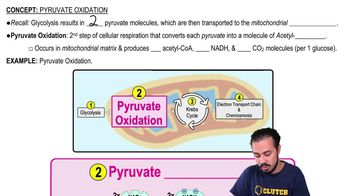
Pyruvate Oxidation

Redox Reactions

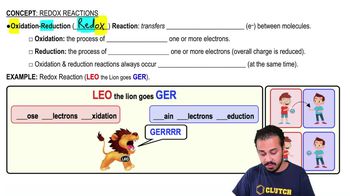
Redox reactions, or oxidation-reduction reactions, involve the transfer of electrons between two substances. One substance is oxidized (loses electrons), and the other is reduced (gains electrons). Understanding which components are oxidized and reduced is crucial for identifying the oxidizing and reducing agents in a reaction.
Video consigliato:
04:47
Redox Reactions

Role of NADH in Cellular Respiration

NADH is a coenzyme that plays a critical role in cellular respiration, acting as an electron carrier. It is involved in redox reactions, where it donates electrons and is oxidized to NAD+. In the given reaction, NADH donates electrons to pyruvate, reducing it to lactate, and is itself oxidized, indicating its role as a reducing agent.
Video consigliato:
03:39
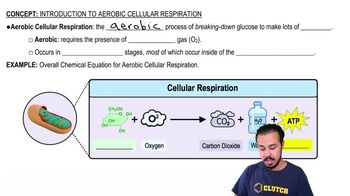
Introduction to Cellular Respiration
Pratica correlata
Domanda del libro di testo

In mitochondria, exergonic redox reactions

a. Are the source of energy driving prokaryotic ATP synthesis.

b. Provide the energy that establishes the proton gradient.

c. Reduce carbon atoms to carbon dioxide.

d. Are coupled via phosphorylated intermediates to endergonic processes.

3081
views
Domanda del libro di testo

The final electron acceptor of the electron transport chain that functions in aerobic oxidative phosphorylation is

a. Oxygen.

b. Water.

c. NAD+.

d. Pyruvate.

4045
views
Domanda del libro di testo

Which metabolic pathway is common to both fermentation and cellular respiration of a glucose molecule?

a. The citric acid cycle

b. The electron transport chain

c. Glycolysis

d. Reduction of pyruvate to lactate

3207
views
Domanda del libro di testo

Most CO2 from catabolism is released during

a. Glycolysis.

b. The citric acid cycle.

c. Lactate fermentation.

d. Electron transport.

5057
views
Domanda del libro di testo

Step 3 in Figure 9.8 is a major point of regulation of glycolysis. The enzyme phosphofructokinase is allosterically regulated by ATP and related molecules (see Concept 8.5). Considering the overall result of glycolysis, would you expect ATP to inhibit or stimulate activity of this enzyme? Explain.

(Hint: Make sure you consider the role of ATP as an allosteric regulator, not as a substrate of the enzyme.)

2340
views
Domanda del libro di testo

When electrons flow along the electron transport chains of mitochondria, which of the following changes occurs?

a. The pH of the matrix increases.

b. ATP synthase pumps protons by active transport.

c. The electrons gain free energy.

d. NAD+ is oxidized.

3826
views